
Kwong v. United States: The Practitioner’s Guide to the July 2026 IRS Protective Claim Deadline
If you paid federal tax penalties or underpayment interest during the COVID-19 pandemic, the U.S. Court of Federal Claims may have just handed you a mechanism to get that money back. In late 2025, the court issued a landmark ruling in Kwong v. United States (179 Fed. Cl. 382), declaring that the IRS improperly assessed failure-to-file and failure-to-pay penalties during the federally declared disaster period.
The government filed an appeal on May 15, 2026. Because the IRS will not voluntarily refund a dime while actively litigating the case, the burden falls entirely on taxpayers.
To preserve your legal right to a refund when the litigation concludes, you must file a formal Protective Refund Claim before the statute of limitations expires on July 10, 2026. Miss this deadline, and your money stays with the Treasury, regardless of what the appellate court decides.
Disclaimer: This article provides general tax and legal information, not personalized legal or financial advice. IRS controversy is highly fact-specific. Consult a licensed CPA, Enrolled Agent, or Tax Attorney before filing protective claims or interacting with the IRS regarding past-due balances.
The Legal Foundation: IRC § 7508A(d) and the “Disregarded Period”
The Kwong decision hinges on a strict textual interpretation of Internal Revenue Code § 7508A(d). The statute governs how the IRS must handle tax deadlines during a federally declared disaster.
The IRS originally argued that its administrative relief measures—such as shifting individual deadlines to July 15 in 2020—represented the maximum allowable pandemic extensions. Judge Molly Silfen disagreed. The court ruled that a federal disaster triggers a mandatory, self-executing suspension of deadlines for the entire duration of the disaster, plus an additional 60 days.
Because the COVID-19 disaster period ran from January 20, 2020, through May 11, 2023, the court determined that tax obligations falling in that window were not legally late until after July 10, 2023.
This 3.5-year block is a “disregarded period.” If the IRS assessed late penalties or underpayment interest against you based on original deadlines during this window, those assessments were legally invalid under the Kwong precedent.
The IRC § 6511 Statute of Limitations Trap
Why July 10, 2026? Tax law (IRC § 6511) strictly limits refund claims to three years from the date the return was filed or two years from the date the tax was paid. Three years from the court’s established July 10, 2023 deadline lands squarely on July 10, 2026. A Protective Refund Claim acts as a legal placeholder. It freezes your statute of limitations, forcing the IRS to honor your refund request if the government ultimately loses its appeal at the U.S. Court of Appeals for the Federal Circuit.
Who Qualifies for the COVID Penalty Refund?
The ruling is not restricted to a niche demographic. Eligible taxpayers include individuals, corporations, partnerships, LLCs, estates, trusts, and nonprofits.
You should request a transcript audit from your tax professional if you meet the following criteria:
- You had a federal tax obligation originally due between January 20, 2020, and July 10, 2023.
- The IRS assessed a Failure-to-File penalty, a Failure-to-Pay penalty, an estimated tax penalty, or related underpayment interest on that obligation.
- You actually paid those penalties to the IRS (if the penalties are unpaid, you need an abatement request, not a refund claim).
This primarily impacts tax years 2019, 2020, 2021, and 2022. Note that accuracy-related penalties and fraud penalties are excluded from this relief.
Critical Update: How to File Your Claim (Form 843)
Filing procedures shifted rapidly in the weeks leading up to the deadline. While all claims require IRS Form 843 (Claim for Refund and Request for Abatement), how you submit that form depends entirely on your entity type.
Track 1: The New Online Portal for Individual Taxpayers
To alleviate the paper backlog, the IRS recently opened an electronic portal specifically for Kwong-related claims.
- Who is eligible: Individual taxpayers seeking refunds for fully paid penalties and interest.
- The Process: Log into your IRS Online Account. Navigate to “Records and Status” -> “Forms” -> “Other Forms” and select Form 843.
- The Requirement: You must explicitly designate the claim by writing or typing “Kwong vs. United States” on the submission. If filing a joint return, both spouses must possess active IRS online accounts.
Track 2: Mandatory Paper Filing for Businesses and Trusts
Corporations, small businesses, and trusts cannot use the online portal. If you are filing on behalf of an entity, or if you are an individual with unpaid penalties seeking abatement, you must execute a flawless paper trail.
- Isolate the Tax Years: You cannot bundle multiple years or entity types onto a single document. Prepare a distinct Form 843 for every individual tax period.
- Mark the Contingency: Write “Protective Refund Claim Pursuant to Kwong v. United States” in red or black ink across the top margin of the form.
- Specify the Ground for Relief: On line 7, state that you are preserving your right to a refund of penalties/interest improperly assessed during the disregarded period established by Kwong v. United States (179 Fed. Cl. 382).
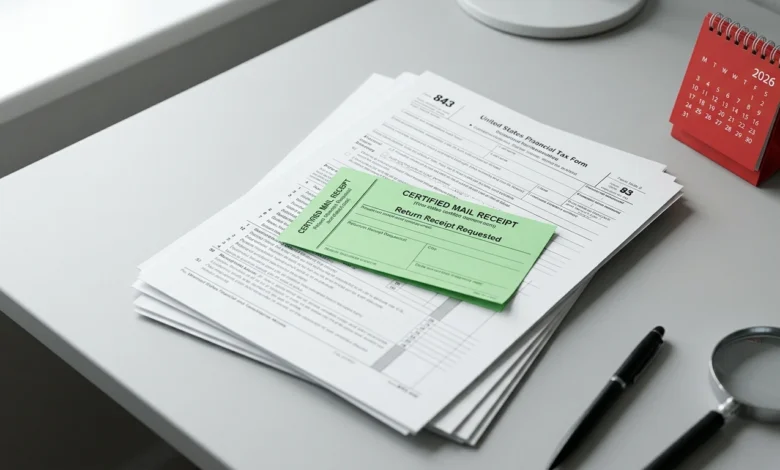
- Mail via Certified USPS: Send the packet to the designated IRS service center (recent notices route paper Kwong claims to the Ogden, UT processing center, but verify with your CPA based on your state). You must use USPS Certified Mail with a Return Receipt. The stamped green card is your definitive proof of meeting the July 10, 2026 deadline.
Next Steps for Taxpayers
Do not assume your CPA filed this automatically. A protective claim requires specialized preparation and your physical or digital signature.
Pull your IRS Account Transcripts for 2019 through 2022 immediately. Look for Transaction Codes (TCs) related to penalty and interest assessments. If you see thousands of dollars in capitalized late fees, engage a tax professional to calculate your potential refund and execute your Form 843 before July 10. As National Taxpayer Advocate Erin Collins noted, a timely but imperfect claim is far superior to a perfect claim filed a day late.
Frequently Asked Questions
Is this refund guaranteed if I file the form?
No. The Department of Justice is actively appealing the ruling. Filing Form 843 simply buys you a ticket to collect the refund if the appellate courts uphold the original decision. If the government wins the appeal, your claim will be closed with no payout.
I haven’t paid the penalty yet; I’m currently on an installment agreement. Do I still file this?
Yes, but the mechanism is slightly different. You will file Form 843 as a request for “abatement” rather than a refund. This asks the IRS to wipe out the remaining balance rather than cutting you a check for what you already paid.
Can my business use the new IRS online portal?
No. The electronic filing option introduced in 2026 is strictly limited to individual taxpayers with an IRS Online Account who have fully paid their penalties. Businesses, nonprofits, and trusts must continue to file paper claims via certified mail.
How long will it take the IRS to process my claim?
Expect a delay of several years. The IRS will likely place all Kwong-related protective claims in a suspense file until the appellate litigation is entirely resolved. The current objective is solely to beat the statute of limitations deadline, not to secure an immediate check.
Sources
- Calibre CPA Group: Kwong v. United States: Recovering Invalidated COVID-Era Penalties and Interest [https://calibrecpa.com/tax-regulation-reporting/kwong-v-united-states/]
- UHY Advisors: Kwong Decision and COVID-Era IRS Penalties: IRS Adds Online Filing Option for Certain Protective Claims [https://uhy-us.com/insights/news/2026/july/kwong-decision-and-covid-era-irs-penalties-irs-adds-online-filing-option-for-certain-protective-claims]
- Gammon & Grange, P.C.: Protective Claim for Refund After Kwong: File Now [https://www.gg-law.com/tax-law/protective-claim-for-refund/]
- Kugelman Law: Kwong v. United States: A Complete Guide to IRS COVID-Era Penalty Refunds [https://www.kugelmanlaw.com/blog/kwong-irs-covid-penalty-refund/]
- BDO USA: Kwong v. United States: A Development Worth Watching — and Possibly Acting On [https://www.bdo.com/insights/tax/kwong-v-united-states-a-development-worth-watching-and-possibly-acting-on]
- The Washington Post: Missing this July 10 deadline could cost you an IRS tax refund [https://www.washingtonpost.com/business/2026/07/08/how-get-pandemic-era-irs-tax-refund/]
- Dean Dorton: The IRS May Owe You Money – But You Must Act Soon to Protect Your Rights [https://deandorton.com/the-irs-may-owe-you-money-but-you-must-act-soon-to-protect-your-rights/]
- Sensiba: Kwong v. United States: COVID IRS Penalty Refunds Explained [https://sensiba.com/resources/alerts/kwong-v-us-covid-irs-penalty-refunds-explained/]
- Boyer & Ritter LLC: Important Client Alert: Recent Court Decision May Unlock COVID-Era Refunds—Action Required Before July 10, 2026 [https://www.cpabr.com/article-important-client-alert-kwong-decision]