

Google Ads for Doctors SEO Outline & 2026 ROI Blueprint
Medical marketing in 2026 is expensive and heavily regulated. Cost-per-click rates are climbing. Standard tracking pixels are triggering strict HIPAA violations. A disjointed strategy bleeds money fast.
To succeed, you need a sequential plan. You must secure your data pipeline, use Google Ads for immediate patient bookings, and build compounding SEO to lower your acquisition costs over time.
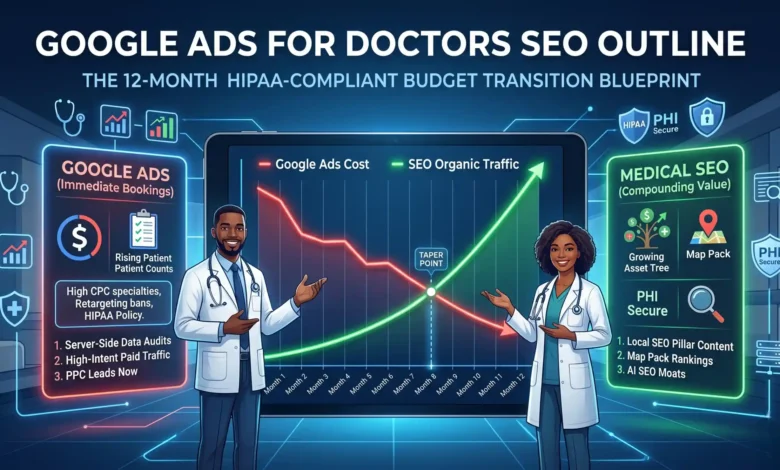
A successful Google Ads for doctors SEO outline sequences paid and organic channels over 12 months. It begins with a strict audit to implement server-side tracking, preventing PHI leaks. Next, Google Ads captures high-intent searches for immediate patient acquisition, while SEO compounding traffic eventually reduces paid reliance by month eight.
Key Takeaways
- Google does not offer a Business Associate Agreement (BAA) for its Ads platform.
- Standard client-side tracking pixels now create severe liability by inadvertently leaking Protected Health Information (PHI).
- Medical marketers must use server-side tracking pipelines to strip PHI before sending conversion data to ad platforms.
- Google’s personalized advertising policies strictly ban retargeting users based on past healthcare website visits.
- Competitive US medical practices need a minimum Google Ads budget of $1,500 to $5,000 per location.
- SEO is the required exit strategy to replace expensive paid clicks with compounding organic traffic.
Quick Start / Quick Answer
Are you ready to launch a dual-channel campaign? Run through this 3-step checklist before spending ad budget:
- Run a Pixel Audit: Confirm no Meta or Google Analytics tags are firing on your appointment booking pages.
- Verify Your Ad Budget: Ensure you have at least $1,500 a month allocated strictly for Google Ads spend.
- Check Your Ad Copy: Verify you are not attempting to retarget past visitors or directly naming specific medical conditions in a personalized way.
Phase 1: Audit & Initialization
Medical clinics often skip straight to keyword research. That is an expensive mistake. Before spending a single dollar on Google Ads, you must secure your data pipeline.
Recent guidance from the Department of Health and Human Services (HHS) changed the rules for healthcare tracking. You cannot run typical digital marketing campaigns without adjusting your tech stack.
Auditing Existing Pixels for PHI Leakage
Standard ad-tracking pixels can inadvertently collect and transmit PHI. This includes common tags from Meta and Google Analytics. If your website booking page uses these client-side tags, you are creating immediate legal liability.
Pro Tip: Audit your website analytics pixels immediately. Do not wait for a compliance notice to find out your scheduling page is leaking patient data.
HIPAA & Ads Pixel Compliance Checklist:
- Identify and remove all client-side Meta and Google tags on scheduling pages.
- Check for data leakage in your URL parameters after a patient books an appointment.
- Ensure no tracking scripts fire inside secured patient portals.
Initializing Server-Side Tracking Infrastructure
To maintain HIPAA compliance in 2026, medical marketers must transition to server-side tracking pipelines. This infrastructure legally anonymizes data. It strips out all PHI before sending conversion signals to advertising platforms.
Common Mistake: Do not sign a BAA for your Google Workspace and assume it covers your paid campaigns. Google does not offer a BAA for its Ads platform.
Mini Case Study: A regional medspa received an HHS compliance warning for using standard Meta and Google tracking pixels on their appointment booking page, which leaked PHI. To salvage their ad campaigns, they immediately halted client tags and migrated to a server-side tracking pipeline to anonymize conversion signals.
[Improvado Server-Side Healthcare Guide]
Phase 2: Google Ads Strategy (The Short-Term Engine)
SEO takes time to build. Google Ads provides immediate visibility, but the lead flow stops the second your budget runs out. You should use paid search as your short-term engine while organic traffic scales in the background.
Navigating Google’s Healthcare & Retargeting Policies
Google enforces strict rules on healthcare advertising. Their personalized advertising policies automatically disapprove ads that target users based on specific medical conditions.
Pro Tip: Do not attempt to build retargeting audiences based on past website visitors for healthcare services. The algorithms will suspend the ads.
There are narrow exceptions for specific services. As of March 2026, Google updated its recurring billing policy. This change permits certified U.S. online pharmacies to promote prescription drug subscriptions, bundles, and consultation services.
CPC Benchmarks & Budget Allocation for 2026
The financial realities of medical PPC require precise planning. The average cost per click (CPC) for healthcare advertising benchmarks is approximately $5.64 in US markets.
However, competitive specialties face much higher costs. Plastic surgery and orthopedic search terms frequently exceed $50 per click.
Pro Tip: Medical practices typically require a minimum monthly Google Ads budget of $1,500 to $5,000 per location to compete effectively.
Filtering Low-Intent Traffic
You cannot afford to pay $20 per click for users looking for free advice. You must actively filter out informational searches to protect your budget.
5 Steps to Building a Negative Keyword Seed List for Medical Practices:
- Filter out price shoppers by excluding terms like “free,” “cheap,” and “discount.”
- Exclude job seekers by blocking “hiring,” “salary,” “jobs,” and “resume.”
- Block educational intent by removing “what is,” “definition,” and “symptoms.”
- Exclude DIY queries like “at home,” “how to fix,” and “remedies.”
- Review search term reports weekly to add new irrelevant queries to your negative list.
[Google Ads Official Policy on Healthcare Advertising]
Mid-Campaign Checkpoint
- Phase 1 guarantees your tracking setup will not trigger an HHS violation or a lawsuit.
- Phase 2 ensures your daily budget captures immediate, high-intent patients without wasting money on informational clicks.
- Phase 3 (below) builds the organic infrastructure required to eventually turn off the expensive paid tap.
Phase 3: SEO Strategy (The Long-Term Asset)
Google Ads works fast, but it is fundamentally a rental strategy. While paid campaigns generate immediate visibility and leads, that visibility ceases immediately when the advertising budget runs out.
SEO provides long-term, compounding patient acquisition. It establishes a trustworthy organic presence that does not disappear when marketing spend is paused.
Transitioning Budget: The 12-Month Sequence
The recommended 2026 acquisition strategy sequences both channels. You utilize Google Ads initially for immediate patient booking, while simultaneously building SEO to lower long-term acquisition costs.
Mini Case Study: A new orthopedic clinic spends $4,000 a month on Google Ads for immediate “knee specialist near me” visibility. At the same time, they publish robust, localized SEO pillar pages. By month eight, their organic presence ranks #1 in the Map Pack. This allows them to reduce their Google Ads budget by 40% while maintaining the identical patient lead volume.
You can visualize this shift using a phased budget matrix:
| Campaign Phase | Months | Google Ads Allocation | SEO Content Allocation | Primary Goal |
| Launch | 1–3 | 80% (High Spend) | 20% (Pillar Setup) | Immediate patient acquisition; test high-intent keywords. |
| Build | 4–6 | 60% (Optimization) | 40% (Local/Map SEO) | Maintain lead flow; begin ranking for secondary terms. |
| Shift | 7–9 | 40% (Targeted Spend) | 60% (Scaling Content) | Organic leads begin replacing expensive paid clicks. |
| Scale | 10–12 | 20% (Retargeting/Brand) | 80% (Authority Assets) | Maximum ROI; paid ads used only for competitive gaps. |
Winning with AI SEO in Healthcare
Search behavior is shifting rapidly. Patients increasingly rely on AI-generated answers for their medical queries.
“AI SEO”—optimizing authoritative medical content to appear in AI-generated answers like ChatGPT or Google’s AI Overviews—is a major 2026 trend. This provides an exclusive competitive advantage that paid Google Ads cannot access. You cannot simply buy your way into an AI-generated medical summary; you must earn it through high-quality, highly structured data.
Pro Tip: Optimize your authoritative medical content specifically for AI Overviews. Focus on clear definitions, comparison tables, and direct answers to secure an organic advantage your competitors cannot buy through PPC.
Conclusion & Next Steps
Scaling a medical practice online requires more than just picking a keyword and setting a daily budget. You have to balance strict data privacy regulations with aggressive patient acquisition. By securing your server-side tracking, capturing high-intent clicks via Google Ads, and shifting your focus to compounding organic assets, you build a highly profitable, legally secure pipeline.
Next Steps:
- Run the Pixel Audit: Manually check your appointment pages for client-side Meta and Google tags.
- Secure Your Ad Budget: Allocate a minimum of $1,500 per location for your initial short-term campaigns.
- Map Out Your First SEO Pillars: Plan three highly detailed, location-specific service pages to begin building your long-term organic presence.
FAQs
Is Google Ads HIPAA compliant?
Google Ads is not inherently HIPAA compliant. Google does not offer a Business Associate Agreement (BAA) for its Ads platform, which restricts how you can track conversions and target patients.
What is the minimum budget for medical Google Ads?
Medical practices typically require a minimum monthly Google Ads budget of $1,500 to $5,000 per location to compete effectively, depending on the specialty and local market density.
Can doctors retarget past website visitors on Google?
No. Google’s personalized advertising policies automatically disapprove ads that attempt to retarget users based on specific medical conditions or past website visits for healthcare services.
How do tracking pixels leak PHI?
Standard client-side tags, like Meta or Google Analytics pixels, collect data directly from the user’s browser. If placed on a booking page, they can inadvertently capture and transmit Protected Health Information (PHI) back to the advertising platforms.
What is server-side tracking in healthcare marketing?
Server-side tracking acts as a middleman. Instead of sending data directly from the patient’s browser to Google, the data goes to a secure server you control. There, any PHI is legally anonymized and stripped before the conversion signal is sent to the ad platform.
How long does it take for medical SEO to replace Google Ads traffic?
It typically takes eight to twelve months of consistent, high-quality SEO effort before organic traffic scales enough to allow a significant reduction in paid advertising budgets without losing lead volume.
Can online pharmacies advertise recurring prescriptions on Google?
Yes. As of March 2026, Google updated its recurring billing policy to permit certified U.S. online pharmacies to promote prescription drug subscriptions, bundles, and consultation services.
References
- Paubox — 2026
- Gatorworks — 2026
- Improvado — 2026
- Estipona Group — 2026
- ALM Corp — 2026
- StubGroup — 2026
- Design Co Studio — 2026
- Elysian Digital Services — 2026