
Why Southwest Planes Clipped Wings at BWI: The “Uncontrolled Ramp” Explained
Most travelers don’t expect a fender bender at 30,000 feet, but the real risks often happen before the wheels leave the pavement. On the night of May 4, 2026, passengers on two Southwest Airlines flights at Baltimore/Washington International (BWI) felt a sudden, sharp jolt that grounded their travel plans. This wasn’t a mechanical failure or turbulence, but a low-speed wingtip collision that highlights the tight operational space at one of the region’s busiest hubs.
Featured Snippet On May 4, 2026, two Southwest Airlines Boeing 737 MAX 8 aircraft clipped wingtips at Baltimore/Washington International (BWI) during pushback maneuvers. The incident occurred at approximately 10:30 p.m. between Gates A7 and A9. While no injuries were reported, both aircraft sustained minor damage and were removed from service for safety inspections.
Key Takeaways
- Two Boeing 737 MAX 8 jets (Flights 1048 and 562) made contact at BWI.
- The incident happened at 10:30 p.m. on Monday, May 4, 2026.
- No passengers or crew members were injured in the ground collision.
- The FAA is investigating the event as an “uncontrolled ramp” incident.
- Both planes were pulled from service for structural safety checks.
Quick Answer
If you were on Flight 1048 to Hartford or Flight 562 to Houston, your aircraft was grounded for safety inspections. Southwest Airlines has since reaccommodated passengers on alternative flights. The FAA investigation is ongoing, but initial reports confirm the collision happened in a zone where pilots and ground crews, not the control tower, manage movement.
The May 4 Incident: Flights 1048 and 562
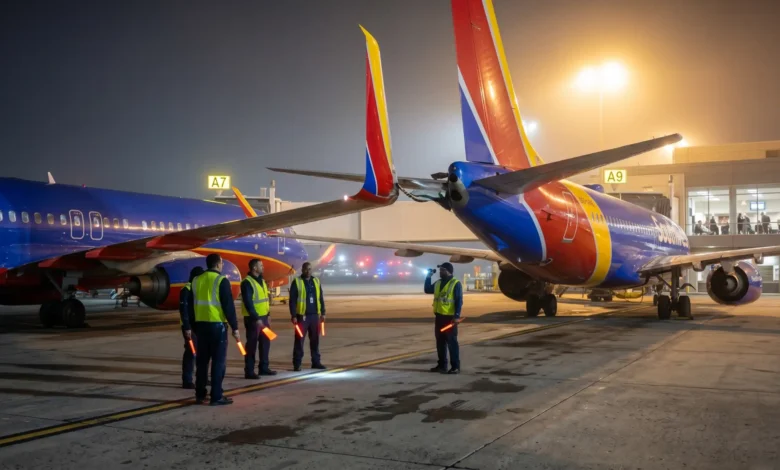
Ground collisions at major airports are rare, but the geometry at BWI Concourse A creates a challenging environment for pilots. At 10:30 p.m., Southwest Flight 1048 was preparing for its trip to Hartford while Flight 562 was bound for Houston. As the planes pushed back from adjacent gates A7 and A9, their wingtips, specifically the “winglets” designed for fuel efficiency, clipped each other.
“Hey, ground, Southwest 1048, we had contact between the 2 aircraft back here,” the pilot of Flight 1048 reported via LiveATC radio. He immediately requested to taxi back to Gate A7 to assess the damage.
Immediate Response and Passenger Safety
Passengers described the sensation as a “good jolt,” similar to being rear-ended in a car at low speed. Following standard protocol, both aircraft were immediately stopped. Ground crews inspected the wings under floodlights before the airline made the call to deplane all passengers.
The “Minor” Wing Clip Protocol Even a small scrape on a wingtip can ground a multi-million dollar jet. In US aviation, any structural contact requires a certified mechanic to perform a non-destructive test (NDT). This check looks for hairline fractures or internal stress that the naked eye might miss. This is why a “fender bender” that looks like a scratch can lead to hours of delays and aircraft swaps.
The “Uncontrolled Ramp” Factor: Why the Tower Didn’t Stop It
Many travelers assume air traffic controllers in the high tower watch every move a plane makes. However, the FAA confirmed this incident happened on an uncontrolled ramp. This is an area of the airport where the airline, not the government, is responsible for directing traffic.
Jurisdiction on the Tarmac
In these zones, ground crews (ramp agents) guide the pushback tug using hand signals or lighted “wands.” The pilots rely on these crews to be their “eyes” because wingtips are often not visible from the cockpit windows.
Common Mistake: A frequent misconception is that the FAA tower can see and stop these collisions. In reality, the tower’s radar and visual focus are on active taxiways and runways, leaving the congested gate areas to airline operational staff.
The transition of responsibility usually follows these three steps:
- Non-Movement Area (Ramp): Controlled by the airline; ground crews manage the pushback.
- The Hand-off: Responsibility shifts to the FAA tower only once the plane reaches a designated “spot” on the taxiway.
- Movement Area: Controlled by the FAA; requires specific clearance to taxi or take off.
BWI Concourse A: A Case Study in Tight Gate Geometry
Every airport has its “tight spots,” and at BWI, Concourse A is a known challenge for ground operations. This concourse serves as a major base for Southwest Airlines, meaning high-frequency departures and arrivals often happen simultaneously. When two Boeing 737 MAX 8 aircraft, each with a wingspan of roughly 117 feet, are parked or moving in adjacent spots like Gates A7 and A9, the margin for error is razor-thin.
The geometry of these older gate layouts was originally designed for smaller aircraft. While modern winglets (the upward-curving tips on the wings) help save fuel in the air, they add vertical and horizontal complexity during ground maneuvers.
Real Example: The Nashville Near-Miss
This isn’t an isolated concern for the airline. In April 2026, a similar “tight squeeze” led to a federal probe in Nashville. These incidents usually point to a breakdown in communication between the “wing walkers”, the ground crew members assigned to monitor the wingtips, and the tug driver pushing the plane backward.
Your Rights: What to Do After a Ground Incident
If you are sitting on a plane that has just clipped another aircraft, your travel day has changed instantly. Safety protocols dictate that the flight cannot proceed until a structural inspection is completed. However, you still have specific rights under US Department of Transportation (DOT) rules regarding how long you can be held on the tarmac.
Passenger Entitlements During Ground Delays
The following rules apply to all US domestic flights when a plane is delayed on the tarmac after leaving the gate or, as in the BWI case, after an incident occurs during pushback.
| Wait Time | Airline Requirement | Legal Source |
| 30 Minutes | Must provide an update on the delay status and reason. | US DOT (2026) |
| 2 Hours | Must provide food (snack) and drinking water. | US DOT (2026) |
| 3 Hours | Must allow passengers to deplane (Domestic flights). | US DOT (2026) |
| Continuous | Must provide working toilets and medical care if needed. | US DOT (2026) |
Pro Tip: Skip the Gate Line
When an incident like the BWI wing clip grounds a flight, the line at the customer service desk will grow long within minutes. Instead of waiting, use the airline’s mobile app to rebook yourself. Airlines often “auto-rebook” passengers on the next available flight, and you can confirm or change this choice much faster on your phone than in person.
Summary: Incident Quick Facts
- The Event: Wingtip contact between Flights 1048 and 562.
- The Location: BWI Airport, “Uncontrolled Ramp” near Gates A7 and A9.
- The Result: No injuries; minor aircraft damage; FAA investigation launched.
- Passenger Impact: Both flights canceled/delayed; passengers moved to new aircraft.
The FAA Investigation: What Happens Next?
The Federal Aviation Administration (FAA) does not take ground collisions lightly, even at low speeds. The investigation will focus on the “pushback sequence.” Investigators will review cockpit voice recorders (CVR) and interview the ground crew to determine if the wing walkers were in the correct positions.
Southwest Airlines is also conducting an internal review. Since the incident happened in an “uncontrolled” area, the airline’s own safety procedures for ground handling will be under the microscope.
Timeline for Updates:
Typically, the FAA releases a preliminary report within 30 days of a ground mishap. While these reports rarely assign final blame, they provide the technical data needed to understand if mechanical failure or human error was the primary cause.
End Summary
The May 4 wing clip at BWI serves as a reminder that aviation safety starts on the ground. While no one was hurt, the collision caused significant disruption for hundreds of travelers and grounded two advanced aircraft for safety checks. The incident highlights the ongoing challenges of managing large aircraft in tight, older gate environments.
3 Next Steps:
- Monitor the FAA Newsroom: Look for the preliminary report on the BWI incident in June 2026.
- Check Your Flight’s Gate: If flying through BWI Concourse A, be aware that gate changes are common due to the tight spacing.
- Know Your Rights: Bookmark the US DOT Tarmac Delay page to stay informed about food, water, and deplaning rules.
FAQs
Were there any injuries in the BWI wing clip?
No. Both Southwest Airlines and the FAA confirmed that no passengers or crew members were injured during the ground collision on May 4, 2026.
Which flight numbers were involved in the Southwest collision?
The incident involved Southwest Flight 1048, which was scheduled to fly to Hartford, and Flight 562, which was bound for Houston.
What is an “uncontrolled ramp” in aviation?
An uncontrolled ramp is an area of the airport tarmac where the airline is responsible for aircraft movement. Air traffic controllers in the tower do not direct planes in these zones; instead, pilots and ground crews coordinate pushbacks.
Will Southwest compensate me for a ground collision delay?
Under US law, airlines are not required to provide cash compensation for delays. However, they must provide food and water for tarmac delays over two hours and usually provide rebooking or refunds if the flight is canceled.
How does a wing clip affect a plane’s airworthiness?
Even minor scrapes can hide internal structural damage. FAA rules require a full inspection by certified mechanics to ensure the “winglet” or wing structure hasn’t suffered stress fractures before the plane can fly again.
Is BWI Concourse A particularly narrow?
Concourse A is known for its high-traffic volume and tight gate spacing. The architectural layout makes maneuvering large jets like the Boeing 737 MAX 8 more difficult than in newer, more spacious terminals.
What did the pilot say to ground control after the clip?
The pilot of Flight 1048 reported the incident to ground control via radio, stating, “we had contact between the 2 aircraft back here,” and requested to return to the gate.
References
- CBS News Baltimore — 2026
- Simple Flying — 2026
- US Department of Transportation — 2026
- Federal Aviation Administration — 2026
- Asatu News — 2026