
Blockchain Technology: New 2026 US Rules & Frameworks
Blockchain technology is no longer just the underlying system for speculative digital assets. It has become a foundational infrastructure layer used to secure federal software systems and clear institutional financial trades.
Building or deploying tools on this architecture requires a firm grasp of both its mathematical foundations and the rapid policy shifts reshaping US compliance. A wave of new federal directives and agency rules has altered how businesses store data and issue assets on distributed networks.
This guide explains how the system works beneath the surface and maps out the exact rules required for compliant US corporate operations.
Blockchain technology is a decentralized, peer-to-peer distributed ledger architecture that chronologically records data across a network of independent computers called nodes. By securing data entries with cryptographic hashes and validating records through automated consensus algorithms, the technology creates a shared, tamper-evident, and immutable record of transactions without relying on a centralized intermediary.
Key Takeaways
- Cryptographic Links: The system connects data blocks chronologically using SHA-256 and ECDSA encryption algorithms.
- Federal Blueprints: The National Institute of Standards and Technology now drafts rules utilizing private nodes to safeguard government software distribution.
- SEC Classifications: Clear agency criteria differentiate automated digital commodities from tightly restricted security tokens.
- Statutory Laws: Enacted statutes govern payment stablecoins, while pending bills aim to hand regulatory power over spot trades to the CFTC.
- Banking Safety: Rescinded administrative restrictions enable US commercial banks to hold digital assets without balance sheet penalties.
Quick-Start Technical Guide: How Blockchain Works
The Step-by-Step Data Processing Lifecycle
- Transaction Initiation: A user creates a digital record and signs it with a private cryptographic key to prove ownership.
- Network Broadcast: The raw data payload is sent directly across a peer-to-peer topology, which is a network layout connecting computers without a central server.
- Mempool Staging: Independent computers, known as nodes, check the digital signature and store the unverified transaction in a temporary memory pool.
- Block Aggregation: A designated validating node pulls transactions from the pool and bundles them chronologically into a raw block.
- Cryptographic Hashing: The validator runs a cryptographic math function to create a fixed-length string of characters representing that block’s unique identity.
- Consensus Verification: The computer network uses automated rules to confirm the block is valid, permanently appending it to the ledger.
Core Architectural Components
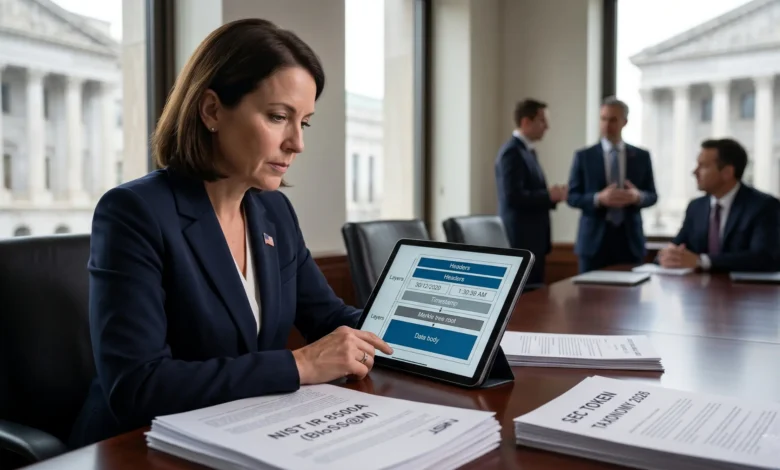
Every individual block contains a block header and a block body. The header holds vital tracking information, including a precise timestamp, a Merkle tree root (a single hash value summarizing all transactions within that block), and the unique hash of the block directly preceding it.
This cryptographic linking creates a continuous chain. If an unauthorized entity tries to alter data in an old block, the hash of that block changes instantly. Because every block points to the previous one, changing a single legacy entry breaks the entire sequence, forcing the network to reject the modification.
Common Mistake: Treating blockchain and cryptocurrencies as identical concepts. A cryptocurrency is simply a digital token built on top of a blockchain to incentivize network participation. Blockchain itself is the structural ledger architecture that can track non-financial data like software keys, legal contracts, or supply chain shipments without using tokens at all.
Understanding Consensus Mechanisms
Distributed networks solve the problem of coordination among untrusted participants by using automated consensus algorithms. These systems act as governance engines that decide which node has the right to write the next block.
Public networks often rely on Proof of Stake, where validators lock up financial collateral to earn processing rights, or Proof of Work, which requires intensive computational puzzle-solving. Enterprise systems usually deploy faster, private options like permissioned Byzantine Fault Tolerant protocols where only pre-vetted corporate nodes can cast votes to finalize entries.
The 2026 US Regulatory Architecture: Compliance for Enterprise Deployment
The SEC’s Token Taxonomy Clarification
Navigating corporate development means aligning digital assets with the explicit classifications issued by the U.S. Securities and Exchange Commission. A landmark administrative interpretation has clarified how federal agencies treat blockchain-based assets.
The SEC’s framework hinges on operational decentralization. If an asset’s market value stems strictly from organic supply-and-demand forces and the automated mechanics of a functional network, it avoids security status. Instead, it is classified as a non-security digital commodity. However, if buyers rely on the ongoing managerial efforts of a centralized team or promoter to generate profits, the asset remains a security subject to strict disclosure rules.
SEC Token Taxonomy Compliance Matrix (March 2026 Framework)
| Core Attribute | Security Token Classification | Digital Commodity Classification |
| Primary Value Driver | Managerial efforts of a centralized promoter/issuer | Organic supply/demand forces & automated blockchain mechanics |
| Howey Test Status | Meets all prongs (Investment of money, common enterprise, expectation of profit) | Fails managerial reliance prong via functional decentralization |
| Regulatory Lead Agency | U.S. Securities and Exchange Commission (SEC) | Commodity Futures Trading Commission (CFTC) |
| Enterprise Use Suitability | Capital fundraising, equity distribution, revenue-share models | Network utility keys, raw computational gas, protocol access |
Legislative Realities: The GENIUS Act and the CLARITY Act
Federal statutory law has adapted alongside these agency shifts. The Guiding and Establishing National Innovation for US Stablecoins Act, known as the GENIUS Act, created a federal blueprint for fiat-backed digital tokens. Issuers must maintain liquid, audited asset reserves and secure explicit regulatory licenses to operate legally within the US banking system.
Simultaneously, lawmakers are advancing the CLARITY Act through congressional committees. Text of House-Passed CLARITY Act Bill Record. This bill aims to strip overlapping jurisdiction by granting the Commodity Futures Trading Commission exclusive authority over spot digital commodity transactions.
However, enterprise developers must note a practical operational bottleneck: the CFTC has faced structural strains, including a drop to 556 active staff members. This resource gap means processing timelines and regulatory clarifications may face administrative delays even if the legislation secures final approval.
Institutional Banking Integration and Custody Evolution
The Rescission of SAB 121 and Balance Sheet Relief
Traditional financial institutions in the United States faced a turning point when the SEC rescinded Staff Accounting Bulletin 121, known as SAB 121. Previously, this administrative rule forced depository banks to record client-custodied digital assets as liabilities on their own balance sheets.
This accounting treatment forced banks to hold equal amounts of cash to meet capital requirements, making digital asset custody too expensive. The formal removal of these restrictions allows banks to keep these client assets off their balance sheets, providing substantial financial relief.
Joint Agency Guidance and OCC Letter 1184
Following the SEC’s policy shift, other federal banking regulators adjusted their positions. The Federal Reserve Board and the FDIC jointly withdrew their older, highly restrictive interagency statements regarding bank crypto activities.
The agencies replaced those old warnings with clean, updated guidance for crypto-asset safekeeping. This shift allows traditional banking organizations to build out compliant custody programs.
Furthermore, the Office of the Comptroller of the Currency, or OCC, finalized this path through Interpretive Letter 1184. This document confirms that national banks have explicit authority to provide and outsource digital asset execution and custody services. [OCC Interpretive Letter Archive]
Case Study 1: Post-Trade Institutional Reconciliation
Major Wall Street financial firms now use private, permissioned ledgers to solve legacy data matching delays. In the traditional financial sector, clearing and reconciling complex equity swaps can take several days and requires extensive manual review.
To solve this friction, an institutional banking consortium deployed a shared distributed ledger infrastructure using the Axoni Veris platform. Firms like BlackRock, Goldman Sachs, and Citigroup use this platform to synchronize trade data at the base ledger layer. By maintaining a single, cryptographically verified source of truth, these firms have lowered data discrepancies and cut down internal audit spending.
Enterprise Implementation: Private Ledgers vs. Public Protocols
Architectural Divergence Matrix
Corporate engineering teams must select the proper network structure based on data privacy needs and processing speeds. The table below outlines the core differences between open, public networks and closed, corporate environments.
| Structural Attribute | Public Blockchain Protocols | Private Permissioned Ledgers |
| Access Control | Open to anyone; anonymous nodes can read and write data | Restricted to verified, pre-vetted corporate participants |
| Transaction Velocity | Slower; throttled by global consensus distribution | High; optimized for internal corporate data processing |
| Consensus Overhead | High energy or financial collateral requirements | Low; uses simple voting or endorsement protocols |
| Primary Use Case | Public tokens, decentralized finance, open apps | Supply chain tracking, auditing, interbank clearing |
The NIST BloSS@M Blueprint
Blockchain utility has moved far beyond basic financial tracking. The National Institute of Standards and Technology, or NIST, has introduced a framework targeting cybersecurity within the federal software supply chain.
Outlined in an initial public draft of Internal Report 8500A, the project is called BloSS@M, which stands for Blockchain-Based Secure Software Assets Management. This model uses distributed ledgers to securely track software components and updates across federal agencies.
Case Study 2: Fed-Level Supply Chain Integrity
In a typical scenario example, a federal defense contractor must verify that an incoming software update is free from malicious code before installation. Under the NIST BloSS@M model, the software manufacturer logs the unique binary cryptographic signature of the update onto a private ledger node.
When the contractor receives the files, an automated script hashes the file and checks it against the immutable ledger record. If an attacker has injected malware into the codebase upstream, the calculated hash will not match the ledger, and the system automatically blocks the installation.
Enterprise Blockchain Architecture Decision Flow
[Start: Assess Data Storage Needs]
  │
  ▼
1. Do multiple independent entities need to write to the database concurrently?
   ├── No  --> [STOP: Use Standard Centralized Database (SQL / Cloud Storage)]
   └── Yes --> Proceed to Step 2
  │
  ▼
2. Is there a universally trusted third-party intermediary available to manage data?
   ├── Yes --> [STOP: Use Centralized Intermediary Ledger]
   └── No  --> Proceed to Step 3
  │
  ▼
3. Must identity and access be restricted to verified ecosystem entities?
   ├── Yes --> [Deploy Private Permissioned Blockchain (Hyperledger / Enterprise Node)]
   └── No  --> [Deploy Public Permissionless Blockchain (Ethereum / Layer-2 Protocols)]
Mid-Article Summary Box
- Accounting Relief: The reversal of SAB 121 allows US commercial banks to custody digital assets without balance sheet penalties.
- Federal Blueprints: NIST’s new BloSS@M framework utilizes private ledgers to secure critical software supply chains.
- Design Choices: Enterprise projects must choose private networks if they require absolute data privacy and rapid transactional speeds.
Cybersecurity Vulnerabilities and Operational Risk Management
The Shift in the Enterprise Threat Landscape
Corporate security teams frequently make the mistake of relying on legacy defense perimeters when launching blockchain tools. Traditional network firewalls offer zero protection against exploits targeting distributed applications.
Enterprise threats have shifted from boundary break-ins to the manipulation of autonomous smart contract logic. This structural shift is severe, as over 73% of organizations now report experiencing broad network effects from cyber-enabled fraud. If a smart contract contains a coding flaw, attackers can drain funds or lock data states permanently, even if the underlying node servers sit behind secure corporate firewalls.
Operational Pro Tips for Technical Teams
- Distinguish DLT from Blockchain: Do not use the terms interchangeably. While all blockchains are distributed ledgers, some distributed ledgers use Directed Acyclic Graphs instead of chained blocks.
- Enforce Reversing Entries for Errors: Because blockchain records are immutable and cannot be deleted, you must correct input mistakes by writing a secondary, offsetting transaction to maintain a clear audit trail.
- Deploy Merkle Proofs for Mobile Nodes: For lightweight systems or mobile applications, use Merkle roots in the block header to verify a single transaction without forcing the device to download gigabytes of data.
- Audit Contract Logic Prior to Deployment: Focus security budgets on structural code reviews rather than server firewalls, as automated smart contracts execute code exactly as written, flaws included.
Central Bank Activity Infrastructure
The steady evolution of distributed systems has drawn the attention of global financial policymakers. Research indicates that over 98% of the global economy’s central banks are actively researching, piloting, or deploying central bank digital currencies, known as CBDCs. These official financial systems rely heavily on distributed ledger structures to settle cross-border transactions and improve wholesale banking speeds.
Article Summary and Immediate Action Steps
Summary
Blockchain technology has evolved into a highly regulated, cryptographically secure mechanism for institutional data and financial asset management. Succeeding in this space requires pairing an understanding of cryptographic blocks with strict adherence to updated SEC, NIST, and federal banking guidelines.
Strategic Next Steps
-
Run an Architecture Audit: Review your company’s multi-party data flows against the Enterprise Architecture Decision Flow to ensure a distributed ledger is genuinely necessary.
-
Verify Asset Classifications: Cross-reference your token designs against the March 2026 SEC Token Taxonomy Matrix to confirm your project does not trigger unexpected security registration rules.
-
Track Federal Standards: Align your software logistics plans with the emerging NIST IR 8500A framework to remain compatible with future federal procurement security rules.
Frequently Asked Questions
What is the simple definition of blockchain technology?
Blockchain technology is a decentralized digital ledger that records data chronologically across a network of computers. This structure ensures the data is tamper-evident and immutable without relying on a central authority.
Is blockchain technology legally regulated in the United States?
Yes. Blockchain applications must comply with rules from multiple federal agencies, including the SEC’s asset classifications, the financial reserve rules of the GENIUS Act, and current banking custody guidelines.
What is the difference between a public and a private blockchain?
Public blockchains are completely open networks where anyone can read, write, and validate transactions. Private blockchains restrict data access and node validation rights to verified, pre-vetted corporate entities.
Can traditional banks hold blockchain-based digital assets in the US?
Yes. Following the removal of SAB 121 and the issuance of OCC Interpretive Letter 1184, national banks can legally provide compliant custody and safekeeping services for digital assets.
What is the SEC token taxonomy for digital assets?
Issued in March 2026, this framework classifies assets based on decentralization. Tokens that rely on automated network mechanics are labeled digital commodities, while those relying on centralized management are regulated as securities.
How does a cryptographic hash protect blockchain data?
Each block header contains a unique hash string based on its contents, alongside the hash of the previous block. If any data within an old block is modified, its hash changes breaks the chain, and causes the network to reject the edit.
What is the CLARITY Act in crypto regulation?
The CLARITY Act is a federal bill designed to clarify agency boundaries by giving the Commodity Futures Trading Commission, or CFTC, clear, exclusive authority over spot transactions involving digital commodities.
How is NIST using blockchain for cybersecurity?
Through its draft Internal Report 8500A (BloSS@M), NIST uses private distributed ledger structures to track and secure software assets, preventing unauthorized code changes within federal supply chains.
References
- National Institute of Standards and Technology (NIST) [2026] — NIST IR 8500A (BloSS@M) Initial Public Draft
- The White House [2026] — Presidential Executive Order on Integrating Financial Technology Innovation
- U.S. Securities and Exchange Commission (SEC) & CFTC [2026] — Joint Interpretation on Federal Securities Laws & Crypto Assets
- Consumer Finance Monitor [2026] — Analysis of the White House Executive Order on Fintech and Payment Systems
- Dentons [2026] — Legal Breakdown: SEC Clarifies Crypto Asset Regulation and Token Taxonomy
- Office of the Comptroller of the Currency (OCC) [2025] — OCC Interpretive Letter 1184: Clarification of Bank Authority Regarding Crypto Custody
- ExecutiveGov [2026] — NIST Releases Draft Blockchain Framework for Federal Software Asset Management
- Wikipedia [2026] — Core Conceptual Ledger and Blockchain Enterprise Applications
- Kroll Compliance [2025] — Digital Asset Custody and Evolving Bank Regulatory Landscapes
- Wallarm Cybersecurity [2026] — Smart Contract Logic Exploits and Enterprise Network Risk Audits
- World Economic Forum (WEF) [2026] — Central Bank Digital Currency (CBDC) Global Research Infrastructure
- McKinsey & Company [2024] — What is Blockchain Technology and Distributed Ledgers? Explained
- IBM Technology [2026] — Enterprise Blockchain Architecture Layers and Private Consensus Mechanics
- AWS (Amazon Web Services) [2026] — How Ledger Immutability and Reversing Records Work
- Scribd Technical Library [2026] — Merkle Tree Root and Header Verification Frameworks for Light Clients
- BitGo Institutional [2026] — Federal Stablecoin Compliance Under the GENIUS Act
- Value the Markets [2026] — The CLARITY Act and CFTC Personnel & Spot Market Resource Realities
- State Street Banking [2026] — SAB 121 Rescission and Institutional Accounting Balance Sheet Impacts