

Krispy Kreme Data Breach Settlement 2026: Employee Eligibility and Payout Rules
Stop looking for a claim form if you only bought coffee and donuts.
Despite what several local news stations have mistakenly reported, the $1.61 million Krispy Kreme data breach settlement is not for customers. Retail buyers were never part of the November 2024 cyberattack.
The litigation, officially filed as In Re: Krispy Kreme Data Security Litigation in the Western District of North Carolina, exclusively compensates 161,676 current and former Krispy Kreme employees. If you are part of that internal workforce, your unencrypted human resources data was leaked onto the dark web by a specific ransomware syndicate. You now have until June 22, 2026, to file a claim for either a flat $75 cash payment or up to $3,500 in documented fraud reimbursement.
Here is the exact legal reality of the settlement, stripping away the social media rumors and providing the exact steps eligible workers must take.
The Media Myth Versus the Legal Reality
In late May 2026, network affiliates like WSB-TV in Atlanta and Click2Houston published headlines suggesting Krispy Kreme “customers” could net a $3,500 payout. This triggered a massive influx of retail buyers searching for a consumer claim portal.
The court docket tells a completely different story.
According to the Consolidated Class Action Complaint (Case No. 3:25-cv-00434-MOC-SCR), the compromised databases belonged strictly to corporate human resources. Customer credit cards, rewards app credentials, and point-of-sale registers were entirely untouched. The settlement class is legally restricted to living U.S. residents who were sent a direct notice stating their employment files were breached. If you did not receive a postcard containing a unique Class Member ID from the Portland based settlement administrator, you are not in the class.
Anatomy of the Breach: The “Play” Ransomware Attack
To understand why the court authorized a $1,616,760 common fund, you have to look at the root cause of the November 29, 2024 network intrusion.
Court filings reveal that a notorious cybercriminal organization known as the “Play” ransomware group bypassed Krispy Kreme corporate security. The attackers did not just view the data; they exfiltrated massive batches of personnel files. The lawsuit alleged that Krispy Kreme left highly sensitive data unencrypted and unredacted.
When Krispy Kreme executives refused to pay the extortion demand, the Play gang published the stolen batch on their dark web leak site. This exposed the workforce to immediate identity theft risks. The compromised files included:
- Full legal names and dates of birth
- Social Security numbers
- Corporate financial account access information
- Direct deposit banking details
While Krispy Kreme denies all allegations of wrongdoing and liability, they agreed to settle the federal lawsuit to avoid the unpredictable costs of a jury trial.
Payout Tiers: Option A versus Option B
Class members must select a single compensation track when filing their paperwork. The court has structured these tiers to separate those who suffered actual financial damage from those who simply had their data exposed.
Option A: Documented Financial Losses (Up to $3,500)
This track is built for employees who can prove the dark web leak directly cost them money. If you spent money on identity restoration, experienced unauthorized bank withdrawals, or paid out of pocket for credit freezes, you can claim up to $3,500.
You cannot simply check a box for this tier. The settlement administrator requires hard evidence. Acceptable documentation includes bank statements showing unreimbursed fraud, invoices from credit repair agencies, or phone bills showing toll charges incurred while dealing with identity theft.
Option B: Alternative Flat Cash (Estimated $75)
This is the fallback option for the vast majority of the 161,676 class members who did not experience direct financial fraud. By selecting Option B, you receive a flat cash payment without having to upload a single receipt.
Be aware of the “pro rata” legal clause attached to this tier. The $75 figure is an estimate based on expected claim rates. If participation is unusually high, the administrator will proportionally reduce everyone’s payout to ensure the total distribution does not exceed the $1.61 million fund limit. Conversely, if claim rates are low, the payout could marginally increase.
Both tiers automatically include access to 12 months of free credit monitoring services, which you can activate using the code printed on your official mailer regardless of whether you file for cash.
How to File Your Claim Before the Deadline
Federal class action deadlines are entirely unforgiving. Missing the cutoff by a single day means forfeiting your right to compensation.
- Locate your official notice. Find the postcard mailed to you on March 25, 2026. You need the unique Class Member ID and the activation PIN printed on the front.
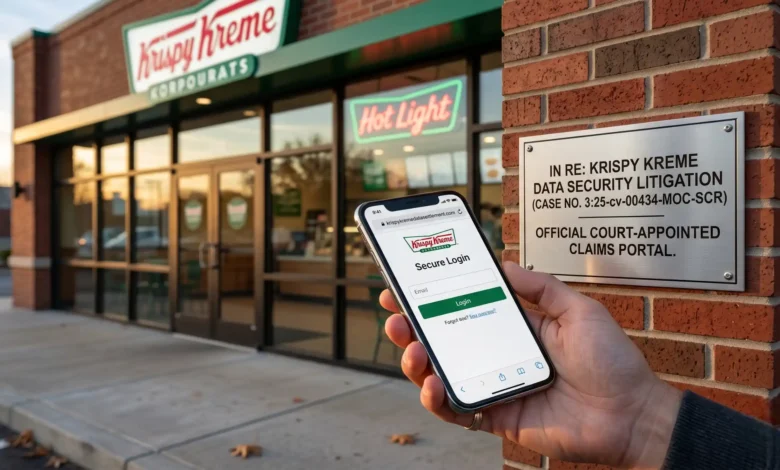
- Access the secure portal. Go directly to the court approved domain (KrispyKremeDataSettlement.com). Do not use third party legal aggregator sites, which often harvest your data.
- Choose your tier. Select either the Documented Loss track or the Alternative Cash track.
- Upload evidence. If pursuing the $3,500 tier, attach clear PDF or JPEG copies of your financial records. If your evidence is deemed insufficient, the administrator will automatically default your claim to the $75 flat cash tier rather than rejecting you entirely.
- Submit. Your digital form must be submitted, or your paper form postmarked, by June 22, 2026.
Upcoming Legal Milestones
Do not expect a check in the mail the day after the portal closes. The legal calendar dictates a strict sequence of events.
If you want to reserve your right to sue Krispy Kreme individually, you must mail a physical opt out request postmarked by June 6, 2026. Doing nothing binds you to the settlement terms permanently.
Judge Max O. Cogburn, Jr. will hold the Final Approval Hearing in Charlotte, North Carolina, on July 6, 2026, at 9:30 a.m. EDT. The administrator can only begin cutting checks or initiating direct deposits after the judge signs the final order and the 30 day window for legal appeals expires. Realistically, class members should expect funds to arrive in late Q3 or early Q4 of 2026.
Disclaimer: This analysis is for informational purposes only and does not constitute legal or financial advice. Class members should consult the official settlement administrator or their own legal counsel regarding specific claims.
Frequently Asked Questions
Can I claim the settlement if I used the Krispy Kreme rewards app?
No. Retail consumer data, credit card swipes, and rewards applications were not breached in this specific incident. The class is strictly limited to internal employees.
What happens if I lost my postcard and PIN?
You can recover your credentials by contacting the Portland based settlement administrator directly. Call their toll free line at 1-877-239-1879 to verify your employment history and request a new PIN.
Are settlement payouts taxable?
The Internal Revenue Service generally does not tax settlements meant to reimburse direct financial losses or identity theft out of pocket costs. However, flat cash payouts without documented losses can sometimes be viewed as taxable income. Consult a certified tax professional for your specific situation.
Is it safe to enter my Social Security number on the settlement site?
Yes, provided you are on the verified court authorized domain. The official administrator uses standard encryption protocols to safely match your identity against the corporate personnel logs provided by Krispy Kreme.
Sources
- United States District Court Western District of North Carolina: Consolidated Class Action Complaint (Case No. 3:25-cv-00434-MOC-SCR) – https://www.classaction.org/media/in-re-krispy-kreme-data-security-litigation-complaint.pdf
- United States District Court Western District of North Carolina: Preliminary Approval Order – https://www.classaction.org/media/krispy-kreme-pao.pdf
- Official Settlement Administrator Long Form Notice – https://krispykremedatasettlement.com/Content/Documents/Long%20Form%20Notice.pdf
- Official Settlement Administrator Postcard Notice – https://krispykremedatasettlement.com/Content/Documents/Postcard%20Notice.pdf
- WSB-TV Atlanta (Example of incorrect media reporting regarding customers) – https://www.wsbtv.com/news/trending/krispy-kreme-16m-settlement-could-net-customers-lot-dough/OJ2JIA2UJBA6ZCSD5PKT2PUI5M/
- Click2Houston (Example of incorrect media reporting regarding customers) – https://www.click2houston.com/news/local/2026/06/22/krispy-kreme-data-breach-settlement-claim-deadline-is-june-22/