

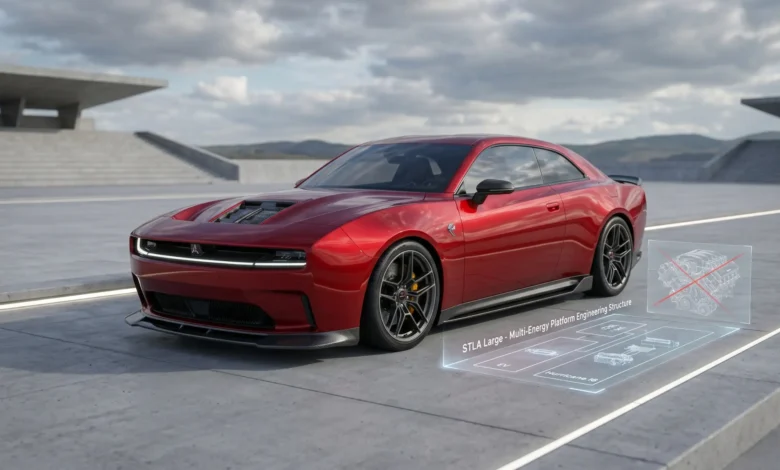
Dodge Viper Successor News: 2026 Reality Check
Every few months, a new hyper-realistic digital design sweeps across automotive social media, promising the immediate return of the V10 Dodge Viper. These viral images rack up millions of views and fuel endless speculation.
With parent company Stellantis overhauling its North American manufacturing lines and cutting slow-selling vehicles, the path for a dedicated sports car has completely shifted. The business models that allowed low-volume performance cars to exist a decade ago no longer apply.
While a traditional, giant-displacement sports car is blocked by modern economics and federal safety legislation, official corporate roadmap updates from mid-2026 show that Dodge is actively planning a new performance flagship strategy. It just looks completely different from what purists expect.
As of mid-2026, there is no official development program or active vehicle code for a direct, V10-powered Dodge Viper successor. Stellantis has permanently retired the bespoke front-mid sports car architecture. Instead, official corporate roadmaps confirm Dodge is developing a high-performance halo coupe under the Copperhead SRT track using the shared STLA Large platform.
Key Takeaways
- The original Dodge Viper platform was permanently retired in August 2017 due to federal safety non-compliance.
- The iconic 8.4-liter V10 engine cannot return due to modern emissions footprints and packaging limitations.
- Stellantis has moved all North American muscle and performance cars to the shared STLA Large platform framework.
- Dodge CEO Matt McAlear confirmed the brand is pursuing unique halo projects, separating affordable entry options from premium flagships.
- The newly teased “Copperhead SRT” project represents the true corporate roadmap path for Dodge’s next-generation sports coupe.
- No physical camouflage prototypes or supplier component orders support an imminent standalone sports car launch.
Quick Answer: Is the Viper Coming Back?
If you are looking for a short answer to the endless stream of internet rumors, the structural truth comes down to a clear division between internet fiction and factory reality:
- The V10 Engine: Permanently dead. Stellantis has ended production of large-displacement, naturally aspirated engines across all passenger vehicle lines.
- The Production Plant: Permanently closed. The specialized Detroit facility that hand-assembled the sports car cannot build vehicles anymore.
- The Real Future: A high-performance coupe built on a shared corporate framework is currently under development, moving away from the Viper name to establish a new identity.
The Manufacturing Reality: Why the Gen 5 Viper Was the End of an Era
The Legislative Roadblock
The primary reason the fifth-generation Viper exited showrooms in August 2017 was not low consumer demand. It was a direct conflict with federal safety regulations.
Specifically, the vehicle could not comply with Federal Motor Vehicle Safety Standard 226, which is also known as FMVSS 226. This federal regulation mandates side-curtain ejection mitigation airbags to prevent occupants from being thrown from a vehicle during a rollover crash.
The Viper feature that enthusiasts loved most—its low, ultra-narrow cabin geometry and signature double-bubble roofline—left no physical space to package or deploy these mandatory side-curtain airbag modules. Redesigning the entire roof and door structures would have required building a completely new vehicle from scratch.
⚠️ Common Mistake: Many enthusiasts believe Dodge discontinued the Viper simply because sales dropped. In reality, federal safety standard changes made the hand-built chassis illegal to sell in the United States without a multi-million-dollar structural redesign.
The Plant Closure Factor
Even if engineers solved the airbag packaging issue, building a traditional Viper requires a highly specific type of factory. The car was built using hand-assembly methods rather than automated robotic assembly lines.
The final generation of the vehicle was built exclusively at the specialized Conner Avenue Assembly plant located in Detroit, Michigan. Following the final production run in 2017, Stellantis permanently decommissioned the facility from vehicle manufacturing.
The building was later converted into an internal corporate collection and meeting space. Because the tooling, custom jigs, and specialized hand-assembly infrastructure have been entirely dismantled, Stellantis has no active facility capable of building a low-volume, spaceframe sports car.
The Financial Equation of Independent Architectures
Developing an independent, low-volume sports car requires a massive financial investment that large automotive corporations can no longer justify. To understand why, look at how safety compliance and engineering costs are distributed across an automaker’s lineup.
- Testing Expenses: Federal safety frameworks mandate that all large-scale manufacturers perform full, destructive crash testing and active safety validation on every unique vehicle architecture.
- Exemption Barriers: Major mainstream brands are legally disqualified from using small-scale, low-volume kit-car safety exemptions.
- Return on Investment: Spending hundreds of millions of dollars to engineer a bespoke chassis that projects sales of fewer than 1,500 units a year results in a severe financial loss.
Platform Engineering vs. Internet Rumors: Speculative Specs vs. Real Architecture
The Demise of the 8.4L V10
The massive, naturally aspirated 8.4-liter aluminum V10 engine was the heart of the original car’s identity. However, that powerplant is permanently locked in the past.
Modern federal emissions laws and corporate fleet averages mean massive displacement engines are no longer viable for volume manufacturers. Stellantis has redirected its research and engineering capital entirely away from big-block engines.
The packaging requirements for a modern engine also conflict with the old architecture. A massive V10 cannot clear modern pedestrian impact safety zones, which require a specific amount of empty space between the top of the engine block and the underside of the hood.
The STLA Large Foundation
Any future performance vehicle built by Dodge must use a shared platform. Stellantis has consolidated all of its North American performance and muscle car development onto a single, flexible foundation called the STLA Large platform architecture.
This modular unibody framework is designed to handle multiple distinct drivetrain options on the exact same assembly line. Instead of a standalone sports car platform, Dodge is using this architecture to power its entire modern performance lineup, including the dual-motor Charger Daytona electric vehicle and the gas-powered Charger SIXPACK.
The Charger SIXPACK uses the Hurricane engine, which is a twin-turbocharged 3.0-liter inline-six engine that delivers up to 550 horsepower. This engine family represents the maximum performance ceiling for the brand’s traditional combustion options.
Old Engineering vs. Modern Scalable Infrastructure
| Engineering Parameter | Historical Viper Platform (Gen 5) | Modern STLA Large Performance Platform |
| Chassis Foundation | Bespoke spaceframe structure | Scalable, modular unibody framework |
| Powertrain Integration | Naturally aspirated 8.4L V10 only | Inline-six twin-turbo / Hybrid / Fully Electric |
| Manufacturing Hub | Conner Avenue Assembly (Decommissioned) | Flexible mass-production assembly lines |
| Safety Integration | Lacked space for side-curtain deployment | Full multi-zone airbag framework integrated |
| Target Architecture Identity | Independent niche halo model | Shared component architecture |
Corporate Roadmap Analysis: What Stellantis Executives Are Actually Saying
The Shift Away From Low-Margin Projects
Automotive conglomerates are reassessing where they spend their engineering dollars. To protect profit margins, automakers are cutting vehicle lines that require high marketing costs but offer low financial returns.
A clear example of this corporate strategy occurred in January 2026, when Stellantis quietly terminated the Dodge Hornet product line. The rapid cancellation of this compact crossover shows that corporate leadership is shifting its focus away from rebadged global platforms. Instead, the brand is preserving its capital for vehicles that carry distinct performance equity.
The Twin Halo Strategy
When evaluating future sports car development, it is necessary to separate distinct product tiers. Enthusiasts often confuse statements about affordable sports cars with plans for high-end flagship models.
Dodge Chief Executive Officer Matt McAlear clarified this product structure during an industry briefing. He noted that the brand sees a clear division in how high-performance cars should be positioned for consumers.
“I think there’s a market for two things. There’s a market for an entry-level halo and a top-of-the-line halo,” McAlear stated. “We need to get original, like the Viper… It’s gotta come to market and be unique and different and Dodge.”
This dual-tier approach means that while Dodge is exploring a small, affordable weekend performance car, that project is completely separate from their premium flagship development tracks.
The Emergence of the Copperhead SRT
The concrete path forward for a premium Dodge sports car became clear during the global Stellantis Investor Day presentation in mid-May 2026. Corporate leadership displayed a 3D-printed physical design buck, which is a full-scale structural model used to preview future vehicle proportions.
This design buck was labeled under a familiar historical banner: the Dodge Copperhead SRT. Using the Copperhead name allows the brand to build a high-performance sports coupe while avoiding immediate comparisons to older vehicle architectures.
Former brand executive Tim Kuniskis previously detailed the strategic reasoning behind using separate historic nameplates for new vehicle platforms.
“We purposely called it a Copperhead because it’s not a Viper,” Kuniskis explained.
By utilizing the Copperhead nomenclature, the brand can introduce an advanced, automated performance car without triggering backlash from purists who demand a traditional manual transmission and a V10 engine.
Tracking the Supply Chain: Has a Physical Test Car Been Spotted?
The Absence of Development Mules
Before any automotive manufacturer brings a new performance car to market, the vehicle must leave a massive trail of industrial evidence. A vehicle cannot transition from a corporate slide deck to a local dealership without passing through specific manufacturing validation phases.
To track whether a real sports car project is secretly underway, industry analysts look for three specific supply chain milestones:
- Tooling Contracts: Corporate procurement teams must issue official requests for quotes to external Tier-1 suppliers for specialized low-volume carbon fiber panels or unique structural frames.
- Body-in-White Validation: Factory teams must construct initial structural shells, known as body-in-white structures, to perform early physical stress testing.
- Public Road Calibration: Engineers must log thousands of miles running heavily camouflaged prototypes on public roads to calibrate emission control systems and active suspension components.
As of mid-2026, no custom two-seat validation prototypes or specialized supplier tooling orders have surfaced in regional component tracking reports. Every active development car spotted on public roads has matched the longer, wider footprint of the four-door Charger platform.
How to Spot Real Prototype Components
When reviewing future spy photographs, you can easily separate real performance prototypes from standard passenger cars by looking for specific aerodynamic choices.
- The S-Duct Layout: Look closely at the hood line. A true high-output platform requires an integrated “S-Duct” air pass-through system, which routes air through the front grille and exits it out of the top of the hood to generate front downforce.
- Pillar Thickness: Pay attention to the roof pillars. Modern side-curtain airbag packaging regulations mean any new sports coupe will feature significantly thicker, wider structural pillars than classic models.
- Cowl Dimensions: Look at the distance between the front axle and the base of the windshield. A front-mid engine layout requires an extended cowl dimension to house a high-output longitudinal powertrain behind the front suspension towers.
Mid-Article Summary: Separating Fact from Speculation
- The Standalone Architecture: Bespoke spaceframe platforms are permanently gone due to destructive safety validation costs and facility decommissioning.
- The Drivetrain Rule: Any upcoming performance flagship must abandon large-displacement engine blocks in favor of high-output twin-turbo inline-six configurations or electric motors.
- The Corporate Track: Capital allocations through 2026 focus entirely on modular platforms, positioning the Copperhead SRT design buck as the official blueprint for the brand’s next sports coupe. :::
Summary: The Path Forward for Dodge’s Performance Flagship
A traditional, V10-powered spaceframe Viper resurrection is blocked by clear financial constraints, factory closures, and federal safety legislation. However, Dodge is protecting its high-performance heritage by pivoting toward a shared-architecture coupe strategy under the Copperhead SRT development track.
Next Steps for Enthusiasts
- Adjust Monitoring Terms: Shift your automated news alerts away from “Viper revival” and focus on “STLA Large performance variants” and “Copperhead program codes.”
- Review Investor Documents: Monitor upcoming quarterly corporate slide streams from Stellantis to watch for explicit capital allocations toward low-volume performance manufacturing.
- Filter Social Media Claims: Ignore third-party digital animations and YouTube renderings that lack corresponding corporate design patent filings or physical component verification.
FAQs
Is Dodge bringing back the Viper in 2026 or 2027?
No. There is no active vehicle program, capital allocation, or assembly asset reserved for a direct Viper replacement.
Why did Dodge stop making the Viper?
Production ended because the low-profile cabin could not accept the side-curtain airbag modules required by federal ejection mitigation laws under FMVSS 226.
Could a future Dodge sports car use a V10 engine?
No. Modern emissions rules and component consolidation mean future flagships will use high-output twin-turbo inline-six engines or electric powertrains.
What is the Dodge Copperhead SRT project?
It is a design track previewed during the mid-May 2026 corporate investor meetings that explores a high-performance flagship coupe on a shared modular platform.
Where was the original Dodge Viper built?
It was built by hand at the Conner Avenue Assembly plant in Detroit, which has since been permanently decommissioned and turned into a private corporate meeting space.
Can a new sports car use low-volume manufacturing exemptions?
No. Mainstream corporate entities like Stellantis are legally disqualified from using small-scale, kit-car safety exemptions for primary brand models.
Have any real prototypes of a new Viper been seen on US roads?
No physical development test cars or camouflaged two-seat validation models have been captured by automotive spy photographers.
What platform would a future Dodge sports car use?
Any upcoming muscle or performance flagship coupe will be constructed on the flexible STLA Large platform architecture.
References
- National Highway Traffic Safety Administration (NHTSA), 2017
- Stellantis Global Investor Presentation Slide Decks, 2026
- U.S. Department of the Treasury Automotive Task Force Reorganization Asset Records, 2009
- Official Media Room Statements: Dodge Brand & SRT Engineering Executive Transcripts, 2025
- Official Media Room Statements: Dodge Brand & SRT Engineering Executive Transcripts, 2026