
Erin Brockovich Data Center Transparency: Banning Tech NDAs
The transition from industrial chemical pollution to artificial intelligence infrastructure has created a new, unseen battleground for environmental transparency across the United States. In May 2026, grassroots consumer advocates and federal lawmakers synchronized efforts to dismantle the wall of corporate non-disclosure agreements shielding massive hyper-scale data center builds from public scrutiny.
As rapid AI expansion drives unprecedented regional water and power demands, the intersection of Erin Brockovich’s crowdsourced mapping movement and newly introduced federal mandates represents a shift toward mandatory structural transparency in municipal development.
The modern push for Erin Brockovich data center transparency targets the systematic use of corporate non-disclosure agreements (NDAs) by technology developers. By leveraging these legal instruments, companies routinely conceal massive local water and electrical grid footprints from communities. The movement demands independent environmental audits and public site mapping before developers can execute binding utility contracts.
Key Takeaways
- The Transparency Gap: Infrastructure developers frequently use NDAs to mask intensive data center builds as basic commercial warehouses during early zoning.
- Civic Mobilization: Erin Brockovich’s May 2026 digital platform collected thousands of community entries mapping utility secrecy.
- Federal Intervention: The newly proposed AI Data Center Site Selection Transparency Act of 2026 aims to legally restrict privacy clauses between tech developers and public utilities.
- Resource Strain: Modern data center facilities heavily extract clean, potable freshwater to prevent structural scaling and cooling tower corrosion.
- Ratepayer Protection: Emerging state frameworks are beginning to block utilities from passing infrastructure interconnection costs down to residential consumers.
Quick Start: Spotting Secrecy in Your Community
If you want to track whether a secret data center development is coming to your community, look for three initial triggers: unexplained public water main expansion requests, massive utility substation upgrades, and local officials signing binding non-disclosure rules. New 2026 federal bills aim to outlaw these backroom agreements entirely.
The “Stealth Warehouse” Problem: How NDAs Mask AI Infrastructure
The Mechanics of Municipal Information Asymmetries
Local communities and zoning boards frequently experience severe information asymmetries. They lack clear data regarding the long-term cumulative grid or water strain of a proposed data center campus before authorization. Real facility-level resource consumption metrics are frequently shielded from public view by utilities. This happens because of commercial non-disclosure clauses and aggregated reporting styles used by power companies.
To bypass community pushback, tech infrastructure developers typically advance their projects through a predictable sequence of hidden administrative actions:
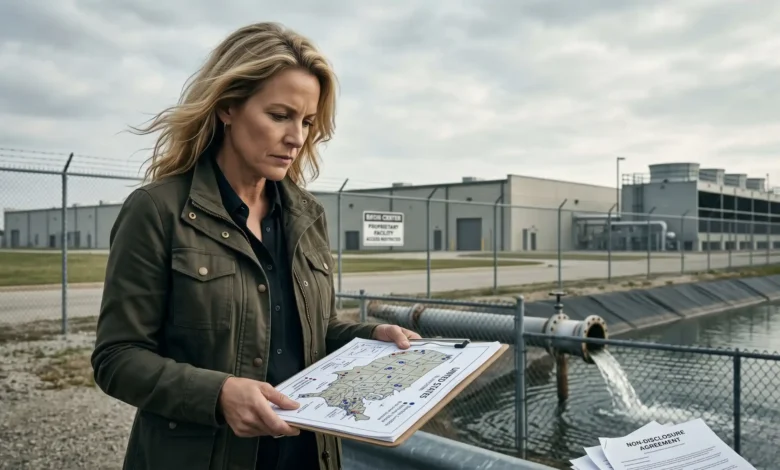
- A developer establishes a regional real estate shell entity to buy land anonymously.
- The entity files a zoning application for a low-employment “fulfillment warehouse.”
- Public municipal officials sign a binding commercial NDA to secure the project before evaluating utility totals.
- The true industrial electrical and water demands are only exposed after final building permissions are locked in.
Common Mistake: Relying on global tech corporate sustainability reports to assess local impact. These documents usually show global aggregated water use, hiding the intense, localized strain on your community’s specific aquifer or river basin.
The “Erin Brockovich Effect” Reimagined for the Digital Era
Environmental activist Erin Brockovich has historically partnered with experts like Robert Bowcock to audit local water treatment infrastructure and empower communities to demand public accountability and data transparency. The historical Hinkley, California groundwater pollution case involved Pacific Gas and Electric (PG&E) discharging hexavalent chromium. This case created a permanent media benchmark for civic accountability often termed the “Erin Brockovich Effect.”
Today, that baseline push for accountability faces digital infrastructure. In late May 2026, Brockovich launched a public platform to crowdsource data center locations and map out utility non-disclosure trends. Local residents use this tool to log unexpected utility inflation and zoning secrecy.
As Erin Brockovich noted regarding her May 2026 platform launch:
“The single most common concern — more than noise, more than water usage… is the one word that keeps appearing: transparency.”
Task Force Blueprint: The Stealth Development Red Flag Checklist
Local municipal boards and civic organizers can use this diagnostic check to determine if an incoming project is hidden behind an NDA. If an applicant claims they are building a standard logistics hub but triggers these indicators, they may be masking a heavy-load AI data center build.
| Red Flag Indicator | Operational Signpoint | Risk Alignment |
| Zoning Mismatch | Project is introduced as a low-employment logistics warehouse but requests a massive electrical substation expansion. | High Risk: Indicates high-density server racks rather than standard asset storage. |
| Public Official Silence | Municipal representatives cite active, binding commercial non-disclosure parameters when questioned about specific utility metrics. | Critical Risk: Triggers the primary non-disclosure vulnerabilities targeted by the 2026 McIver Act. |
| Water Drawdown Disconnect | Siting application requires heavy public water mains connection despite claiming low employee counts on-site. | High Risk: Points directly to high-volume industrial evaporative cooling loops. |
Inside the AI Data Center Site Selection Transparency Act of 2026
Breaking Down the House Framework
To address these infrastructure blind spots, U.S. Representative LaMonica McIver formally introduced the AI Data Center Site Selection Transparency Act of 2026. This federal bill establishes strict transparency mandates for any developer building AI-focused computing infrastructure.
The proposed legislation forces developers to disclose physical site locations and estimated structural impacts to municipal officials and the public at least 180 days before executing definitive steps. This early notification requirement aims to give local authorities adequate time to evaluate utility baselines.
[House Legislative Repository for Rep. McIver Bill]
By establishing a mandatory public notice timeline, the bill effectively prevents technology firms from fast-tracking massive server facilities without local oversight. Tracey Lewis, policy counsel for Public Citizen, summarized the direct legislative intent during her congressional testimony:
“This bill prevents backroom deal making between those developers and elected officials by restricting the use of NDAs.”
Mandatory Independent Environmental Audits
A core element of the McIver framework is the shifting of financial and analytical burdens back onto the infrastructure developers. Under this legislative framework, developers are required to fund an independent, third-party environmental impact analysis. This study cannot be an internal corporate overview; it must be managed by an unaligned third-party expert.
The independent audit must specifically account for three core operational parameters:
- Specialized Electrical Loads: Peak megawatt demands and local substation capacity limits.
- Cooling Requirements: Total volume and exact infrastructure engineering design of the HVAC systems.
- Water Footprint Metrics: Net consumption rates across local water basins.
The law applies these disclosure triggers whenever a developer attempts to take “definitive steps” toward building. Under the 2026 Act, legally binding real property acquisitions or grid interconnection contracts with power utilities are formally categorized as definitive steps. This definition stops developers from claiming that early-stage utility layouts are confidential corporate plans.
Organizations tracking watershed preservation have strongly backed this structural approach. Marc Yaggi, Executive Director of the Waterkeeper Alliance, highlighted the immediate necessity of public access to these infrastructure reviews:
“AI data centers have massive impacts… and industry often hides this information from communities during the proposal process.”
Jenifer Bosco, staff attorney at the National Consumer Law Center, also emphasized how these mandatory audits protect everyday regional ratepayers from hidden system strains:
“This bill stops data center developers from shrouding their actions in secrecy by requiring public analysis…”
The Hydrologic Friction: Why Data Centers Demand Potable Freshwater
The Thermodynamics of Evaporative Cooling Loops
To keep high-density AI server racks from overheating, data centers rely heavily on industrial cooling systems. Modern data centers heavily prioritize the extraction of clean, potable freshwater for industrial cooling loops. Developers choose high-quality public drinking water rather than raw river water or municipal greywater (recycled wastewater) to protect their equipment.
Using untreated or recycled water introduces significant mechanical risks. Clean water is required to mitigate the long-term risk of mineral scaling (crusted mineral deposits that reduce cooling efficiency), hardware corrosion, and dangerous bacterial development like Legionella within the cooling towers.
However, this clean water does not simply vanish; a large portion is discharged as heavy wastewater after evaporation occurs. Peer-reviewed legal and environmental research states that current data center cooling water discharge practices suffer from a severe transparency deficit. This leaves local water regulators completely unable to track concentrated toxic elements in blowdown water (the highly concentrated wastewater flushed from cooling towers).
[UC Law San Francisco Environmental Law Review Database]
Local Watershed Stress vs. Global Aggregated Metrics
Technology companies frequently downplay their environmental footprints by pointing to national averages. While data centers account for an estimated 0.3% of national public water supply withdrawals, their specific consumption peaks intensely during seasonal droughts and localized heat waves.
This creates intense localized friction. A data center campus might pull a low percentage of water on a national scale, but it can completely drain a small town’s local aquifer or surface basin during a July heat wave. This specific local strain is exactly what the crowdsourced mapping database at brockovichdatacenter.com aims to expose. By matching community utility billing spikes with unclassified zoning records, citizen groups can see where computing infrastructure is directly competing with local agricultural and residential water supplies.
Mid-Article Summary: Corporate Disclosures vs. Legislative Realities
| Disclosure Parameter | Traditional Corporate Practice | 2026 Legislative Mandate Framework |
| Siting Intentions | Kept confidential via regional real estate shell entities. | Public mapping required 180 days before execution. |
| Environmental Cost | Internal modeling or aggregated global corporate metrics. | Mandatory independent third-party local basin impact audits. |
| Public Utility NDAs | Standard tool used to protect proprietary infrastructure design. | Strictly prohibited when dealing with public entities. |
The Legislative Counteroffensive: State and Federal Actions in 2026
Tracking Federal Energy Transparency Frameworks
Capitol Hill is also addressing the electrical grid strain caused by AI infrastructure. In March 2026, U.S. Senator Dick Durbin introduced S. 4213, titled the Data Center Water and Energy Transparency Act of 2026. This bill focuses on federal environmental oversight, creating an active reporting track that bypasses local utility non-disclosure walls.
The Durbin bill mandates that large-scale infrastructure operators report standardized energy and water efficiency data directly to the Environmental Protection Agency (EPA). Independent water planners strongly advocate for this standardized, mandatory reporting of both direct Scope 1 consumptive water volumes (on-site cooling water used) and indirect Scope 2 electricity-embedded water impacts (the water consumed off-site to generate the electricity that powers the data center).
Without these mandatory energy metrics, the long-term environmental projections for the US utility sector remain severe. Environmental tracking models predict that without robust federal clean energy policies, the massive electrical demands of scaling data centers could increase annual US power plant carbon dioxide ($CO_2$) emissions by up to 29% by 2035.
[Union of Concerned Scientists Data Center Energy Projection Portal]
State-Level Intervention Strategies
Because federal bills can take months to pass through committee sessions, individual states are advancing their own emergency regulatory frameworks. These actions specifically target utility cost transparency and infrastructure freezes:
- The New Jersey Ratepayer Pivot: In May 2026, state utility regulators instituted a four-pillar regulatory system. This framework permanently decoupled public utility upgrades from consumer rate baselines. The rules force data center developers to entirely self-fund their grid interconnections, preventing tech firms from shifting infrastructure expansion costs onto local residential utility bills.
- The Oklahoma Infrastructure Freeze: Oklahoma successfully implemented Senate Bill 1488. This emergency statute freezes construction on all new data center projects exceeding 100 megawatts until late 2029. The pause allows the state Public Utility Commission (PUC) to perform complete local valuations on regional water access and residential property impacts.
Summary and Next Steps for Local Communities
The unchecked deployment of AI infrastructure behind non-disclosure agreements creates severe resource imbalances for local utility networks. True accountability requires moving beyond voluntary corporate sustainability updates into legally enforceable pre-development reporting tracks.
3 Immediate Actions for Municipal Boards:
- Enact Local NDA Bans: Implement county-level zoning ordinances that invalidate commercial development applications if utility metrics are withheld under commercial confidentiality clauses.
- Audit Wastewater Profiles: Demand complete independent chemical disclosures of industrial cooling tower blowdown water before approving municipal sewer treatment access.
- Differentiate Footprint Metrics: Force upcoming infrastructure applicants to supply separate, verified breakdowns for both direct Scope 1 consumptive water volumes and indirect Scope 2 electricity-embedded water impacts.
Frequently Asked Questions (FAQs)
What is the Erin Brockovich data center transparency movement?
An investigative and civic tracking movement aimed at exposing and restricting the corporate non-disclosure agreements used by tech developers to hide local water and power grid consumption metrics.
Why do data center developers use non-disclosure agreements (NDAs)?
Developers use NDAs during early site selection to prevent competitor front-running and bypass public infrastructure debates before zoning variances are signed.
What does the AI Data Center Site Selection Transparency Act of 2026 require?
It legally mandates that developers map physical site locations and file independent, third-party environmental impact reviews at least 180 days prior to executing real estate or utility contracts.
How do data centers impact local water systems?
They extract immense volumes of potable freshwater for evaporative cooling mechanisms, which can stress regional aquifers during seasonal heat waves and return concentrated chemical scale-inhibitors into local wastewater.
What is the difference between Scope 1 and Scope 2 water footprints?
Scope 1 refers to direct on-site water consumption used in facility cooling towers, while Scope 2 measures the indirect water consumed during the off-site generation of the electricity powering the facility.
Can local zoning boards block secret data center developments?
Yes, by passing local ordinances that require explicit, un-aggregated utility load disclosures as a strict prerequisite for any commercial layout review or zoning variance approval.
What is Senator Durbin’s S. 4213 bill?
The Data Center Water and Energy Transparency Act of 2026, designed to force large-scale digital infrastructure operators to report standardized energy and water efficiency data directly to the EPA.
References
- Carrera & Key, 2021
- Small, 2024
- House Legislative Repository (mciver.house.gov), 2026
- Kim, 2026
- Privette, 2026
- Rising, 2026
- Saul Ewing Legal Archives, 2026
- MultiState Legislative Tracking Database, 2026
- Society of Environmental Journalists, 2026