
Star Wars Movies in Order: Updated for 2026 Releases
Walking blindly into a 50-year-old movie series is an easy way to hit major story spoilers or drown in timeline clutter. With multiple trilogies, spin-offs, and streaming shows, finding a clear path is notoriously difficult. Fortunately, you do not need to watch hundreds of hours of optional television series just to understand the core cinematic story.
To watch the core Star Wars movies in order by theatrical release, start with Star Wars: Episode IV – A New Hope (1977). To watch them in chronological order based on the timeline of the story, start with Star Wars: Episode I – The Phantom Menace (1999). New viewers should use release order to avoid major plot spoilers.
Key Takeaways
- The main film franchise consists of 11 live-action theatrical movies, grouping the nine-part Skywalker Saga and two standalone stories.
- Release order matches how audiences originally saw the films in theaters and preserves every major cinematic twist.
- Chronological order follows the in-universe timeline linearly from Anakin Skywalker’s childhood to the final generation.
- The fan-made Machete Order treats the prequel films as an extended flashback sequence between the original movies.
- Streaming series and animated projects are entirely optional side-quests for understanding the theatrical universe.
- The cinematic timeline just expanded with the theatrical debut of The Mandalorian & Grogu on May 22, 2026.
The Decision Engine: Which Order Should You Pick?
Before picking a track, identify your viewing goals. The right path changes depending on whether you are experiencing these stories for the first time or returning for a deep dive into the lore.
- First-Time Viewer? Choose Release Order. It preserves the emotional payoffs and protects you from massive plot reveals.
- Franchise Veteran? Choose Chronological Order. It highlights the political evolution of the galaxy and structural lore connections.
- Narrative Purist? Choose Machete Order. It keeps the focus entirely on a single character arc while keeping the main plot twist intact.
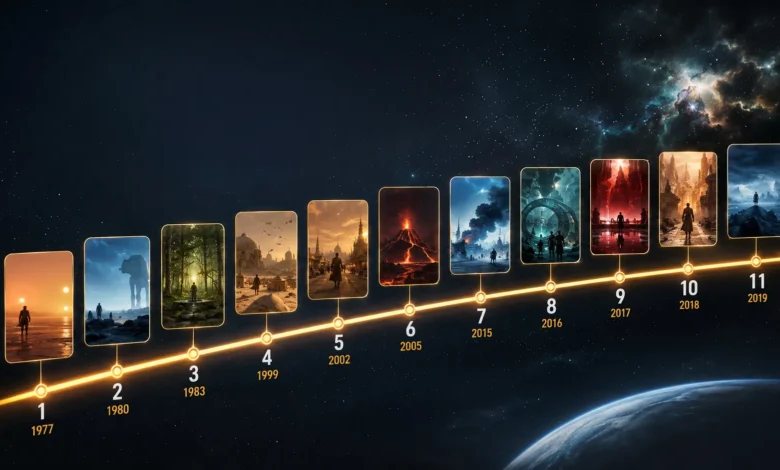
1. The Theatrical Release Order (The Recommended Path)
This sequence lets you watch the movies exactly how they debuted in theaters over the last five decades. It starts in 1977 with George Lucas’s original vision before jumping back and forth through production history.
- Star Wars: Episode IV – A New Hope (1977)
- Star Wars: Episode V – The Empire Strikes Back (1980)
- Star Wars: Episode VI – Return of the Jedi (1983)
- Star Wars: Episode I – The Phantom Menace (1999)
- Star Wars: Episode II – Attack of the Clones (2002)
- Star Wars: Episode III – Revenge of the Sith (2005)
- Star Wars: Episode VII – The Force Awakens (2015)
- Rogue One: A Star Wars Story (2016)
- Star Wars: Episode VIII – The Last Jedi (2017)
- Solo: A Star Wars Story (2018)
- Star Wars: Episode IX – The Rise of Skywalker (2019)
The Pros: Preserving the Drama
The primary benefit of this path is preserving the cultural history of cinema. Major plot reveals remain shocking because the films do not give away secrets ahead of time. It allows you to appreciate how filmmaking technology evolved over time.
The Cons: Visual and Pacing Whiplash
The main downside is the jarring jump in technology and pacing. You go from the practical effects of 1983 directly into the heavy digital animation of 1999. This stylistic jump can feel unnatural to younger viewers.
Common First-Timer Mistake: Do not let a crowded streaming menu trick you into watching standalone prequels first. Watching spin-off stories too early dilutes the mystery of the core universe.
2. The Chronological Viewing Order (The Lore Path)
This order rearranges the movies to follow the literal sequence of events inside the fictional universe. Instead of looking at release dates, you track the timeline of galactic history from start to finish.
As the official platform notes, “Watching in chronological order lets you follow Anakin Skywalker’s rise, Darth Vader’s reign, and the next generation’s fight.” [Disney Plus Star Wars hub]
- Star Wars: Episode I – The Phantom Menace (1999)
- Star Wars: Episode II – Attack of the Clones (2002)
- Star Wars: Episode III – Revenge of the Sith (2005)
- Solo: A Star Wars Story (2018)
- Rogue One: A Star Wars Story (2016)
- Star Wars: Episode IV – A New Hope (1977)
- Star Wars: Episode V – The Empire Strikes Back (1980)
- Star Wars: Episode VI – Return of the Jedi (1983)
- Star Wars: Episode VII – The Force Awakens (2015)
- Star Wars: Episode VIII – The Last Jedi (2017)
- Star Wars: Episode IX – The Rise of Skywalker (2019)
The Pros: Clean Narrative Continuity
Watching the story unfold this way clarifies the political shifts in the galaxy. You see exactly how a democratic republic collapses into a military empire without any confusing timeline jumps.
Pro Tip: The standalone film Rogue One finishes literally minutes before A New Hope starts, making them a perfect cinematic double feature.
The Cons: Ruining the Big Reveals
For someone completely new to the franchise, this route introduces a massive problem. Prequel movies explicitly reveal character backgrounds and family relationships that serve as the main emotional shocks of the original trilogy.
3. The “Machete Order” (The Narrative Compromise)
If you want the best of both worlds, a famous fan-curated sequence known as the “Machete Order” offers a unique solution. Created by software blogger Rod Hilton, this viewing method reorganizes the films to focus entirely on Luke Skywalker’s hero journey.
The viewing sequence is:
- Episode IV: A New Hope
- Episode V: The Empire Strikes Back
- Episode II: Attack of the Clones
- Episode III: Revenge of the Sith
- Episode VI: Return of the Jedi
Notice that this order completely skips Episode I: The Phantom Menace. Fans recommend dropping it because the first prequel has a detached narrative pace and is not strictly required to understand the later films.
By inserting Episodes II and III right after The Empire Strikes Back, the prequels act as an extended cinematic flashback. Right after you learn the identity of Luke’s father, you jump back in time to see exactly how that fall to the dark side happened, before returning to the present for the finale in Return of the Jedi.
As entertainment critics at Art Threat point out, “Chronological order… creates narrative continuity but removes the dramatic twist that defined the original trilogy’s impact.” The Machete Order successfully solves that exact problem.
Comprehensive Star Wars Movie Comparison Matrix
To help you organize your viewing plan, here is a breakdown of the 11 live-action theatrical films, showing how their release years compare to their in-universe eras.
| Movie Title | Release Year | Chronological Era | Streaming Platform |
| Episode I: The Phantom Menace | 1999 | Prequel Trilogy | Disney+ |
| Episode II: Attack of the Clones | 2002 | Prequel Trilogy | Disney+ |
| Episode III: Revenge of the Sith | 2005 | Prequel Trilogy | Disney+ |
| Solo: A Star Wars Story | 2018 | Standalone / Mid-Era | Disney+ |
| Rogue One: A Star Wars Story | 2016 | Standalone / Mid-Era | Disney+ |
| Episode IV: A New Hope | 1977 | Original Trilogy | Disney+ |
| Episode V: The Empire Strikes Back | 1980 | Original Trilogy | Disney+ |
| Episode VI: Return of the Jedi | 1983 | Original Trilogy | Disney+ |
| Episode VII: The Force Awakens | 2015 | Sequel Trilogy | Disney+ |
| Episode VIII: The Last Jedi | 2017 | Sequel Trilogy | Disney+ |
| Episode IX: The Rise of Skywalker | 2019 | Sequel Trilogy | Disney+ |
Quick Checkpoint:
- New to the galaxy? Run Release Order.
- Want to watch the story unfold linearly? Run Chronological Order.
- Want maximum narrative impact? Run Machete Order.
- Do not let 100+ hours of optional animated TV shows derail your movie marathon.
Common Pitfalls: Mistakes First-Time Viewers Make
When planning a franchise marathon, viewers often make a few structural mistakes that derail their experience.
- Getting trapped in television shows: The animated series Star Wars: The Clone Wars sits chronologically between Episode II and Episode III. Many fans try to watch all seven seasons of the show before finishing the prequel movies. This burns out casual viewers. Stick to the movies first.
- Tracking down the Holiday Special: Do not watch the infamous 1978 Holiday Special as part of your marathon. It is not officially canon, you will not find it on Disney+, and it is a jarring historical oddity rather than a real chapter of the story.
- Treating anthologies as mandatory: Solo and Rogue One add rich world-building, but they are optional cinematic side-quests. You do not need to watch them to understand the main nine-film Skywalker Saga.
What is Next? The Evolving Star Wars Cinematic Universe
The cinematic timeline is expanding again. For the first time since The Rise of Skywalker concluded the saga in 2019, the franchise has returned to theaters.
The Mandalorian & Grogu, directed by Jon Favreau, was released on May 22, 2026. This marks a new era of theatrical releases spinning directly out of the live-action television shows.
Beyond 2026, Lucasfilm has officially announced several future projects Lucasfilm production announcements. These include a film exploring the deep history of the “Dawn of the Jedi” era, a “New Jedi Order” movie featuring Rey rebuilding the Jedi, and a major crossover event film set during the New Republic era.
Frequently Asked Questions
Do I need to watch Rogue One before A New Hope?
If you are watching in chronological order, yes. Rogue One leads directly into the opening sequence of A New Hope. However, if you are using release order, you should watch the original trilogy first.
Is Star Wars Episode 1 okay to skip?
It is strictly part of the official canon, but fan-created sequences like the Machete Order recommend skipping it to maintain a tighter focus on the main characters.
Where do the Disney Plus shows fit into the movie order?
Most of the popular live-action series, including The Mandalorian and Ahsoka, take place in the chronological gap between Episode VI (Return of the Jedi) and Episode VII (The Force Awakens).
What is the Machete Order for Star Wars?
It is a viewing order that goes Episode IV, Episode V, Episode II, Episode III, and Episode VI. It treats the prequels as a flashback immediately following the big plot twist in Episode V.
What is the correct order to watch Star Wars for the first time?
Release order (starting with the 1977 film A New Hope) is highly recommended for first-time viewers to protect the story’s biggest surprises.
Are Solo and Rogue One mainline movies?
No. They are standalone anthology stories that take place within the same universe but exist outside the episodic Skywalker Saga structure.
Is The Mandalorian movie out yet?
Yes. The Mandalorian & Grogu released in theaters on May 22, 2026.
What is the next Star Wars movie coming out?
Following the mid-2026 release of The Mandalorian & Grogu, Lucasfilm has announced a New Jedi Order film featuring Rey, a Dawn of the Jedi film, and a New Republic crossover film.
Summary & Next Steps
Choosing how to watch Star Wars determines whether you experience the series as a groundbreaking piece of historical cinema or a massive, linear space opera. Select your entry point based on whether you want to protect the plot twists or absorb the political history of the galaxy.
To get started:
- Print or screenshot the movie comparison matrix above to track your progress.
- Confirm your subscription access to Disney+ or secure the physical Blu-ray sets, as streaming rights can occasionally shift.
- Clear your schedule for the core movies and leave the television spin-offs for a later date once your initial movie run is complete.
References
- Lucasfilm, 1977
- Lucasfilm, 2008
- Lucasfilm, 2023
- Lucasfilm, 2026
- StarWars.com, 2026
- Disney, 2026
- Disney+, 2026
- IGN, 2026
- Art Threat, 2026