
2026 Rove Lite 12RK Weight: Why “Dry Weight” is Dangerous
Small SUVs and crossovers are a common sight on US highways, and many owners are looking for “ultra-light” trailers to match their vehicles. The 2026 Travel Lite Rove Lite Sport 12RK is a popular choice because it is built with specialized, lightweight materials. However, focusing on the wrong weight number can lead to mechanical failure or accidents.
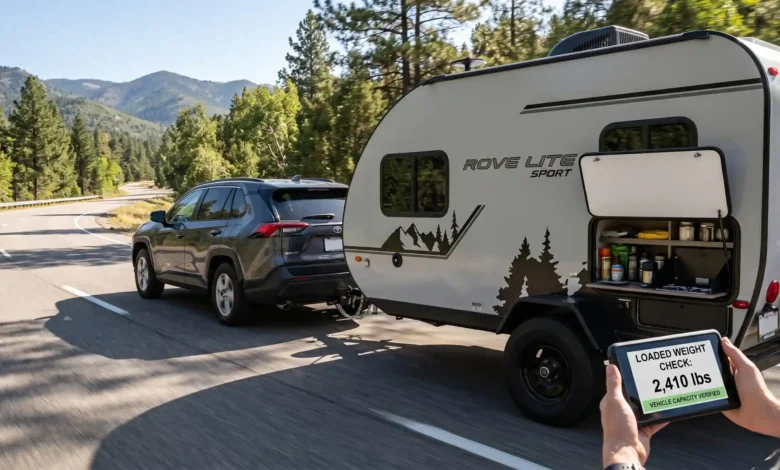
The 2026 Travel Lite Rove Lite Sport 12RK has a verified Unloaded Vehicle Weight (UVW) of 1,550 lbs and a Gross Vehicle Weight Rating (GVWR) of 2,500 lbs. To tow this trailer safely, your vehicle must be rated for the 2,500 lb maximum loaded weight, as gear, water, and propane quickly use the 930 lb cargo capacity.
Key Takeaways
- Unloaded Vehicle Weight (UVW): 1,550 lbs (Empty).
- Max Loaded Weight (GVWR): 2,500 lbs (Limit).
- Cargo Carrying Capacity (CCC): 930 lbs.
- Dry Tongue Weight: 190 lbs.
- Construction: 100% Wood-free composite.
- The Safety Rule: Always match your tow vehicle to the 2,500 lb GVWR, not the dry weight.
Quick Start: Can You Tow It?
If your vehicle has a 2,000 lb towing limit, which is common for many base-model crossovers, you cannot safely tow the Rove Lite 12RK at its full capacity. While the trailer starts at 1,550 lbs, once you add water, propane, and camping gear, you will likely exceed your car’s limit. For a safe experience, your vehicle should be rated for at least 2,500 lbs, though 3,000 lbs is better for mountain driving.
The 2026 Rove Lite 12RK Weight Specification Table
Before you visit a dealership, you need to understand the hard numbers. These specifications represent the baseline for the 2026 model year.
| Weight Metric | Pounds (lbs) | Why It Matters |
| Unloaded Weight (UVW) | 1,550 | The weight of the trailer exactly as it leaves the factory. |
| Max Loaded Weight (GVWR) | 2,500 | The absolute maximum the trailer can weigh for safe travel. |
| Cargo Capacity (CCC) | 930 | The total weight you can add in gear, food, and fluids. |
| Hitch (Tongue) Weight | 190 | The downward pressure placed on your vehicle’s hitch. |
Understanding UVW vs. GVWR
The Unloaded Vehicle Weight (UVW) is often called “dry weight.” It does not include the weight of fresh water in the tanks, propane in the bottles, or the dealer-installed battery. The Gross Vehicle Weight Rating (GVWR) is the most important number because it is the safety ceiling for the trailer’s axle and tires.
Cargo and Fluid Limits
With 930 lbs of cargo capacity, the 12RK is generous for its size. However, this capacity disappears fast. A single battery, a full propane tank, and a full fresh water tank can easily consume the first 150 to 200 lbs of that limit before you even pack a suitcase.
Why “Dry Weight” is a Marketing Trap for Small SUV Owners
RV dealerships and brochures often highlight the 1,550 lb “Dry Weight” because it makes the trailer look compatible with almost any vehicle. This is technically true when the trailer is empty, but trailers are rarely towed empty.
The Hidden Weight of Water and Gear
In the US, fresh water weighs approximately 8.34 lbs per gallon. If you fill the 10-gallon fresh water tank on the 12RK, you have immediately added over 83 lbs to your tow load. When you add a 40 lb battery and 20 lbs of propane, your “dry” trailer is now over 1,700 lbs before you have added a single sleeping bag or cooler.
Common Mistake: Buying a trailer based on the “Dry Weight” and assuming you have “plenty of room” for your gear.
Following Federal Safety Standards
The NHTSA Towing Guide emphasizes that safety depends on the fully loaded weight. As noted by the NHTSA (2026), “USA towing safety guidelines dictate that a tow vehicle’s maximum towing capacity must safely exceed the trailer’s fully loaded weight.” If your trailer weighs 2,300 lbs on the road but your car is only rated for 2,000 lbs, you are risking a transmission failure or a dangerous sway event.
Safety Percentages and the 12RK
A safe towing setup requires that your hitch weight remains between 10% and 15% of the total trailer weight. For the 12RK, this means your hitch should stay between 250 lbs and 375 lbs when you are fully loaded. If you put too much heavy gear in the very back of the trailer, the hitch weight drops, which can cause the trailer to fishtail at highway speeds.
Tow Vehicle Compatibility: Can Your Car Pull the 12RK?
A common rule of thumb in the towing industry is the “80% Rule.” This means you should aim to keep your fully loaded trailer at or below 80% of your tow vehicle’s maximum rated capacity. This provides a safety buffer for steep inclines, high winds, and emergency braking.
If the 2026 Rove Lite 12RK reaches its maximum weight of 2,500 lbs, an ideal tow vehicle should be rated to handle at least 3,100 lbs.
While many popular US crossovers like the Toyota RAV4, Honda CR-V, or Subaru Forester have specific trims that can tow between 1,500 and 3,500 lbs, you cannot rely on the marketing brochure. A base model might only be rated for 1,500 lbs, making it entirely unsafe for the 12RK once you add cargo.
Pro Tip: Verify your specific tow vehicle’s Gross Combined Weight Rating (GCWR) on the driver’s side door sticker. The owner’s manual often lists a generic maximum towing number that assumes a driver with no passengers. Your specific trim level, transmission, and passenger weight directly lower your real-world towing capacity.
How Construction Materials Impact the 12RK Weight
The primary reason the Rove Lite 12RK maintains a relatively low starting weight of 1,550 lbs is its specialized build. [Travel Lite RV Official uses a wood-free composite construction for this series. Traditional travel trailers use wood framing and paneling, which is heavy and susceptible to water rot.
By using composite materials, the manufacturer removes hundreds of pounds from the frame and walls. However, lighter materials in the walls do not change the heavy reality of the steel chassis, the axles, and the appliances inside.
The “Offroad Package” Weight Deduction
If you select optional dealership upgrades, you must recalculate your available weight. For example, opting for an off-road package generally adds 15-inch all-terrain tires, a raised suspension, and heavy-duty fenders.
Because the trailer’s structural GVWR remains capped at 2,500 lbs, any heavy factory options you add will physically increase your Unloaded Vehicle Weight (UVW). This directly subtracts from your 930 lb cargo allowance.
Mid-Article Summary: The 2,500 lb Rule
- Do not rely on the 1,550 lb dry weight to choose your tow vehicle.
- Plan for the 2,500 lb GVWR, which is the maximum safe weight for the trailer’s axle.
- Your cargo capacity is 930 lbs, but water, propane, and batteries consume this fast.
- Check your vehicle’s door sticker to ensure your Gross Combined Weight Rating (GCWR) can handle the loaded trailer plus your family.
3 Critical Weight Safety Checks Before You Tow
Before you sign the paperwork at the dealership or hitch up for your first trip, run through this required safety checklist.
1. Check the Physical VIN Sticker on the Lot Never trust the glossy brochure or the website listing for the exact weight of the unit sitting on the lot. Factory options change the final weight. Find the physical yellow and white weight sticker (usually located on the front driver-side exterior of the trailer or inside the screen door) to verify the exact UVW of that specific VIN.
2. Calculate Your Loaded Tongue Weight The brochure lists a 190 lb hitch weight for the 12RK. That is based on an empty trailer. To prevent dangerous trailer sway at highway speeds, your fully loaded tongue weight needs to sit between 10% and 15% of the total loaded trailer weight. If your trailer weighs 2,000 lbs with your gear, your hitch weight needs to be between 200 and 300 lbs.
3. Weigh the Unit at a CAT Scale The only way to know your exact towing numbers is to use a certified truck scale. Load your tow vehicle with your family, pets, and gear. Load the 12RK with your camping supplies and typical water levels. Drive to a local truck stop and pull onto the CAT Scale to ensure neither your trailer axle nor your tow vehicle’s rear axle exceeds federal safety limits.
Summary
The 2026 Travel Lite Rove Lite Sport 12RK is an excellent option for owners of capable mid-size SUVs and light trucks, provided they understand the math. While the 1,550 lb dry weight is appealing, safe towing requires preparing for the 2,500 lb GVWR. Ignoring the weight of your cargo, water, and optional upgrades can quickly put you over your vehicle’s legal and mechanical limits.
Next Steps for Buyers:
- Open your tow vehicle’s driver-side door and locate the yellow payload and GCWR sticker.
- Inspect your vehicle’s current hitch receiver to verify it is rated for at least a Class II (3,500 lb) load.
- When viewing a 12RK in person, check the factory weight sticker to see exactly how much cargo capacity remains after dealer upgrades.
FAQs
What is the tongue weight of a 2026 Rove Lite 12RK?
The baseline, unloaded tongue weight is listed at 190 lbs. However, once you add a battery, full propane tanks, and load gear into the front storage, your real-world tongue weight will likely sit between 250 and 350 lbs.
Does the 2026 Rove Lite 12RK have brakes?
Most trailers approaching a 2,500 lb GVWR require electronic trailer brakes depending on the state. Many US states require independent trailer brakes for anything weighing over 1,500 to 3,000 lbs. Check your local state towing regulations and ensure your tow vehicle has a brake controller installed.
Can a Toyota RAV4 tow a Rove Lite 12RK?
It depends entirely on the trim. A base RAV4 rated for 1,500 lbs cannot safely tow the 12RK. The RAV4 TRD Off-Road or Adventure trims, which are rated for 3,500 lbs, can safely tow the 12RK even fully loaded to its 2,500 lb GVWR.
How much does water add to the Rove Lite weight?
Fresh water weighs roughly 8.34 lbs per gallon. Filling a standard 10-gallon fresh water tank will immediately add over 83 lbs to your towing weight, not including the weight of water in the water heater tank.
What is the difference between Rove Lite Sport and Classic weights?
Different trim levels include different standard features. A “Sport” or off-road oriented trim generally weighs more than a base model due to heavier all-terrain tires, raised axles, and protective exterior molding, which lowers the available cargo capacity.
Is the Rove Lite 12RK wood-free?
Yes, the Travel Lite Rove Lite series is known for utilizing a completely wood-free composite construction in its walls and roof, which prevents rot and keeps the baseline weight low.
What happens if I exceed the 2,500 lb GVWR?
Exceeding the Gross Vehicle Weight Rating stresses the trailer’s frame, axle, and tires beyond their engineered limits. This can cause tire blowouts, axle bending, severe trailer sway, and mechanical failure of your tow vehicle’s transmission or brakes.
References
- NHTSA (National Highway Traffic Safety Administration) — 2026
- Travel Lite RV Official — 2026
- RVUSA — 2026
- Wilkins RV — 2026