
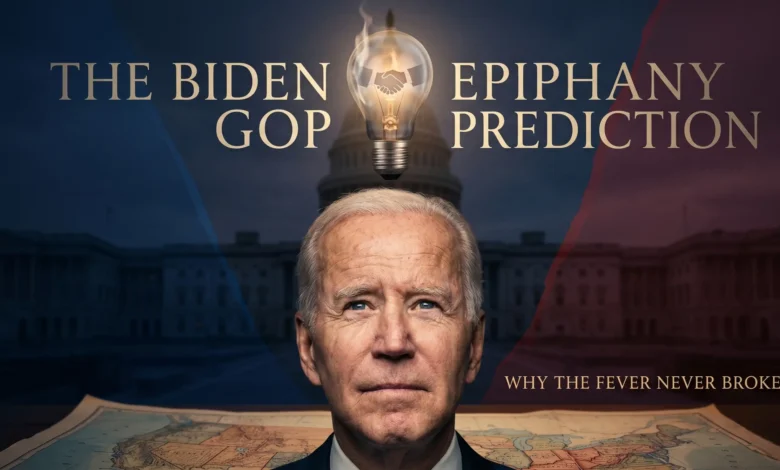
The Biden GOP Epiphany Prediction: Why the Fever Never Broke
In 2020, Joe Biden campaigned on a specific, hopeful vision for the United States. He argued that the intense political division of the era was an anomaly. He believed that once Donald Trump was no longer in the White House, Republican lawmakers would experience an “epiphany” and return to traditional cooperation.
Now, looking back from 2026, we can see how that prediction shaped the early Biden administration and where it met the hard reality of modern polarization. This retrospective examines the timeline of that quote and why the political “fever” remained.
What was the Biden GOP Epiphany Prediction?
The Biden GOP epiphany prediction was the belief that Republican lawmakers would return to bipartisan cooperation once Donald Trump left the White House. While President Biden maintained this optimism through early 2021, persistent legislative gridlock and Donald Trump’s 2024 election victory confirmed that the predicted political “fever” did not break.
Key Takeaways
- The Origin: Joe Biden first predicted a Republican “epiphany” during his 2020 campaign.
- The Timeline: In March 2021, he suggested the change would happen by 2022.
- Senate Roots: The prediction was based on Biden’s decades of experience in a less polarized U.S. Senate.
- The Exception: The 2021 Infrastructure Bill was a rare moment of the cooperation he expected.
- The Conclusion: The 2024 election results proved that the GOP remained closely aligned with Donald Trump.
Quick Answer: The Epiphany Timeline
| Date | Event | Significance |
| 2019–2020 | Campaign Speeches | Biden first uses the “epiphany” and “fever break” language. |
| March 2021 | White House Presser | Biden sets a window for the epiphany: “between now and 2022.” |
| Nov 2021 | Infrastructure Bill | A rare $1.2 trillion bipartisan success occurs. |
| Nov 2024 | Presidential Election | Donald Trump’s victory ends the “epiphany” narrative. |
What Was the Biden GOP Epiphany Prediction?
Joe Biden built his 2020 platform on the idea that he could “restore the soul of the nation.” A big part of that restoration involved making Congress work again. He told voters that Republicans were under a temporary “fever” caused by the Trump presidency.
The 2020 Campaign Promise
During the primary and general elections, Biden repeatedly claimed that his former Republican colleagues would change their behavior once the “shadow” of Donald Trump was removed. He positioned himself as the antithesis of Trump, someone who could reach across the aisle because of his 36 years in the Senate.
Biden’s decades of experience in the Senate, an era where opposing parties often socialized and compromised, led him to believe that the current gridlock was personal rather than structural. He viewed bipartisanship (when two opposing parties find common ground) as a natural state that Washington would eventually return to.
The March 2021 Reiteration
Even after the events of January 6, 2021, President Biden did not immediately abandon this hope. In his first formal press conference in March 2021, he doubled down on the prediction. He told reporters that he believed an epiphany would arrive “between now and 2022.”
Expert Quote: Biden predicted the epiphany would arrive “between now and 2022.” (Associated Press, 2021)
This timeline was vital. It suggested that after a year of his presidency, the Republican party would realize that cooperation was more popular or effective than total opposition.
The Legislative Reality: 2021 to 2024
The reality of governing proved much more difficult than the campaign trail suggested. Instead of a broad epiphany, the Biden administration encountered a Republican party that remained largely unified in its opposition to his core domestic agenda.
Partisanship and Gridlock
Major initiatives, such as voting rights legislation and the “Build Back Better” plan, faced total Republican opposition in the Senate. This forced the Biden administration to rely on a process called budget reconciliation. This tool allows certain spending bills to pass with a simple majority (51 votes) rather than the usual 60 required to overcome a filibuster.
Common Mistake: Many observers assume Biden’s term was entirely gridlocked. In reality, he passed significant legislation, but he did so mostly using narrow Democratic majorities rather than the broad GOP support he predicted.
The Comparison: Expectations vs. Reality
| Biden’s Expectation | Legislative Reality (2021–2024) |
| GOP lawmakers would break from Donald Trump. | Trump remained the dominant influence on GOP policy and voting. |
| Bipartisan consensus would become the “norm.” | Most major bills passed on strict party-line votes. |
| The political “fever” would break by 2022. | Polarization increased leading into the 2024 cycle. |
While the “fever” did not break, there were small cracks in the wall of opposition. These exceptions provided the only evidence that Biden’s old-school Senate approach still had some life left in it.
The Infrastructure Exception: A Case Study in Bipartisanship
While the broad “epiphany” Biden hoped for never arrived, his term was not a total stalemate. There were moments when his old-school Senate approach, focusing on local benefits rather than national ideology, actually worked.
The $1.2 Trillion Infrastructure Success
In November 2021, Biden signed the Infrastructure Investment and Jobs Act. This was a significant moment because it gained actual bipartisan support in a deeply divided Congress.
Real Example: The bill passed the Senate with a 69-30 vote. Nineteen Republicans joined every Democrat to approve the funding. This showed that for specific, high-value projects like roads and bridges, the “fever” could subside for a moment.
Case Study: Why the Infrastructure Bill Passed
This bill succeeded where others failed because it focused on “kitchen table” issues.
- Localized Funding: Money was earmarked for specific state projects, making it hard for local senators to vote “no.”
- Economic Impact: It was framed as a jobs creator and a necessity for American competition.
- Political Cover: Because it was separate from more controversial social spending, it gave moderate Republicans a way to support a major bill without supporting the entire Biden agenda.
Pro Tip: Avoid labeling the Biden era as entirely gridlocked. Referencing specific wins like the Infrastructure Bill or semiconductor policy provides a more accurate historical record than a simple “failure” narrative.
Why the “Fever” Didn’t Break: The 2024 Election and Beyond
The core of Biden’s prediction was that the Republican party would move away from Donald Trump’s influence after his 2020 defeat. However, political data from 2022 through 2026 shows the opposite happened.
The 2022 Midterm Turning Point
The 2022 midterms were supposed to be the deadline for the GOP epiphany. Instead of a break from the past, the election cycle saw a Republican base that remained largely loyal to “America First” candidates. This signaled to the White House that the internal GOP dynamics were not returning to the pre-2016 status quo.
The 2024 Election Conclusion
The most definitive proof that the “fever” remained was the 2024 presidential election. Donald Trump not only secured the Republican nomination but won a non-consecutive term in the White House.
Real Example: The 2024 election outcome saw the GOP win the popular vote and control of both the Senate and the House. This victory effectively ended the theory that the Republican party would have an “epiphany” and move back toward the center-left’s version of bipartisanship.
Pro Tip: To understand why the prediction failed, look at the change in Republican primary voters. The base of the party shifted toward populist nationalism, making the “Senate-style” consensus Biden remembered less relevant to modern voters.
Fact vs. Fiction: Assessing the 2020 Rhetoric
When evaluating these political predictions, it is important to separate what was actually said from what people assume happened behind the scenes.
What Is Confirmed vs. Unconfirmed
We can confirm the dates and wording of Biden’s public statements. However, other details remain unknown.
- Confirmed: Biden repeatedly used the terms “epiphany” and “fever break” as central themes of his governing philosophy.
- Unconfirmed: There is no verified data on the exact date the Biden administration internally “gave up” on the epiphany idea.
- Unconfirmed: We cannot assume that private GOP sentiments ever matched the public cooperation Biden predicted.
Practical Tooling: Fact vs. Fiction Checklist
| Claim | Status | Source |
| Biden predicted GOP cooperation by 2022. | Confirmed | AP News (2021) |
| The Infrastructure Bill had zero GOP support. | False | Senate Records (2021) |
| Trump’s 2024 win proved the “fever” remained. | Confirmed | The Guardian (2026) |
| Biden secretly planned to end bipartisanship. | Unconfirmed | No verified data |
Pro Tip: Cross-reference political quotes with the exact context and date. Campaign promises are often more optimistic than the reality of governing, and identifying that gap is key to accurate analysis.
Mid-Article Summary
- The Infrastructure Bill was the only major example of the “epiphany” occurring in practice.
- The 2022 midterms showed that the GOP base was not shifting away from Donald Trump.
- The 2024 election served as the final evidence that the “fever break” prediction was a miscalculation.
- Current 2026 data shows a political landscape that remains more polarized than in Biden’s early Senate years.
Conclusion: The Legacy of a Prediction
As of 2026, Joe Biden is out of office, and the American political system is led by a second Trump administration. The “epiphany” quote is now viewed by historians as a symbol of a bygone era of politics. While it helped Biden win in 2020 by promising a return to “normalcy,” it failed to account for the deep structural changes in how modern political parties and their voters interact.
The prediction serves as a reminder that in modern Washington, policy is rarely shaped by personal epiphanies, but rather by the intense demands of a polarized electorate.
Next Steps for Readers:
- Review the Infrastructure Bill: Look at the specific projects funded in your state to see bipartisan policy in action.
- Compare Voting Records: Check current 2026 Senate voting patterns to see how they differ from the 2021-2024 period.
- Monitor the 2026 Midterms: Watch for any signs of party realignment as the current administration moves toward its first major electoral test.
FAQs
When did Joe Biden first mention the “epiphany” prediction?
He began using the phrase during his 2020 campaign, notably suggesting it would happen once Donald Trump was out of office.
What did the “fever breaking” mean?
It was Biden’s metaphor for the Republican party moving away from populism and returning to traditional, bipartisan legislative cooperation.
Did any major bills actually pass with GOP support?
Yes. The $1.2 trillion Infrastructure Investment and Jobs Act (2021) passed with significant Republican support in the Senate.
Why did the prediction fail?
Most analysts point to the continued influence of Donald Trump over the GOP base and the increased polarization of the American electorate.
How did the 2024 election impact this narrative?
Donald Trump’s 2024 victory and the GOP’s success in Congress proved that the “fever” did not break and that the party had not experienced the predicted epiphany.
Was the “epiphany” quote a campaign mistake?
While it helped win over moderate voters in 2020, it is often cited as a miscalculation of how much Washington had changed since Biden’s early career.
Is the U.S. still polarized in 2026?
Yes. Current political data suggests that polarization remains at high levels under the current administration.
Referen
- Associated Press, 2021
- Miller Center, 2021
- United States Studies Centre, 2022
- The Guardian, 2026
- Protiviti US, 2021
- Bournemouth University, 2025