

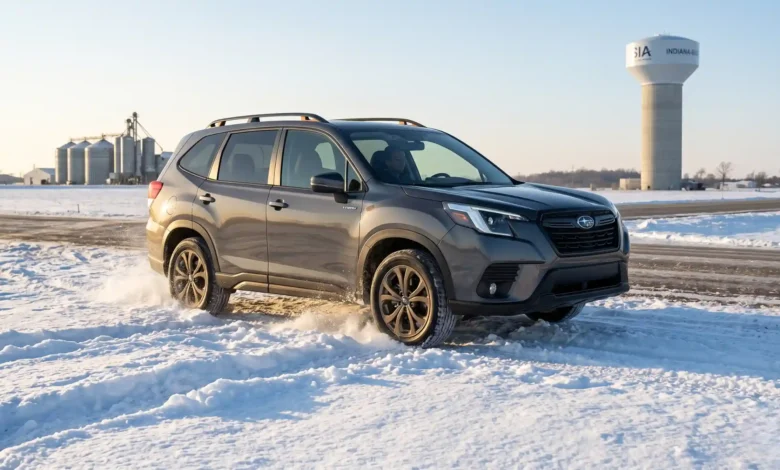
2026 Subaru Forester Hybrid: 35 MPG Meets Real Mechanical AWD
The 2026 Subaru Forester Hybrid marks a significant shift for the brand and its US fans. For the first time, a Subaru hybrid is rolling off assembly lines in Lafayette, Indiana. This vehicle aims to solve the classic trade-off: getting high fuel economy without losing the rugged, all-weather traction Subaru is known for.
The 2026 Subaru Forester Hybrid starts at $34,730 and achieves an EPA-estimated 35 MPG combined. Unlike many hybrid SUVs that use a secondary electric motor for the rear wheels, the Forester Hybrid retains a mechanical Symmetrical All-Wheel Drive system paired with a 2.5L Boxer engine, offering a total driving range of 581 miles.
Key Takeaways
- US-Built: Manufactured at the Subaru of Indiana Automotive (SIA) plant.
- Fuel Efficiency: 35 MPG combined, a 40% increase over the gas-only model.
- Mechanical AWD: Uses a physical driveshaft for consistent power to all four wheels.
- Range: Up to 581 miles on a single full tank of gas.
- Modern Tech: Standard 11.6-inch center screen and 12.3-inch digital gauges.
Quick Answer: Is the Forester Hybrid Right for You?
If you want an SUV that handles deep snow and mud like a traditional truck but sips fuel like a sedan, this is a strong contender. It is ideal for families who prioritize safety and traction over pure speed. However, if you need to tow more than 1,500 pounds, you may need to look at larger rivals.
The Indiana Milestone: Why “Made in the USA” Matters
The 2026 Forester Hybrid is the first Subaru hybrid vehicle manufactured in the United States. While previous Subaru hybrids were imported, this model is built alongside the Outback and Ascent in Indiana. This shift helps Subaru manage the high demand in the American market more effectively.
Boosting Local Production
By moving production to the Subaru of Indiana Automotive (SIA) plant, the brand has integrated hybrid technology directly into its US supply chain. This move was not overnight; it required years of preparation and facility upgrades.
“Bringing hybrid vehicle assembly to our facility has been in the works for five years,” says Scott Brand, President of SIA. He noted that seeing the start of mass production is “the culmination of a lot of hard work by our associates.”
A Focus on US Drivers
Building the car in Indiana allows Subaru to tune the vehicle specifically for American roads and weather. Since the US is Subaru’s largest market, this local assembly ensures that the Forester Hybrid meets the specific durability standards that American buyers expect from an “outdoor” brand.
Powertrain & Performance: 35 MPG and the Boxer Engine
Under the hood, the Forester Hybrid uses a specially developed 2.5-liter Boxer engine paired with two electric motors. This system creates a total of 194 horsepower. While that might sound modest, the electric motors provide instant torque (turning force), which helps the SUV feel punchy when pulling away from a stoplight.
Efficiency Gains
The main reason to choose the hybrid is at the pump. The system delivers 35 MPG combined, which is 35 MPG in the city and 34 MPG on the highway. This is a 40% improvement in fuel economy compared to the non-hybrid 2026 Forester.
Common Mistake: Don’t assume all hybrids are slow. While the Forester Hybrid isn’t a race car, the electric assistance makes it more responsive in city traffic than the standard gasoline version.
Range and Refinement
Because of this efficiency, the Forester Hybrid can travel up to 581 miles on a single tank. This makes it an excellent choice for long American road trips where gas stations might be far apart. The power moves through a Lineartronic Continuously Variable Transmission (CVT), which Subaru has refined to reduce the “droning” noise often associated with these types of gearboxes.
Pro Tip: If you are coming from a traditional gas SUV, you will notice the car is much quieter at low speeds because it often runs entirely on battery power during parking lot maneuvers or slow commutes.
The Technical Edge: Mechanical vs. Electronic AWD
Most hybrid SUVs on the market today use an “electronic” all-wheel-drive system. This means the gasoline engine powers the front wheels, while a separate electric motor handles the back. There is no physical connection between the two. Subaru took a different path with the 2026 Forester Hybrid by sticking to a mechanical Symmetrical All-Wheel Drive system.
Why a Physical Connection Matters
By using a physical driveshaft to connect the front and rear axles, the Forester Hybrid can send power to the wheels that need it almost instantly. In electronic systems, there can sometimes be a slight delay while sensors “decide” to turn on the rear motor. For drivers in the US “Snow Belt” or those navigating muddy trails, this mechanical link provides more predictable traction.
Mini Case Study: Traction Recovery
Imagine you are driving up a steep, icy driveway. In a “typical scenario,” an electronic AWD system might allow the front tires to spin briefly before the rear motor kicks in. Because the Forester Hybrid has a physical connection, torque is distributed across all four wheels more evenly from the start, reducing the chance of getting stuck in a rut.
AWD Decision Tool: Which System Do You Need?
| If you drive in… | Recommended AWD Type | Why? |
| Occasional rain / Light suburbia | Electronic AWD (Competitors) | Slightly lighter weight; fine for basic slickness. |
| Deep snow / Unpaved hills | Mechanical AWD (Forester) | Immediate, consistent torque to all four wheels. |
| Frequent off-roading | Mechanical AWD (Forester) | Better heat management during heavy trail use. |
2026 Forester Hybrid Trim Levels & May 2026 Pricing
Subaru has streamlined the hybrid lineup into four distinct trims. Each one comes standard with the hybrid powertrain and Symmetrical AWD. Below is the updated pricing for the US market as of May 2026.
May 2026 Pricing & Trim Matrix
| Trim Level | Starting MSRP | Key Features |
| Premium | $34,730 | 11.6″ screen, Wireless Apple CarPlay/Android Auto |
| Sport | $37,930 | 19″ bronze wheels, sport-tuned suspension |
| Limited | $39,430 | Leather-trimmed seats, Power rear gate |
| Touring | $41,545 | 360-degree camera, Ventilated front seats |
Pro Tip: For many buyers, the Sport Hybrid is the “sweet spot.” It offers a more aggressive look with bronze accents without the $4,000 price jump to the top-tier Touring model.
Interior Tech and Daily Utility
Inside, the Forester Hybrid mirrors the high-tech feel of the rest of the 2026 lineup. Drivers sit behind a 12.3-inch full digital gauge cluster that shows hybrid power flow in real-time. The center of the dash features the 11.6-inch STARLINK Multimedia Navigation system, which is standard on all hybrid trims.
No Sacrifice on Space
A common worry with hybrids is that the battery pack will eat up trunk space. Subaru engineers integrated the battery into the chassis in a way that preserves the Forester’s famous cargo capacity. You still get a wide rear opening and a flat load floor, making it easy to haul camping gear or groceries.
Pro Tip: Use the MySubaru app to “pre-condition” your cabin. You can start the climate control while the car is still in the driveway to save battery range once you start driving.
Towing and Limitations: Is it Right for You?
While the Forester Hybrid excels in efficiency and traction, it does have a specific limit that buyers should note. The towing capacity is rated at 1,500 pounds. This is lower than some non-hybrid SUVs and significantly less than the 3,500-pound limit found on some rivals like the RAV4 Hybrid.
Towing Capability Checklist
Before you buy, check your gear against these weight limits:
- Safe to Tow: Two mountain bikes on a hitch rack, a small aluminum utility trailer, or a single kayak.
- Not Recommended: Large fiberglass boats, dual-axle campers, or heavy horse trailers.
Common Warning: Exceeding the 1,500-pound limit can put excessive strain on the hybrid’s CVT and electric motors, potentially voiding parts of your warranty.
Mid-article Summary: Forester Hybrid At-a-Glance
- Price Range: $34,730 to $41,545.
- Power: 194 HP from a 2.5L Boxer engine + dual motors.
- Traction: True mechanical Symmetrical AWD.
- Efficiency: 35 MPG combined / 581-mile total range.
End Summary: The Verdict
The 2026 Subaru Forester Hybrid is a calculated move by a brand that knows its audience. By keeping the mechanical AWD system and building the car in Indiana, Subaru has ensured that “going green” doesn’t mean “getting stuck.” It isn’t the fastest SUV in its class, and it won’t tow a heavy boat, but for the average US family facing winter weather, it offers a blend of ruggedness and efficiency that is hard to find elsewhere.
Next Steps for Buyers:
- Check your hitch: If you plan to tow, verify that your trailer weighs less than 1,500 lbs fully loaded.
- Compare Trims: Visit a local dealer to see if the leather upgrades in the Limited are worth the $4,700 premium over the base model.
- Test the AWD: Schedule a test drive on a rainy day or unpaved road to feel how the mechanical system engages compared to your current vehicle.
FAQs
Where is the 2026 Forester Hybrid made?
It is manufactured at the Subaru of Indiana Automotive (SIA) plant in Lafayette, Indiana.
What is the real-world MPG of the 2026 Forester Hybrid?
The EPA estimates it at 35 MPG combined, with 35 MPG in the city and 34 MPG on the highway.
How much can the 2026 Subaru Forester Hybrid tow?
The maximum towing capacity is 1,500 pounds.
Does the Forester Hybrid have a spare tire?
Yes, unlike many hybrids that use a repair kit to save weight, Subaru has maintained space for a spare tire.
What is the ground clearance of the 2026 hybrid model?
It maintains Subaru’s standard 8.7 inches of ground clearance, making it capable of light off-roading.
How does it compare to the Toyota RAV4 Hybrid?
The Forester offers a mechanical AWD system, whereas the RAV4 Hybrid uses an electric rear motor. The RAV4 has a higher towing capacity (3,500 lbs).
Is the 2026 Forester Hybrid a plug-in (PHEV)?
No, it is a standard hybrid that recharges its battery through the engine and braking; it does not need to be plugged in.
References
- Subaru U.S. Media Center, 2026
- Subaru of Indiana Automotive, 2026
- CarPro, 2026
- Edmunds, 2026
- Car and Driver, 2026