

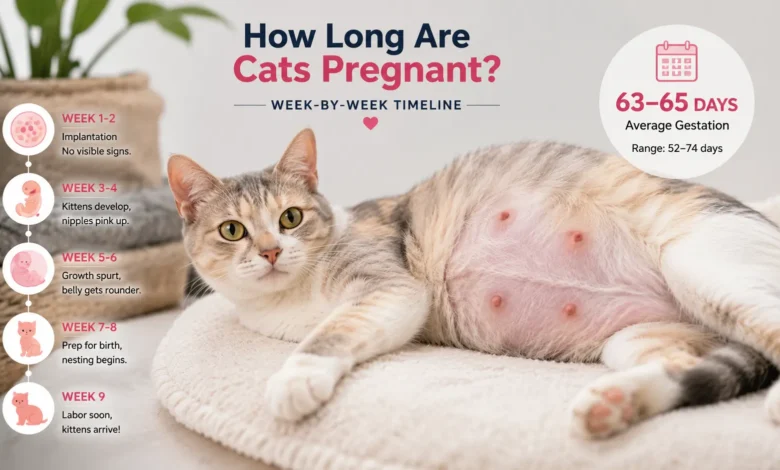
How Long Are Cats Pregnant? Week-By-Week Vet Timeline
Watching your cat prepare for motherhood brings a mix of excitement and anxiety. You want to know exactly when to expect kittens and how to keep the mother safe.
While the standard timeline is about two months, tracking your cat’s exact week-by-week progress is the best way to prevent medical emergencies.
The average gestation period for a domestic cat is 63 to 65 days, or roughly two months. However, veterinary studies show that a healthy feline pregnancy can safely range anywhere from 52 to 74 days. Pregnancies lasting longer than 70 days require immediate veterinary evaluation.
Key Takeaways
- Domestic cats are pregnant for an average of 63 to 65 days.
- A clinically viable pregnancy has a wide range of 52 to 74 days.
- Kittens born before 60 days face serious survival risks.
- Pregnant queens need special diets containing at least 32% protein and 18% fat.
- Eclampsia, a dangerous drop in calcium, can strike pregnant cats 3 to 17 days before birth.
- Veterinarians can usually confirm a pregnancy via ultrasound starting around day 21.
Quick Start: At a Glance
- Average Gestation: 9 weeks (63–65 days)
- First Action Step: Schedule a vet visit around day 21 for an ultrasound confirmation.
- Diet Shift: Transition the mother to a high-protein, high-fat kitten formula immediately.
The True Feline Gestation Period Explained
Most people hear that cats are pregnant for exactly nine weeks. “The gestation period for cats is about two months, or 63–65 days,” according to veterinary experts at PetMD.
But real clinical data shows a slightly wider window. Broad veterinary studies put the statistical average at 65.6 days. A perfectly healthy pregnancy can last anywhere from 52 to 74 days.
This wide range is why tracking the exact dates your cat mated is so helpful for planning.
Common mistake: Assuming any early delivery is safe. Gestation lengths of less than 60 days are generally associated with decreased viability of the kittens.
Typical Scenario Example (Early Delivery):
Imagine a queen delivers her litter at day 58. Because her gestation fell under the 60-day safety threshold, her kittens’ lungs and organs may not be fully developed. They will likely require immediate, intensive veterinary neonatal care and artificial heat support to survive. [American Veterinary Medical Association feline health guidelines]
Cat Pregnancy Timeline: Week-by-Week Development
A cat’s pregnancy moves incredibly fast. Knowing what happens inside the womb helps you prepare your home for the litter.
To track the pregnancy safely, your veterinarian will use three main diagnostic milestones:
- Palpation (Day 17+): The vet gently feels the cat’s abdomen for tiny, marble-sized amniotic sacs.
- Ultrasound (Day 21+): The vet uses sound waves to detect fetal heartbeats and confirm the kittens are alive.
- X-ray (Day 42+): The fetal skeletons calcify, allowing the vet to count the exact number of kittens.
Inside the womb, rapid changes occur halfway through the pregnancy. Fetal length begins to increase significantly at 31 days after mating.
Shortly after, feline placental thickness reaches its peak around 39 days to support the growing litter.
On the outside, you will notice physical changes. The most obvious is “pinking up,” where the queen’s nipples become swollen and bright pink around week three.
Gestation & Diagnostic Timeline
| Week | Days | Fetal & Physical Development | Veterinary Action |
| Week 1-2 | Days 1-14 | Embryos implant in the uterine wall. No visible outward signs. | None required yet. Keep cat indoors. |
| Week 3 | Days 15-21 | Nipples begin “pinking up.” Morning sickness may occur. | Vet can perform gentle abdominal palpation. |
| Week 4 | Days 22-28 | Fetal organs develop rapidly. Queen’s appetite increases. | Ultrasound confirmation to check heartbeats. |
| Week 5 | Days 29-35 | Fetal length increases significantly (Day 31). | Transition to high-protein diet if not already done. |
| Week 6 | Days 36-42 | Placental thickness peaks (Day 39). Abdomen swells noticeably. | None, monitor weight gain. |
| Week 7 | Days 43-49 | Skeletons calcify. Mother begins looking for nesting spots. | X-ray to count exact litter size. |
| Week 8 | Days 50-56 | Kittens develop fur. Mother rests more often. | Set up a whelping box in a quiet room. |
| Week 9 | Days 57-65 | Milk drops may appear. Mother may pace or vocalize. | Monitor closely for active labor signs. |
Mid-Article Summary
- Gestation Average: Expect a 9-week (63-65 day) pregnancy, though up to 74 days can be normal.
- Veterinary Milestones: Confirm pregnancy via palpation (Day 17+), ultrasound (Day 21+), or X-ray (Day 42+).
- Warning Sign: If the pregnancy extends past 70 days without signs of labor, call your veterinarian immediately.
Critical Prenatal Care & Nutrition Targets
A pregnant queen’s dietary demand for protein increases significantly as her body works to grow the litter. Many owners make the mistake of feeding standard adult cat food throughout the pregnancy, which lacks the dense calories she requires.
Pro Tip: Switch your pregnant cat to a specialized kitten formula containing a minimum of 32% protein and 18% fat to support fetal development.
Nutritional Label Verification Test: Flip your cat’s food bag over and find the “Guaranteed Analysis” panel. Look at the crude protein and crude fat percentages. If the protein sits below 32%, you need to find a higher-quality growth formula.
Proper nutrition during gestation sets the kittens up for success after they are born. “Weaning can begin around 4-5 weeks of age and how a kitten is weaned can make a lasting difference,” notes Dr. Lisa Restine, DVM.
By the time of giving birth, a healthy queen should have gained between 12% and 38% of her pre-pregnancy body weight. Avoid overfeeding her beyond this percentage, as excess weight increases the risk of difficult labor.
Recognizing Pregnancy Complications & Pre-Labor Risks
Most feline pregnancies progress smoothly, but sudden medical emergencies require fast action. One of the most severe risks is eclampsia, a dangerous drop in blood calcium levels. Eclampsia can affect pregnant cats 3 to 17 days before giving birth.
Typical Scenario Example (Eclampsia Risk): Ten days before her due date, a heavily pregnant queen begins exhibiting muscle tremors, stiffness, and restlessness. Because this timeline falls squarely in the 3-to-17-day risk window for hypocalcemia, the owner immediately seeks emergency veterinary intervention. [Veterinary partner page on feline hypocalcemia]
Pro Tip — The Calcium Warning: Never arbitrarily supplement your pregnant cat’s diet with calcium without a direct order from your veterinarian. Giving extra calcium can actually disrupt her parathyroid gland and artificially induce eclampsia.
Preparing for Labor (Parturition) at Home
As your cat approaches the 60-day mark, she will start looking for a safe, quiet place to deliver. You can help her by preparing the environment in advance.
Pre-Labor Checklist:
- Set up a whelping box: Line a sturdy, low-sided box with clean, washable blankets or puppy pads.
- Control room temperature: Place the box in a warm, draft-free room away from heavy household traffic.
- Gather emergency supplies: Keep clean towels and a pet-safe heating pad nearby.
- Prepare vet contacts: Save your primary veterinarian’s number and the nearest 24/7 animal emergency clinic’s number in your phone.
Pro Tip: Keep the pregnant queen strictly indoors during her final two weeks. If left outside, she will naturally build a hidden nest, making it impossible for you to monitor her safety during labor.
The Science of Feline Litters: Size and Super-Fecundation
You might wonder how many kittens you will need to find homes for. The average litter size for a domestic cat is 4.0 kittens.
Many people assume that a highly active mating period leads to more kittens. However, clinical studies show that the total number of matings a cat experiences during her estrus cycle does not correlate with her eventual litter size.
Cats do, however, possess a fascinating biological capability called super-fecundation. This phenomenon occurs when offspring in a single litter have entirely different fathers. Because a female cat releases eggs in response to mating, she can mate with multiple males over a few days, resulting in a genetically mixed litter.
End Summary
While the average cat is pregnant for 63 to 65 days, closely tracking her specific timeline ensures her safety. Knowing the clinical signs of labor, scheduling the right diagnostic imaging, and meeting her changing nutritional needs can mean the difference between a healthy delivery and a medical emergency.
Next Steps:
- Check the guaranteed analysis on your cat’s food bag to confirm it hits the 32% protein and 18% fat targets.
- Mark your calendar with the dates you suspect she mated.
- Call your veterinarian to schedule an ultrasound around day 21.
FAQs
How can I tell how far along my pregnant cat is?
A veterinarian can determine how far along a cat is using an ultrasound (after 21 days) or an X-ray (after 42 days), which reveals fetal skeleton development.
Is 70 days too long for a cat to be pregnant?
While a viable pregnancy can last up to 74 days, reaching 70 days without signs of labor warrants an immediate veterinary checkup to ensure the kittens are safe.
Can a cat get pregnant by two different male cats?
Yes. Through a biological process called super-fecundation, a female cat can mate with multiple males during her heat cycle and have a litter of kittens with different fathers.
When can a vet feel kittens in a pregnant cat?
A veterinarian can gently feel (palpate) the kittens in a pregnant cat’s abdomen starting around 17 to 20 days after conception. Owners should not try this at home to avoid injuring the fetus.
What should I feed my pregnant cat?
Feed her a high-quality kitten or growth formula that contains a minimum of 32% protein and 18% fat to support fetal development and milk production.
What are the signs of eclampsia in a pregnant cat?
Signs of eclampsia (dangerously low calcium) include muscle tremors, stiffness, heavy panting, and pacing. It most commonly occurs 3 to 17 days before birth and is a veterinary emergency.
How many kittens are usually in a cat’s first litter?
The average litter size for domestic cats is 4 kittens, though first-time mothers sometimes have slightly smaller litters of 2 or 3.
References
- National Institutes of Health (PMC) — 2021
- National Institutes of Health (PMC) — 2024
- MDPI Veterinary Sciences — 2025
- PetMD — 2024
- Hill’s Pet Nutrition Report — 2026