
Social Security Administration May Payments: Shift Explained
If your household budget relies on federal retirement or disability distributions, a quick glance at the calendar reveals an immediate layout anomaly for May 2026. The Social Security Administration processes millions of monthly transfers, but shifting weekends frequently compress delivery windows at the start of the month. Understanding how the federal weekend-adjustment rules apply to your specific enrollment status and birth date ensures you know exactly when your funds will clear and how to handle unexpected banking delays.
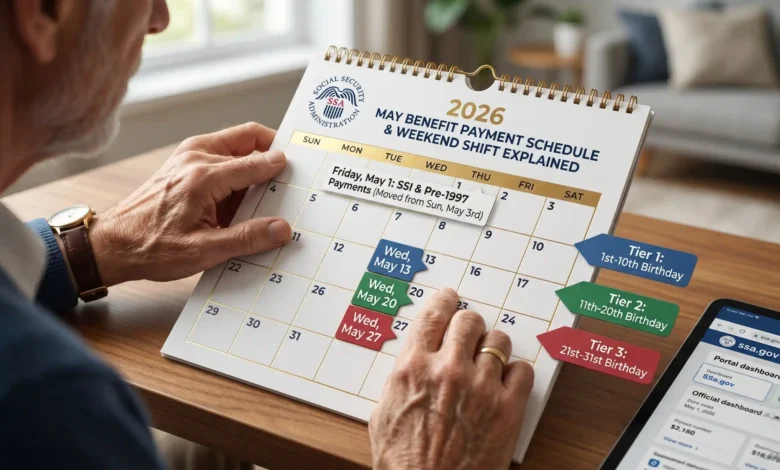
Social Security Administration May payments for 2026 distribute on three specific Wednesdays (May 13, May 20, and May 27) based on your day of birth. However, due to a calendar weekend rule, Supplemental Security Income (SSI) and pre-May 1997 benefit distributions are moved forward to Friday, May 1, 2026.
Key Takeaways
- May 1 Early Alignment: Weekend rules shift multiple benefit classes early to Friday, May 1.
- Arrears Framework: Monthly benefit distributions represent earnings accrued during the prior calendar month.
- Birthday-Based Tiers: Post-1997 direct deposits remain anchored strictly to specific mid-month Wednesdays.
- Three-Day Grace Rule: Federal agencies enforce a mandatory waiting window before tracking lost payments.
- Scam Warning: Automated updates process systematically; the government will never text you to verify data.
Quick Start: The May 2026 Master Payment Matrix
To resolve your timing questions immediately, match your benefit program or birth date against the official federal processing window below.
| Recipient Group | Official Distribution Date | Delivery Method Impact |
| Supplemental Security Income (SSI) Recipients | Friday, May 1, 2026 | Clears early due to the May 1 weekend calendar adjustment. |
| Beneficiaries Enrolled Before May 1997 | Friday, May 1, 2026 | Shifted forward from Sunday, May 3. |
| Birth Dates: 1st – 10th | Wednesday, May 13, 2026 | Standard second-Wednesday electronic fund transfer. |
| Birth Dates: 11th – 20th | Wednesday, May 20, 2026 | Standard third-Wednesday electronic fund transfer. |
| Birth Dates: 21st – 31st | Wednesday, May 27, 2026 | Standard fourth-Wednesday electronic fund transfer. |
May 2026 Operational Distribution Finder
-
Pre-May 1997 Status Check: Did your distribution enrollment initiate prior to May 1, 1997? If yes, your payment went out early on Friday, May 1, 2026.
-
Supplemental Income Status Check: Do you receive Supplemental Security Income (SSI)? If yes, your funds processed on Friday, May 1, 2026.
-
Standard Birthday Tier Matrix: If your enrollment post-dates 1997 and you do not receive SSI, identify your date by your birthday:
- Birth date lands on the 1st through 10th: Wednesday, May 13, 2026
- Birth date lands on the 11th through 20th: Wednesday, May 20, 2026
- Birth date lands on the 21st through 31st: Wednesday, May 27, 2026
How the Arrears System Shapes Your Benefits
Accounting Framework
The federal benefit architecture operates entirely on a system called payments in arrears. This means that any monthly payment you receive represents benefits that accrued during the previous calendar month. For example, the checks distributed throughout the month of May are actually covering your living expenses and allocations accrued during April.
Treasury Execution
Once the Social Security Administration calculates these allocations, the United States Department of the Treasury takes over execution. The Treasury issues the massive data files directly to the Federal Reserve clearing systems to authorize the electronic funds transfers. Because these files are automated, the money routes along strict institutional clearing schedules rather than manual processing queues. You can monitor your specific authorization statuses online via the My Social Security Portal.
The May 1 “Double Wave”: SSI and Pre-1997 Allocations
Statutory SSI Distribution Rules
Supplemental Security Income, or SSI, provides financial assistance to individuals with limited income or disabilities. By statutory law, the standard rules require these payments to distribute on the very first day of the calendar month. For the May 2026 operational cycle, May 1 falls perfectly on a Friday, allowing the federal system to push these payments out exactly on time.
The Weekend Shift Impact Explained
The calendar gets more interesting for beneficiaries who began receiving payments prior to May 1997, or those who collect both standard retirement and SSI simultaneously. Normally, the system schedules this group for payment on the third day of the month.
However, whenever a scheduled date lands on a weekend or a federal holiday, an automatic safety rule triggers. The regulations force the distribution to move to the closest preceding business day. Because May 3, 2026, falls on a Sunday, the system automatically adjusts the transfer date backward.
Common Mistake: Many beneficiaries see two payments arrive on May 1 and assume the government made an accounting error or issued a bonus check. In reality, this “double wave” is simply your regular SSI and your adjusted pre-1997 retirement benefit clearing on the same day due to the weekend rule. No extra money is being provided, and no payment will arrive later in the month for these groups.
Real-World Calendar Adjustment Impact
Consider the case of a retired factory worker who qualified for benefits in 1994. Under normal rules, this recipient looks for their money on the third of each month. Because May 3, 2026, is a Sunday, their payment safely cleared early on Friday, May 1, 2026, aligning perfectly with the standard SSI release.
Post-1997 Enrollments: The Wednesday Birthday Tiers
Tier 1: Birth Dates 1st – 10th
If you applied for benefits after May 1997 and do not receive Supplemental Security Income, your payment tracks a rolling calendar schedule. The system organizes distribution into three blocks based on the day of the month you were born. The first block covers individuals with birth dates falling between the 1st and the 10th. For this group, the Treasury transmits funds on the second Wednesday of the month, which marks your deposit day as Wednesday, May 13, 2026.
Tier 2: Birth Dates 11th – 20th
The second distribution block targets beneficiaries born between the 11th and the 20th of any given month. The agency coordinates this transfer on the third Wednesday of the month.
A claimant born on May 15, 1958, falls directly within this mid-month structural group. Their regular monthly retirement payment was officially sent on the third Wednesday, which fell on Wednesday, May 20, 2026.
Tier 3: Birth Dates 21st – 31st
The final tier consists of recipients with birth dates landing from the 21st through the 31st. This group receives allocations on the fourth Wednesday of the calendar cycle. For the May cycle, this distribution processes on Wednesday, May 27, 2026. If you fall into this bracket, your processing date remains fixed to this specific Wednesday regardless of when your application was formally approved.
Mid-Article Summary Box
- Early Payments: SSI and pre-1997 accounts hit banks early on May 1 due to the weekend rule.
- Standard Cycle: All other accounts clear on May 13, May 20, or May 27 depending strictly on your birth date.
- Direct Source Check: Always use your secure online profile dashboard to track personal transaction statuses.
Financial Operational Rules for 2026
Payroll Tax Deductions and Threshold Caps
The operational logistics of the Social Security Trust Funds rely directly on annual statutory caps. For the 2026 calendar year, individual earnings up to a maximum taxable threshold of $184,500 are subject to the standard payroll tax. Any wage totals exceeding this specific $184,500 ceiling limit are fully exempt from individual employee Old-Age, Survivors, and Disability Insurance deductions.
OASDI Contribution Rate Parameters
Under current federal law, the combined Old-Age, Survivors, and Disability Insurance payroll tax rate stands at 12.4 percent. This contribution index is split equally, meaning the employer and the employee each pay 6.2 percent. Independent fiscal reviews, such as the Penn Wharton Budget Model Fiscal Overviews, track how these contribution caps maintain system liquidity amidst changing worker-to-beneficiary ratios.
Managing Missing or Delayed May Deposits
Navigating Commercial Bank vs. Treasury Processing Times
Many modern financial technology platforms and digital banks advertise early deposit features that promise funds “up to two days early.” It is vital to recognize that these offers represent institutional processing estimates rather than official changes to the government timeline. The Treasury issues settlement clearances on a structured path, and local bank processing speeds dictate when the ledger updates.
Sarah holds a standard checking account with an early-access digital bank, expecting her fourth-Wednesday distribution on May 27, 2026, to settle two days early. When processing queues push the visible line to Tuesday morning instead of Sunday night, she encounters high stress. This situation illustrates the clear distinction between official Treasury release targets and standard commercial institution processing pipelines.
The Official 3-Day Postal Grace Protocol
If your assigned calendar date passes and your deposit does not show as pending, do not call regional service centers immediately. The federal framework requires waiting three full consecutive mail delivery days to account for local banking delays or logistics variations. If that grace window expires without your funds clearing, you can initiate a payment trace.
Delayed Payment Resolution Steps
- Cross-Verify Schedule Rules: Check your assigned birthday tier or account enrollment group to establish your exact baseline calendar date.
- Review Internal Bank Status: Log into your checking account or card ledger to scan for pending transfers, confirming whether electronic funds are waiting in verification hold steps.
- Execute the Postal Grace Wait: Allow three full consecutive mail delivery days to elapse from your scheduled date to account for local logistics variations.
- Log Into the Account Dashboard: Direct your web browser to your online portal profile to check for any sudden notification alerts, compliance letters, or account updates.
- Launch a Formal Payment Trace: If the grace window passes without funds clearing, call the agency’s toll-free line at 1-800-772-1213 to report a delivery error and initiate an official trace.
Security Measures: Spotting May Benefit Fraud
Automated Text and Phishing Indicators
Bad actors frequently exploit calendar updates and weekend distribution shifts to target benefit recipients. A common scam involves automated text messages or robocalls claiming your account requires immediate validation to lock in your 2.8 percent Cost-of-Living Adjustment. These communications are fraudulent.
Verification Best Practices
The government processes system updates and inflationary indexing automatically at the source level without recipient intervention. Disregard any message asking you to click an unverified link or provide identity details to resolve a “held” May payment. Always log in directly to your official dashboard profile to verify legitimate communication alerts safely.
Conclusion
The May 2026 Social Security distribution schedule is highly predictable once you account for the early May 1 weekend shift and map your corresponding birthday tier accurately. Managing your household budget effectively requires separating official federal clearing rules from commercial banking settlement cycles.
Next Steps
- Audit your baseline calendar distribution assignment group based on your birth date.
- Set up automated deposit notification triggers through your online mobile banking ledger application.
- Flag your secure agency portal account dashboard to resolve address updates or print distribution statements seamlessly.
FAQs
Why am I getting my May Social Security payment early?
If you receive Supplemental Security Income or enrolled before May 1997, your payment arrives early because May 3, 2026, falls on a Sunday. Federal rules mandate that when a payment date lands on a weekend, the distribution moves to the closest preceding business day, which is Friday, May 1.
What are the exact distribution dates for May 2026?
SSI and pre-1997 benefits distribute on May 1, 2026. Standard retirement and disability benefits process on Wednesday, May 13 (birth dates 1–10), Wednesday, May 20 (birth dates 11–20), and Wednesday, May 27 (birth dates 21–31).
Does the Social Security Administration pay benefits in advance or arrears?
The federal benefit system pays monthly allocations in arrears. This means that the payment you receive in any given month represents the benefit credits you earned and accrued during the prior calendar month.
What happens if my Social Security date lands on a Sunday?
Whenever an official distribution target lands on a Sunday or a federal holiday, system regulations automatically shift the transfer date backward. The funds are issued on the immediate preceding business day, usually a Friday.
How many mail days must I wait to report a missing government check?
The administration advises all beneficiaries to wait three full mail delivery days past their official calendar distribution target before contacting a representative to file a missing check report or launch a trace.
What is the maximum taxable Social Security limit for 2026?
For the 2026 operational year, the maximum taxable earnings threshold stands at $184,500. Wages earned beyond this cap are exempt from the standard Old-Age, Survivors, and Disability Insurance payroll tax.
Do individuals receiving dual benefits follow the birthday schedule?
No. Beneficiaries who receive both standard retirement benefits and Supplemental Security Income have their payments combined and issued at the start of the month, completely overriding the standard Wednesday birthday rotation tiers.
Will my early deposit bank change my official SSA transfer date?
No. Early deposit options provided by commercial banks are independent processing mechanisms that do not alter the official federal settlement schedule transmitted by the Treasury.
References
- Social Security Administration, 2026
- Penn Wharton Budget Model, 2026
- Lopez, 2023
- Quinby & Wettstein, 2026