
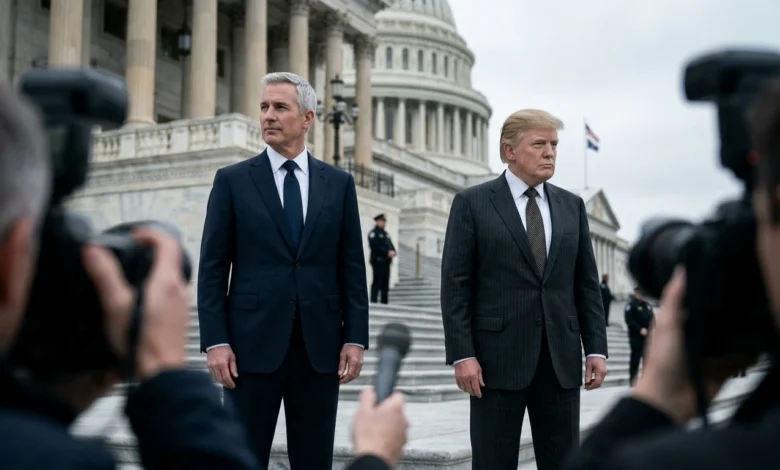
Senate Majority Leader John Thune now goes days or weeks without direct contact from President Trump, often learning of the president’s frustrations through Truth Social posts and rally speeches rather than phone calls, a stark shift from their frequent early-2025 communication as tension over the stalled SAVE America Act and filibuster reform splits the GOP ahead of the midterms.
Key Takeaways
- Trump and Thune have gone from close early-term coordination to a pattern where Thune reportedly hears about presidential frustration through Truth Social and the media rather than private calls, according to CNN’s reporting on the GOP rift.
- The public rupture centers on the Safeguard American Voter Eligibility Act, which passed the House in February on a near party-line vote but remains stalled in the Senate.
- At a Georgia rally, Trump told supporters to call Thune directly and demand action, a moment detailed in Time’s coverage of the standoff.
- Despite the friction, Sen. John Kennedy says there’s been no internal talk of replacing Thune, a point noted in CNN’s report on Leavitt’s “patience is running out” comments.
From Text Buddies to Radio Silence
Go back to early 2025 and the picture looked almost cozy. Thune and Trump were, according to an early Axios-style report on their bond-building, practically texting buddies.
The two men have never shared a personal bond. One is a mild-mannered South Dakotan; the other is mercurial and combative. But in the opening months of the second term they made the relationship work through sheer volume of contact, according to senators and aides who know both men, as CNN’s deep dive into the dynamic explains.
That volume has collapsed. Compare Thune’s situation to House Speaker Mike Johnson’s. Johnson reportedly fields calls from Trump in the middle of the day, the dead of night, or even after hourslong meetings at the White House. Thune gets nothing like that. It can be days, if not weeks, before the two speak directly.
A source close to the dynamic, cited in NBC’s report on the Trump-Thune relationship, put it bluntly: Thune and Johnson have different ways of communicating with Trump, both in style and in substance, and unlike Johnson, Thune doesn’t sugarcoat the truth when he talks to the president.
The SAVE America Act Becomes the Flashpoint
The mechanism driving the rift is a single piece of legislation. As The Hill outlined ahead of the procedural vote, the SAVE America Act would impose proof-of-citizenship requirements to register to vote and mandate ID to cast a ballot. Trump has called it his top priority and said he will not sign any legislation until the Senate approves the measure.
There’s just one problem: the math doesn’t work. The bill needs 60 votes to clear a filibuster, and no Democrat is expected to back it. Thune has said so publicly, repeatedly, which is exactly what set Trump off.
At a rally in Georgia in late July, Trump described the Senate as “a place that you send things when you want them to die” and urged supporters to pressure Thune directly, a moment captured in WENY News’ report on the rally.
Thune didn’t let it slide. Days later, he told reporters that instead of blaming Senate Republicans, the White House should go after Democrats on the floor, and that press secretary Karoline Leavitt should pick up the phone and start whipping votes herself, per Time’s reporting on his pushback.
White House Turns Up the Heat
The administration’s messaging has grown pointed. As CNN reported, Leavitt told reporters the president’s “patience is running out” as the August recess approached, and Trump escalated on Truth Social, demanding Thune not let the Senate leave town until the bill passes or the filibuster is terminated.
He went further weeks later, telling Republicans via a pointed floor aside to “stop it, John,” a callout documented in NBC News’ coverage of Senate GOP skepticism.
Why Thune Won’t Budge on the Filibuster
This isn’t Thune improvising. He’s drawing on a position he staked out years before he held the gavel, as The Independent traced back to 2022, when as minority whip he resisted Democratic pressure to nuke the filibuster over voting rights, and even noted Senate Republicans had refused Trump’s own 2017 request to kill it under Mitch McConnell.
That history matters now. Thune has told colleagues privately that Republicans don’t have the votes to force a talking filibuster, a private lunch discussion reported by The Hill via AOL. He’s said so on cable news too, telling Fox’s Hannity flatly that the votes aren’t there, according to The Gateway Pundit’s account of the interview.
A Conference Split Down the Middle
The friction has bled into the broader Senate GOP. Roughly a dozen MAGA-aligned senators side with Trump’s approach, while most others back Thune’s more cautious stance, per CNN’s headcount of the divide.
Utah Sen. John Curtis and West Virginia’s Jim Justice both voiced frustration with the ongoing infighting in the same CNN report, saying it’s making an already tough midterm environment harder.
Some Republicans worry Trump is using unrelated leverage to make his point. Thune has said he’s concerned the White House may be slow-walking a Texas Senate primary endorsement because of the filibuster standoff, a detail reported by AOL’s coverage of the Cornyn-Paxton race.
Trump Insists the Relationship Is “Fine”
For all the public sniping, Trump has stopped short of threatening Thune’s job. Asked aboard Air Force One, per Townhall’s report, Trump said the relationship is “fine” and that he hasn’t even thought about replacing him.
Thune, for his part, told reporters, as quoted in Time’s piece, that he’d back a path forward if one existed, but he’s not chasing a doomed vote count.
An Earlier Deal Shows the Relationship Isn’t Broken, Just Different
It’s worth remembering the two men aren’t incapable of working together when it counts. In early June, per NBC News’ account of a direct call between the two, Trump pushed Thune to attach the SAVE Act to a separate immigration bill. Thune told him the votes weren’t there but offered a concession, and Sen. Lindsey Graham drafted an amendment exactly as Trump requested, which went to the floor.
It’s a reminder that when Trump does pick up the phone, Thune still moves. The problem, by most accounts, is how rarely that phone rings these days.
What Happens When the Senate Returns From Recess
The bigger question hanging over Washington is whether this cools off or hardens into something structural. Trump has the bully pulpit and a primary voter base that listens to him. Thune has the vote count, and vote counts don’t bend to rally chants.
Whether the relationship stabilizes before the Senate returns from August recess will likely determine how much of Trump’s remaining 2026 legislative agenda actually reaches his desk. Housing legislation, a debt ceiling deadline, and a broader reconciliation package are all queued up behind the SAVE America Act logjam.