

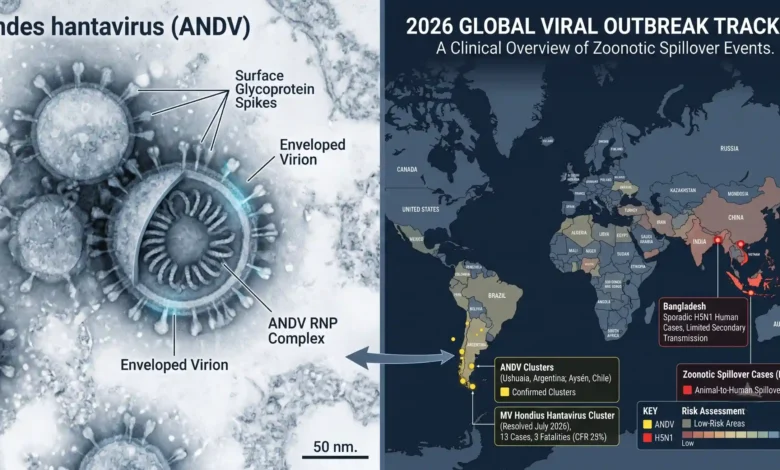
2026 Global Viral Outbreak Tracker: Final Report on MV Hondius and Active Surveillance Zones
If you are searching for confirmation of a “new 2026 pandemic,” the definitive answer is no. There is no active pandemic. However, the first half of 2026 tested global epidemic intelligence systems with several highly publicized zoonotic spillover events.
The most prominent of these was the severe acute respiratory illness cluster aboard the MV Hondius cruise ship. While social media algorithms amplified worst-case scenarios in May, health authorities successfully contained the threat by July.
Epidemiologists are not currently tracking a novel pandemic-grade pathogen in the United States. Instead, we are monitoring isolated clusters of known viruses. This tracker dissects the clinical data behind the mid-2026 health alerts, separating verified transmission chains from online distortion.
Quick Answer: Current Global Threat Level
- Hantavirus (Andes): The MV Hondius cruise ship outbreak is officially over as of July 2, 2026. Total cases: 13. Total deaths: 3.
- H5N1 Avian Influenza: Sporadic animal-to-human transmissions continue globally, including a third 2026 case in Bangladesh. Sustained human-to-human transmission has not occurred.
- Mpox Clade Ib: Active global surveillance continues as the strain shows ongoing community transmission and novel clinical presentations.
- US Public Risk: The Centers for Disease Control and Prevention (CDC) rates the immediate risk to the general American public from these specific clusters as low.
The MV Hondius Hantavirus Cluster: A Post-Mortem
On May 2, 2026, the World Health Organization (WHO) received notification of a severe respiratory cluster aboard the MV Hondius, a polar exploration vessel that had departed Ushuaia, Argentina, on April 1.
By July 2, 2026, WHO Director-General Tedros Adhanom Ghebreyesus officially declared the outbreak over. The containment of this virus is a textbook example of modern epidemiological response, but the pathogen involved warranted the initial high alert level.
Why the Andes Virus Triggered a Global Alert
The pathogen identified was the Andes orthohantavirus (ANDV). Hantaviruses are generally zoonotic, spreading to humans who inhale aerosolized particles from infected rodent urine or saliva. Most hantaviruses hit a dead end in humans. ANDV is the single exception. Out of 38 known hantavirus strains, ANDV is the only one documented to transmit from person to person.
Final Epidemiological Data
The outbreak concluded with the following verified metrics:
- Total Cases: 13 (12 laboratory-confirmed, 1 probable).
- Fatalities: 3 (a case fatality ratio of 23%).
- Median Age of Patients: 65 to 69 years, predominantly male.
-
Containment: Over 650 contacts across 33 countries were tracked. All completed a 42-day follow-up period with zero secondary cases detected outside the initial ship cohort.
The successful isolation of passengers in multiple countries, including the Netherlands, Spain, and the US, halted what could have been a wider transmission chain.
Ongoing 2026 Surveillance: H5N1 and Mpox Clade Ib
With the hantavirus cluster resolved, international focus remains on two pathogens exhibiting concerning, though not yet pandemic-level, evolutionary behaviors.
H5N1 Avian Influenza: The Zoonotic Barrier Holds
Avian influenza remains primarily a disease of poultry and wild birds. However, when it jumps to humans, the clinical outcomes can be severe.
In June 2026, Bangladesh notified the WHO of its third laboratory-confirmed human case of avian influenza A(H5N1) for the year. The patient, a child in the Sylhet Division, developed symptoms on May 17 following exposure to household poultry.
This case followed a fatal infection in the Chattogram Division earlier in February. Crucially, the May case resolved without hospitalization, and extensive testing of the child’s close contacts yielded entirely negative results. The virus remains stuck at the zoonotic spillover stage. It can jump from bird to human, but it lacks the genetic mutations required to spread easily between humans through respiratory droplets.
Mpox Clade Ib: Shifting Clinical Baselines
Mpox (formerly monkeypox) continues to evolve. While the massive 2022 outbreak was driven by Clade IIb, surveillance in 2026 is heavily focused on Clade Ib.
Genomic sequencing in early 2026 identified recombinant mpox viruses containing elements of both clade Ib and IIb. More importantly, the clinical presentation of the disease is shifting. Historically, lesions appeared primarily on the palms, soles, and face. Recent Clade Ib infections show lesions manifesting across mucosal regions, coupled with severe localized lymphadenopathy occurring 24 to 48 hours before skin eruptions.
Unlike H5N1, Mpox Clade Ib spreads efficiently between humans via close physical contact. While current vaccine regimens remain effective, the baseline behavior of the virus is changing, requiring continuous monitoring by public health networks.
Mid-2026 Viral Threat Matrix
| Pathogen | Primary Transmission | 2026 Clinical Updates | US Domestic Risk |
| Andes Hantavirus | Rodent-to-human, rare human-to-human | MV Hondius outbreak contained (July 2026) | Very Low |
| H5N1 (Avian Flu) | Animal-to-human (Spillover) | Sporadic cases in SE Asia, no sustained human spread | Low |
| Mpox Clade Ib | Physical human-to-human contact | Recombinant strains identified; atypical lesion sites | Moderate |
Evaluating Outbreak News without Panic
Social media platforms routinely misclassify localized spillovers as new pandemics. To evaluate public health risks accurately, apply the same parameters used by epidemic intelligence teams:
- Look for “Sustained Transmission”: A cluster of 15 people catching a virus from the same environmental source (like a ship or a farm) is an outbreak. The virus mutating to spread independently through a city is sustained transmission. Only the latter triggers a pandemic.
- Check the Case Fatality Ratio (CFR) vs. R0: A highly lethal virus (high CFR) that cannot spread easily (low R0) is a tragedy for the infected but a low risk to the global population.
- Source the Data: Ignore secondary aggregators. Use the WHO Disease Outbreak News (DON) portal or the CDC Health Alert Network (HAN) for unfiltered epidemiological data.
The events of mid-2026 prove that active surveillance systems work. Pathogens like the Andes virus were identified, tracked, and isolated before they could establish a foothold in the general population. For the average citizen, the immediate response requires no change to daily life beyond standard travel hygiene and routine vaccinations.
Sources
- The Star – Hantavirus outbreak from cruise ship officially ends: https://www.thestar.com.my/lifestyle/health/2026/07/12/hantavirus-outbreak-from-cruise-ship-officially-ends
- World Health Organization – Disease Outbreak News (Hantavirus outbreak linked to cruise ship travel, Multi-locations): https://www.who.int/emergencies/disease-outbreak-news/item/2026-DON611
- Avian Flu Diary – WHO: Bangladesh Reports 3rd H5N1 Human Infection for 2026: https://afludiary.blogspot.com/2026/07/who-bangladesh-reports-3rd-h5n1-human.html
- National Institutes of Health (PMC) – Clade Ib: a new emerging threat in the Mpox outbreak: https://pmc.ncbi.nlm.nih.gov/articles/PMC11693458/
- GOV.UK – Mpox outbreak: epidemiological overview, 9 July 2026: https://www.gov.uk/government/publications/monkeypox-outbreak-epidemiological-overview/mpox-outbreak-epidemiological-overview-9-july-2026
- ANRS – Hantavirus Outbreak Response unit: https://anrs.fr/en/disease-outbreak/emergence-units/hantavirus/