
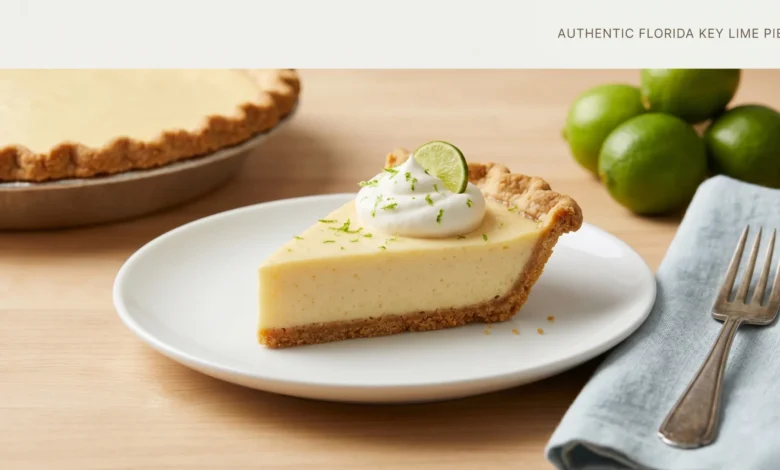
Authentic Key Lime Pie Recipe: The Science of a Perfect Set
A perfect Key lime pie is a masterclass in minimal ingredients delivering a maximal structural reward. Yet, many home bakers encounter the same twin frustrations: a filling that turns out runny and unstable, or a base that collapses into a soggy paste.
Achieving a pristine, bakery-style slice does not require complex culinary tricks. By understanding the simple food science that governs this classic regional dessert, you can ensure a clean, stable structure every time you bake.
To make an authentic Key lime pie, whisk 3 large egg yolks with one 14-ounce can of full-fat sweetened condensed milk until smooth, then slowly fold in 1/2 cup of fresh Key lime juice and 1 tablespoon of lime zest. Pour into a pre-baked graham cracker crust and bake at 350°F for 15 minutes until the edges are stable but the center retains a slight jiggly wobble.
Key Takeaways
- Chemical Setting: Citric acid naturally denatures milk proteins, looping them into a stable network that thickens the filling alongside egg yolks.
- Crust Integrity: A mandatory crust par-bake creates a hydrophobic barrier, blocking moisture from ruining the graham foundation.
- The Right Milk: Full-fat sweetened condensed milk provides the essential protein and fat density required for a proper custard set.
- Doneness Cues: Pull the pie from the oven while the absolute center still retains a slight wobble to prevent weeping.
- Chilling Window: A minimum of 3 to 6 hours of refrigeration is required to lock the fat networks for clean, razor-sharp slicing.
Quick Start Overview
Before working through the step-by-step methods, keep these fundamental baseline values in mind:
- Prep Time: 20 minutes
- Bake Time: 25 minutes (total for crust and filling)
- Chilling Requirement: Minimum 3 hours (ideal: 6 hours to overnight)
- Target Oven Temperature: 350°F (177°C)
The Legal and Cultural Identity of Florida’s State Pie
The Legislative Standard
Key lime pie is more than a traditional regional treat; it is a legally protected cultural symbol. The Florida State Legislature officially designated the dessert as the official state pie under Senate Bill 678. This action established Florida Statute 15.052, which went into effect on July 1, 2006.
This legislative backing highlights the deep pride connected to the dessert’s specific presentation. True authentic identity requires the distinct combination of a sharp citrus profile and a firm crumb base. This standard has made Florida a leading destination for food festivals celebrating local agricultural history.
The Keys Heritage and Southern Innovation
The roots of the pie stretch back to Key West, Florida. Long before modern grocery distribution chains existed, home cooks had to adapt to local geographical limitations. Tropical limes were initially viewed with skepticism by nineteenth-century Northern food writers, but they thrived in the Southern climate.
In the era before widespread home refrigeration, fresh milk spoiled rapidly in the intense summer heat of the American South. Sweetened condensed milk became an essential household staple due to its excellent shelf stability and resistance to spoiling.
Mid-20th-century community cookbooks helped organize and standardize these regional dessert steps across different counties. Local bakers realized they could combine shelf-stable canned milk with wild Key limes to create a thick custard without needing an icebox.
As baking expert Sally’s Baking Addiction (2024) notes:
“The filling works because the acidity of key lime juice naturally thickens sweetened condensed milk, while egg yolks help set the filling.”
The Essential Ingredient Matrix
The Graham Cracker Base Foundations
A traditional pie requires a resilient structural foundation. This base is systematically formulated using three components: finely crushed graham cracker crumbs, granulated white sugar, and melted unsalted butter.
[Crushed Graham Crackers] + [Granulated Sugar] + [Melted Butter] = Hydrophobic Crust Barrier
The melted butter coats the starch molecules in the graham crumbs. When mixed with sugar and exposed to heat, the sugars melt and cool into a firm structure. This structure prevents the liquid filling from seeping downward.
Common Mistake: Skipping the crust par-bake. If you pour raw filling directly into an unbaked crumb shell, the liquid will migrate into the cracks instantly. This results in a heavy, soggy paste instead of a crisp base. Always bake the empty crust at 350°F for 8 to 10 minutes first.
The Custard Engine
The filling relies entirely on a chemical process called protein denaturation (altering protein shapes using acid or heat). When you mix raw egg yolks with sweetened condensed milk and lime juice, you build a powerful emulsification engine.
The high concentration of citric acid in the lime juice lowers the pH of the mixture. This drop in pH causes the proteins in the milk and egg yolks to unfold and loop tightly together.
This chemical thickening happens instantly at room temperature. However, egg yolks remain necessary to bind the fats and liquids securely, ensuring the pie stays firm and sliceable when cut.
The Juice Dilemma
The flavor and structure of your pie depend heavily on your citrus choice. Historical lineage records show that the genus Citrus originated in Southern Asia roughly 11,500 years ago before spreading globally. The resulting fruit varieties carry distinct acid and water volumes.
- Fresh Key Limes (Citrus × aurantiifolia): These fruits are small, spherical, and turn a pale yellow when fully ripe. They deliver an intensely tart, aromatic juice with floral, complex undertones.
- Standard Persian Limes: These are the large green limes found in most US grocery stores. They have a higher water content and a more straightforward, clean citrus profile.
- Bottled Key Lime Juice: Brands like Nellie & Joe’s offer a highly concentrated alternative. While convenient, bottled juice is pasteurized, which removes some delicate floral top notes and adds a sharper, biting sourness.
The Ultimate Lime Substitution Matrix
| Choice of Lime Ingredient | Average Quantity Needed for 1 Cup Juice | Unique Flavor and Acidity Profile | Best Structural Use Case |
| Authentic Fresh Key Limes | 20–25 small fruits | Intensely tart, highly aromatic, distinct floral and complex bitter notes. | Historical accuracy, high-end display, and authentic Florida execution. |
| Standard US Grocery Persian Limes | 4–6 medium fruits | Bright, clean citrus flavor, higher water content, lower aromatic complexity. | Quick everyday baking, cost efficiency, and straightforward prep workflow. |
| Bottled Key Lime Juice | 1 Cup liquid volume | Sharp, intensely concentrated, bracingly sour with a slight shelf-stable bite. | Speed, batch baking, and reliable execution when fresh options are out of season. |
Step-by-Step Culinary Architecture
Phase 1: Shaping and Locking the Hydrophobic Crust
- Grind 11 to 12 full sheets of graham crackers into fine, uniform crumbs using a food processor to establish structural density.
- Combine the crumbs with 1/3 cup of granulated white sugar and 6 tablespoons of melted unsalted butter, mixing until the texture resembles wet sand.
- Dump the mixture into a 9-inch pie plate, using the flat bottom and straight edge of a metal measuring cup to press the crumbs firmly into the base and up the walls.
- Bake the empty shell at 350°F (177°C) for exactly 8 to 10 minutes until golden brown, then set it aside on a wire rack to cool completely.
Phase 2: Emulsifying the Citric Custard Filling
- Separate 3 large egg yolks, ensuring no white remains, and place them into a clean mixing bowl.
- Whip the egg yolks on high speed with an electric mixer for 2 to 4 minutes until they grow thick, pale yellow, and leave distinct ribbons when lifted.
- Pour in one 14-ounce can of full-fat sweetened condensed milk, beating at low speed until completely incorporated.
- Add 1/2 cup of fresh lime juice and 1 tablespoon of finely grated lime zest, using a flexible rubber spatula to fold the liquid gently into the mixture until it thickens naturally.
Phase 3: The Precision Bake and Chilling Window
- Place the cooled pie plate onto a flat metal baking sheet to prevent any tipping or cracking during oven transit.
- Pour the thick lime custard filling into the par-baked crust, smoothing the top surface with a spatula.
- Bake at 350°F (177°C) for 12 to 15 minutes, watching the texture carefully rather than relying solely on a timer.
- Remove the pie from the oven while the absolute center still retains a slight jelly-like wobble; it will finish setting as it cools.
- Allow the pie to reach room temperature on a wire rack, then slide it onto a low refrigerator shelf to chill for at least 3 to 6 hours before slicing.
Science Breakdown: The Chemistry of the Set
- Acid-Driven Thickening: Citric juice drops the filling’s pH level, causing milk proteins to unfold and mesh together.
- The Egg Binder: Egg yolks act as an essential binder, holding fats and liquids securely under low heat.
- Thermal Stabilization: Brief baking activates egg proteins to ensure clean, firm slices without starch thickeners.
- Moisture Isolation: A par-baked shell creates a hard barrier that keeps the structural base crisp.
Troubleshooting and Failure Modes
Case Study 1: The “Soggy, Weeping Crust” Failure
Typical scenario example: A home baker skips the crust baking phase and pours the raw liquid filling directly into an unbaked graham crumb shell. Over the next 24 hours in the refrigerator, moisture leaves the custard and enters the crust, causing the base to collapse into a soggy paste. To fix this, always execute the mandatory 8-to-10 minute par-bake at 350°F (177°C) to lock the sugars and crumbs into a durable, moisture-resistant shield.
Case Study 2: The “Over-Baked and Curdling” Disaster
Typical scenario example: A baker leaves the pie in the oven for 30 minutes until the center is entirely stiff. As the pie cools, deep cracks appear on the surface and a watery liquid leaks out of the filling. This protein over-coagulation (syneresis) happens because excess heat squeezes out trapped moisture. Always pull the pie when the center still jiggles.
The “Why Won’t My Pie Set?” Troubleshooting Checklist
- [ ] Did you skip the par-bake? Failing to bake the empty crust allows filling moisture to ruin crust integrity instantly.
- [ ] Did you use low-fat condensed milk? Standard filling chemistry depends entirely on the high protein and fat structure of full-fat sweetened condensed milk to react with the citrus acid.
- [ ] Did you substitute evaporated milk? Evaporated milk lacks the sugar concentration and viscosity required; using it results in a completely liquid filling.
- [ ] Did you pull the pie while it was hot-liquid? The filling must bake until only slightly jiggly in the center; pulling it too early prevents the egg-yolk network from establishing boundaries.
- [ ] Did you rush the refrigeration window? A classic baked Key lime custard requires an absolute minimum of 3 hours (ideally 6 hours to overnight) on a low refrigerator shelf to lock its sliceable density.
Contemporary Formats and Serving Aesthetics
Alternative Presentations
Modern dessert systems demonstrate that classic citrus custard profiles can be reformatted safely into different styles. You can bake this exact formulation into square bars or modify it into gelled, low-fat dessert cups using a light yogurt base element.
Pristine Slicing Mechanics
To get clean, restaurant-style slices, use a long, thin chef’s knife. Dip the metal blade into a tall container of hot water, then wipe it completely dry with a clean kitchen towel between every single cut. This method keeps the sticky filling from dragging across the crisp graham edge.
Topping Selection
Traditional Florida presentations often leave the glossy yellow top completely bare to highlight its natural tartness. Alternatively, you can use an electric mixer to whip heavy cream and a tablespoon of powdered sugar into stiff peaks, piping small dollops around the outer perimeter of individual slices. Sharing these regional steps helps pass down family traditions and maintains cultural continuity.
Summary and Next Steps
A reliable Key lime pie comes down to structural control, acid chemistry, a par-baked crust, and patient chilling. By treating the filling as a delicate emulsion rather than a standard cake batter, you avoid common texture pitfalls completely.
- Step 1: Select your lime variety or bottled juice choice using our substitution matrix.
- Step 2: Grind and compact your graham crackers, then execute the mandatory par-bake.
- Step 3: Cool the finished bake completely on a wire rack before starting the mandatory refrigeration window.
FAQs
Can I use regular limes instead of Key limes for this recipe?
Yes, regular Persian limes work excellently and offer a balanced, bright flavor profile that avoids the bitter edge of bottled concentrates.
Why did my Key lime pie turn out runny?
Runny pies are usually caused by using low-fat condensed milk, skipping egg yolks, or cutting the refrigeration window short.
Do you have to bake egg yolks in Key lime pie?
While citric acid thickens the proteins, brief baking ensures food safety and helps the egg yolks solidify into a stable slice.
Can I use evaporated milk instead of sweetened condensed milk?
No, evaporated milk lacks the sugar density and viscosity required; using it will completely liquefy the filling.
How can you tell when a Key lime pie is done baking?
The outer edges should look firm and matte, while the exact center must still retain a small, jelly-like wobble when gently shaken.
How long does homemade Key lime pie last in the fridge?
Covered loosely with plastic wrap supported by toothpicks, the pie retains its optimal texture and flavor for 3 to 5 days.
Why is my graham cracker crust crumbling when I slice it?
This happens if the crumbs weren’t pressed firmly enough into the pan or if the butter-to-crumb ratio was unbalanced.
Is authentic Key lime pie green or yellow?
Authentic Key lime pie is always a natural pale yellow color, derived from the rich egg yolks and light lime juice; green pies contain artificial coloring.
References
- Florida Department of State, 2006
- International Journal of Education and Social Science Research, 2024
- National Academic Digital Library of Ethiopia, 2021
- USDA Agricultural Research Service, 2012
- British Food Journal, 2021
- Ann Arbor District Library, 2015
- Nature Communications, 2023
- University of Texas at Dallas, 1869
- KU ScholarWorks, 2024
- IU ScholarWorks, 2024
- Sally’s Baking Addiction, 2024
- Brown Eyed Baker, 2024
- Once Upon a Chef, 2024