
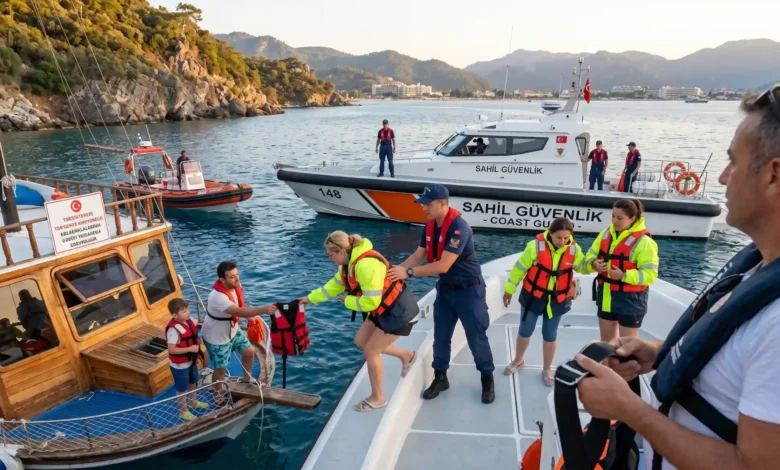
Turkey Tourist Boat Rescue: 2026 Safety Trends & Risks
Dramatic video clips of maritime evacuations along the Turkish Riviera often sweep across social media networks. While these scenes look chaotic, the systems operating behind the scenes follow predictable patterns. The recent sinking of a day-tour boat in Marmaris shows how quickly a recreational trip can transform into an active emergency.
By evaluating historical search and rescue data alongside current coast guard frameworks, international travelers can easily spot risks and protect themselves on the water.
Featured Snippet Direct Answer: A turkey tourist boat rescue is typically triggered by localized hull or machinery failures rather than catastrophic open-sea weather, peaking during the high-density summer tourism season. Data indicates that recreational yachts and day-tour boat classes carry the highest frequency of localized marine incidents across the Aegean and Mediterranean search regions.
Key Takeaways
- Machinery malfunctions cause 12.9% of all regional search and rescue operations.
- Yacht and day-recreational boat classes represent the highest statistical incident rate in tourist zones.
- Sudden local weather shifts lead all environmental triggers, making up 16.0% of rescue incidents.
- Waterway density alters risk profiles: marine injuries are 8.5 times more frequent within the high-traffic Istanbul sectors.
- Drowning incidents involving foreign nationals peak heavily during the late seasonal window of September.
- Evacuation survival rates depend on keeping exit pathways from internal compartments to open decks completely clear.
Quick Reference Safety Summary
If you are planning a boat excursion along the Turkish coast, safety is an operational equation you can actively evaluate. Do not assume all tour boat operations carry identical risks. By matching weather forecasts with visual vessel checks, you can identify structural hazards before leaving the harbor.
Anatomy of an Incident: The May 2026 Marmaris Sinking
On May 29, 2026, a pirate-themed excursion vessel reminded the travel world how rapidly mechanical systems can fail. The incident provides a clear roadmap of how modern rescues unfold.
Operational Breakdown of the Big Boss Diamond Failure
The Big Boss Diamond, a day-tour boat carrying between 110 and 150 passengers, suffered an engine failure and a potential fire hazard. The vessel began taking on water rapidly in Aquarium Cove off Cennet Island, Marmaris. Instead of staying in deep water, the crew used the ship’s remaining momentum to steer directly toward the shallow shoreline.
This spatial decision allowed nearby tour boats and arriving Turkish Coast Guard cutters to execute a flat surface evacuation. All passengers, including children and foreign tourists, were removed safely without a single injury before the vessel fully submerged.
“The greatest consolation was that there were no casualties or injuries in the incident,” stated Marmaris District Governor Nurullah Kaya during an official on-site safety review. This outcome showcases how immediate crew action and close proximity to shore prevent mass casualties.
Lessons in Structural Entrapment: The 2020 Alanya Case Study
Not every coastal incident ends without injury. In November 2020, a tourist excursion vessel named the Baba Selavi encountered sudden severe weather and capsized in the Mediterranean Sea off Alanya. The boat was carrying 33 Russian tourists and 5 crew members.
While responding Turkish Coast Guard units successfully pulled 37 people from the open water, one foreign national died. Investigators found the traveler became trapped inside a narrow, enclosed structural compartment of the overturned boat.
Common Mistake: Many travelers choose seats in enclosed lower cabins to escape the summer sun. However, if a boat capsizes or floods, these lower spaces quickly turn into high-risk entrapment zones with blocked exit paths.
Former Turkish Foreign Minister Mevlut Cavusoglu coordinated the emergency care, noting that authorities would handle all immediate needs of the rescued survivors. This case highlights why open-deck options are structurally safer than multi-tiered enclosed layouts. American travelers can monitor ongoing safety protocols through the Turkish Coast Guard Command incident monitoring directives.
Statistical Reality: What Drives Maritime Rescues in Turkey?
Regional Distribution of Search & Rescue Operations
Maritime rescues are not random anomalies. Peer-reviewed data shows that between 2001 and 2020, there were 576 documented marine accidents within the Aegean Sea Turkish Search and Rescue Region alone.
These operational rescue zones are strictly defined by the Search and Rescue Regulation of Marine and Air Vehicle Accidents, which was published on October 17, 2020. The data reveals that yachts and small recreational tour boats are the specific vessel types most frequently involved in emergency calls within this sector.
The Core Triggers of Vessel Malfunctions
When analyzing what forces a coast guard deployment, researchers separate environmental hazards from mechanical failures. A long-term epidemiological evaluation of 1,796 maritime incident reports from the Main Search and Rescue Coordination Centre outlines the primary root causes:
- Bad Weather Conditions (16.0%): Sudden regional wind shifts can destabilize top-heavy pleasure craft or push them into rocky coastal shelves.
- Human Error (13.4%): This category involves navigation mistakes, over-capacity loading, and failing to anchor safely in crowded tourist coves.
- Machine Malfunctions (12.9%): Hull breaches and cooling system failures often strike older diesel engines during intense summer tourism seasons.
This historical data set recorded 6,046 rescued individuals alongside 311 deaths and 202 missing persons over an 11-year window. It proves that mechanical reliability and operator decisions shape tourist safety far more than extreme open-ocean storms.
Marine Incident Distribution by Region & Vessel Class
| Waterway Zone / Metric | Primary Vessel Risk | Key Incident Driver | Statistical Weight Parameter |
| Aegean Search Region | Yachts & Recreational Day-Boats | Hull & Machinery Failure | Peak seasonal concentration during summer tourism |
| Istanbul Straits / Waterways | Passenger Ferries & Mixed Cruise Traffic | High-density commercial lane crossings | 8.5x increase in baseline injury frequencies |
| Antalya Coastal Hub | Tour Boats & Private Charters | Accidental seasonal drownings | Concentrated heavily between 12:00 and 16:00 |
Mid-Article Summary Box:
- Maritime safety along the Turkish coast is shaped by predictable operational factors rather than random open-ocean storms.
- Vessel choices matter, as small recreational day-boats and yachts experience the highest incident counts in holiday sectors.
- Waterway density alters risk profiles drastically, with high-congestion lanes requiring increased traveler vigilance.
International & Local Safety Infrastructure
The Treaty Framework Guarding Coastal Transit
Local search and rescue operations in Turkey do not exist in a vacuum. They link directly to global maritime frameworks. Turkey’s search frameworks map to several international treaties, including the SOLAS Convention 1974, the SAR Convention 1979, and UNCLOS 1982. These agreements standardize how emergency signals are processed and how neighboring nations cooperate during a crisis.
The physical environment complicates these treaty rules. For instance, the Turkish Straits have evolved from historical low-capacity channels into complex, high-traffic modern maritime bottlenecks. Tens of thousands of large commercial vessels pass through these narrow paths every year. This massive volume creates a crowded environment where recreational tour boats must constantly dodge heavy international shipping traffic, elevating structural collision risks.
Active Monitoring: Vessel Traffic Services (VTS)
To keep these crowded waterways organized, the Directorate General of Coastal Safety manages a network of monitoring stations. Coastal operators use the İzmir Vessel Traffic Center and the Turkish Straits Vessel Traffic Center to track ship movements in real time. These stations use radar, automatic identification tracking, and marine radio bands to guide vessels safely through tight channels.
When a tour boat experiences an engine failure, these centers spot the deviation immediately. They can quickly dispatch emergency response boats to the exact coordinates of the vessel before a situation escalates. Travelers can read more about how authorities track transit updates via the Directorate General of Coastal Safety vessel routing protocols.
The Pre-Boarding Safety Tool & Checklist
Verifying Excursion Safety Before You Step on Deck
You do not have to leave your safety entirely up to the boat crew. You can perform a fast visual inspection during the boarding process to protect yourself and your family.
- Avoid Sealed Lower Cabins: Do not book spots or sit on tourist vessels that restrict open access to main decks. Enclosed lower levels are primary entrapment vectors during sudden capsizes.
- Check Life Jacket Accessibility: Visually cross-check that life jackets are positioned in open-air overhead frames or marked deck lockers. Avoid vessels that keep life saving gear stowed away in locked holds or deep storage rooms.
- Schedule Early Morning Tours: Coordinate your boat trips for early morning hours. Regional drowning records indicate that tourist marine incidents peak sharply between 12:00 and 16:00, which aligns with maximum harbor congestion and changing afternoon thermal winds. September is also documented as the highest-risk month for accidental tourist drownings in regional holiday hubs like Antalya.
- Verify Vessel Registration: Cross-verify that operators possess visible registration decals and functional marine radio setups near the helm before leaving the harbor dock. If an operator cannot point out basic communication equipment, do not board the boat.
Practical Tooling: The Tourist Pre-Boarding Protocol
Use this structured step-by-step verification method before your vessel departs:
- Inspect the Hull and Deck Class: Confirm the ship has a valid commercial license mark near the steering station rather than a private pleasure registration.
- Locate Secondary Exit Pathways: Walk the route from any interior seating space to the open air to ensure it is completely clear of ice chests, ropes, or gear.
- Check Local Marine Forecasts: Verify the daily wind and wave alerts before paying for a ticket. Environmental data lists bad weather as the trigger for 16.0% of all regional rescue missions.
Rapid Emergency Maritime Evacuation Matrix
If your tour boat suffers a severe mechanical failure or begins taking on water while underway, follow this clear response track:
[Vessel Malfunction Identified]
             │
             ▼
[Step 1: Relocate Instantly] Move out of enclosed lower cabins immediately to the open-air upper deck.
             │
             ▼
[Step 2: Equip Life Saving Gear] Secure a life jacket before the vessel loses structural stability or power.
             │
             ▼
[Step 3: Monitor Vessel Trajectory]
       ├── If heading toward land/shallows ──► Wait for crew instructions; prepare for a flat hull exit.
       └── If capsizing or sinking rapidly  ──► Leap clear of the high side of the hull to avoid suction.
Summary & Immediate Next Steps
While tourist boat operations across the Turkish Riviera are heavily monitored by regional vessel services, localized machinery and hull issues present real operational risks. Travelers can significantly reduce these dangers by staying observant and avoiding top-heavy or fully enclosed vessel designs.
Moving forward, keep these three immediate next steps in mind for your next coastal trip:
- Audit Life Jacket Access: Locate and visually verify your life saving gear the moment you step foot on any day-charter.
- Check the Marine Weather: Look up localized wind and wave warnings on official coastal safety portals before boarding.
- Prioritize Open Layouts: Choose tour boats that feature wide, open-deck architectures over multi-tiered enclosed configurations.
FAQs
What are the primary causes of tourist boat accidents in Turkey?
The top three causes for maritime rescues are bad weather conditions at 16.0%, human operational errors at 13.4%, and sudden machine malfunctions at 12.9%. Most incidents involve localized engine or hull failures during the peak summer travel season.
How does the Turkish Coast Guard respond to marine rescues?
The coast guard coordinates with the Directorate General of Coastal Safety and regional Vessel Traffic Services. They monitor radar systems and dispatch rapid-response rescue cutters to track down and assist vessels in distress.
Are day-tour boats along the Turkish Riviera safe?
Most commercial excursions operate without incident, but recreational yachts and day-tour boat classes carry the highest statistical frequency of accidents in coastal tourist sectors. Travelers should inspect safety configurations personally before departure.
What should I check before boarding a boat cruise in Marmaris or Antalya?
You should verify that life jackets are completely accessible on the main deck, ensure all exit pathways are entirely unobstructed, and check that the operator has a visible commercial license.
Which months carry the highest maritime safety risks for tourists in Turkey?
Maritime incidents peak during the summer tourist rush, but drowning records for foreign nationals show a sharp statistical peak during the month of September, particularly during the hot afternoon hours between 12:00 and 16:00.
Is life jacket usage strictly enforced on Turkish excursion boats?
While marine laws require commercial vessels to carry sufficient life saving gear for all passengers, actual deck compliance can vary by operator. Passengers must take personal responsibility to locate their jackets upon boarding.
How do dense commercial shipping lanes affect tour boat safety in Istanbul?
The extreme density of commercial ships, ferries, and transit cargo craft elevates collision risks. Because of this congestion, maritime injuries are statistically 8.5 times more frequent in the Istanbul sector compared to outer international search regions.
References
- DergiPark Academic Database, 2023
- International Maritime Health Journal, 2021
- AVESİS Akdeniz University Records, 2023
- TÜDAV / Turkish Marine Research Foundation Documentation, 2018
- Cambridge University Press Legal Analysis, 2018
- Anadolu Agency, 2020
- WWL-TV (CBS Affiliate), 2026
- APA News Agency, 2026