

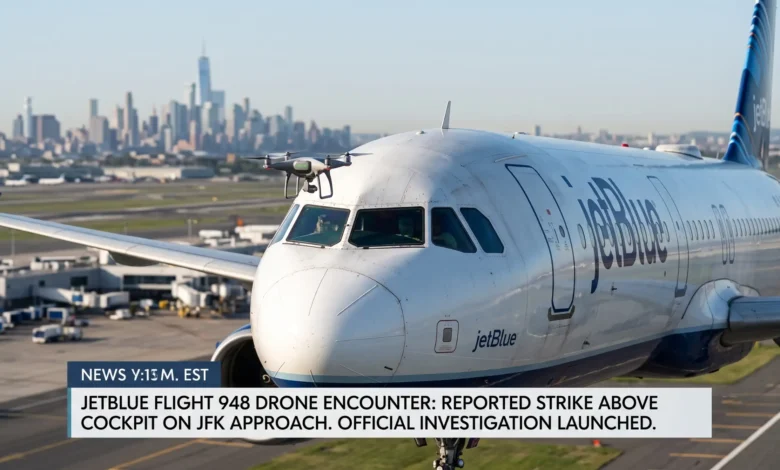
JetBlue Drone Encounter on JFK Approach: The Full Story Behind Flight 948
Imagine flying at 3,000 feet, preparing to land in New York, when an unauthorized object smashes into the fuselage right above your cockpit window. That nightmare became a reality on June 29, 2026. The jetblue drone encounter jfk approach incident immediately sparked national headlines and triggered an urgent Federal Aviation Administration (FAA) investigation. As rogue drones increasingly invade controlled airspace, passengers and aviation experts want answers. Let’s break down the timeline, the actual risks, and what this means for commercial flight safety.
What Happened to JetBlue Flight 948?
During a JetBlue drone encounter on JFK approach on June 29, 2026, Flight 948 from Las Vegas struck a small drone at 3,000 feet near Sea Bright, New Jersey. The Airbus A321 landed safely at John F. Kennedy International Airport moments later, and ground crews found no structural damage to the plane.
Key Takeaways
- Direct Hit: JetBlue Flight 948 collided with a drone at 3,000 feet just minutes before landing at JFK.
- No Damage: Post-flight inspections confirmed the Airbus A321 suffered no structural damage.
- Active Investigation: The FAA launched an immediate probe into the collision.
- Growing Trend: This event closely follows a near-miss involving a United Airlines jet at Newark.
- Event Proximity: Authorities are monitoring airspace heavily, especially with nearby World Cup matches at MetLife Stadium.
Anatomy of the Incident: JetBlue Flight 948
JetBlue Flight 948 was nearing the end of a four-hour journey from Las Vegas to New York. The Airbus A321 carried up to 159 passengers. Everything proceeded normally until the plane began its final maneuvers over New Jersey.
Timeline of Events
The timeline of the collision highlights how fast these situations develop in the air:
- 7:00 a.m. EST: The JetBlue flight begins its final descent into the busy New York airspace.
- 7:10 a.m. EST: The aircraft reaches roughly 3,000 feet over Sea Bright, New Jersey.
- 7:15 a.m. EST: The pilot radios air traffic control to report a direct strike.
- 7:21 a.m. EST: The plane safely touches down on Runway 13L at JFK Airport.
Cockpit Audio and Pilot Reactions
Air traffic control recordings paint a clear picture of the encounter. The pilot calmly but firmly reported, “We collided with a drone back there in the turn. It hit us right above the cockpit.”
The controller quickly verified the strike. Despite the collision, the flight crew did not declare a full emergency. They did not request fire trucks or emergency services on the runway. The pilots relied on their training and landed the plane without further issues.
Assessing the Damage: Did the Drone Breach the Cockpit?
Hitting an object at high speeds can cause massive problems for an aircraft. A small drone might seem harmless, but at 250 miles per hour, it acts like a heavy projectile.
If a drone hits an engine, it can destroy the internal fan blades. If it hits the windshield directly, it can shatter the glass. Luckily, the drone hit the sturdy metal fuselage just above the cockpit windows of Flight 948.
Once the plane parked at the gate, maintenance crews thoroughly inspected the nose, engines, and wings. Both JetBlue and the FAA confirmed they found zero evidence of physical damage.
The Bigger Picture: Drone Threats in Commercial Airspace
The New York metropolitan area has some of the most crowded airspace in the world. Unfortunately, it is also seeing a massive spike in illegal drone activity. The FAA receives more than 100 drone sighting reports near US airports every single month.
The Newark Near-Miss
The JetBlue strike was not an isolated event. Just days prior, on June 26, a United Airlines Boeing 737 experienced a terrifying close call. As the plane approached Newark Liberty International Airport, the crew spotted a three-foot-wide circular drone passing a mere 100 feet below their aircraft.
World Cup Drone Restrictions
Security is exceptionally tight right now. New Jersey’s MetLife Stadium is actively hosting FIFA World Cup matches. Because of the massive crowds, the Transportation Security Administration (TSA) has heavily restricted the local airspace.
Since the tournament began on June 11, authorities have seized more than 300 drones near World Cup venues. Investigators are still trying to determine if the JetBlue or United incidents are connected to rogue World Cup spectators trying to grab aerial photos.
FAA Regulations and Drone Safety Enforcement
The FAA strictly prohibits drones from flying in controlled airspace around airports without explicit authorization. Drones must generally stay below 400 feet. The fact that the JetBlue strike happened at 3,000 feet shows a severe violation of federal law.
To help educate operators, the government provides resources like the FAA B4UFLY airspace map app. This tool tells recreational flyers exactly where they can and cannot fly. Ignoring these maps carries heavy penalties. Violators face massive fines, confiscation of their equipment, and potential federal prison time.
As a response to the growing threat, airports are rushing to install advanced drone detection technologies. These systems can track a drone’s flight path and often pinpoint the exact location of the operator on the ground.
Comparing Recent New York Airspace Drone Incidents
To understand the rising threat, look at how the two most recent events stack up:
| Incident Feature | JetBlue Flight 948 | United Airlines Flight |
| Date | June 29, 2026 | June 26, 2026 |
| Location | Sea Bright, NJ (JFK Approach) | Newark Liberty Approach |
| Altitude | 3,000 feet | Final descent |
| Aircraft | Airbus A321 | Boeing 737 |
| Outcome | Direct collision above cockpit | Near-miss (100 feet below) |
| Damage Reported | None | None |
Conclusion: Safeguarding the Skies
The skies over New York are becoming a testing ground for drone safety. The JetBlue drone encounter on JFK approach serves as a massive wake-up call for the aviation industry. While Flight 948 landed safely without a scratch, the outcome could have been disastrous if the drone had struck an engine or a window. The FAA will likely use this incident to push for stricter enforcement and better detection systems around major travel hubs.
What Should Drone Operators Do Next?
If you own a drone, you share the sky with commercial airliners. Ignorance of the law is not an excuse.
- Always check airspace restrictions before taking off.
- Keep your drone below 400 feet at all times.
- Never fly near airports, stadiums, or emergency response areas.
If you want to stay updated on real-time flight data and safety boundaries, check platforms like Flightradar24 live tracking to understand just how busy your local airspace really is. Fly smart, and keep the skies safe.
FAQs
Was anyone injured during the JetBlue drone strike?
No. All passengers and crew members aboard Flight 948 landed safely, and no injuries were reported.
Did the drone damage the JetBlue aircraft?
Post-flight inspections by maintenance crews and the FAA found no structural damage to the Airbus A321.
Where exactly did the collision happen?
The pilot reported the strike while flying at roughly 3,000 feet over Sea Bright, New Jersey, about 10 to 12 miles away from JFK Airport.
Are drones allowed near airports?
No. Drones are strictly banned from flying in controlled airspace around airports unless the operator has special authorization from the FAA.
What happens if you get caught flying a drone near a commercial jet?
You can face severe legal consequences. This includes massive financial fines, permanent confiscation of your drone, and potential federal prison sentences.
Is the FAA investigating the JetBlue incident?
Yes. The FAA immediately launched a full investigation into the collision to find the operator and determine how the drone reached 3,000 feet.