
Spirit Airlines Chapter 7 Liquidation: How to Secure Your Refund and Rebook
Spirit Airlines permanently ceased operations on May 2, 2026. After 34 years of operation, the carrier collapsed under mounting debt, soaring jet fuel costs linked to the 2026 Iran war, and the failure of a final $500 million federal rescue package.
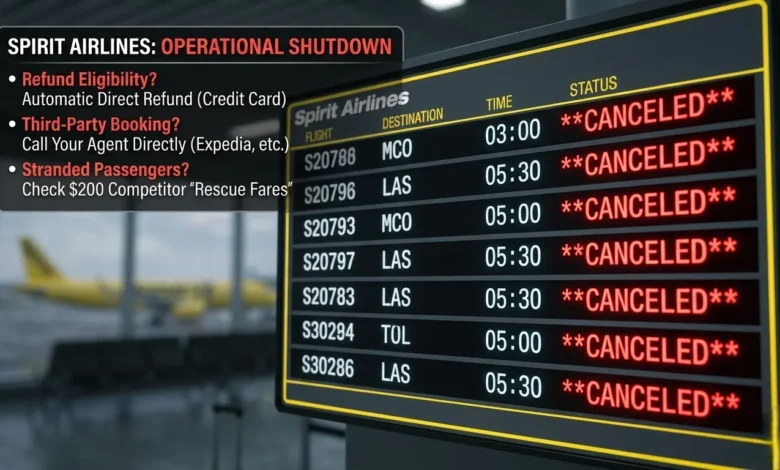
This is not a temporary grounding or a Chapter 11 restructuring. Spirit is transitioning to Chapter 7 liquidation. The airline is being sold off for parts. All 17,000 employees have been laid off, and physical ticket counters are permanently closed. If you hold a ticket, your money is currently tied up in federal bankruptcy proceedings.
Your immediate priorities are securing alternative travel and initiating a legal dispute to recover your original airfare.
The Legal Blueprint for Getting Your Money Back
Airlines in Chapter 7 liquidation do not have the liquid capital to process widespread manual refunds. While US Transportation Secretary Sean Duffy confirmed that a reserve fund exists for passengers who booked directly with Spirit, history shows these funds can deplete rapidly during a total corporate collapse.
Do not wait for Spirit to voluntarily send your money. You must force the refund through federal consumer protection laws.
If you booked directly with a credit card:
Under US Department of Transportation regulations, specifically 14 CFR Part 260, airlines must issue a full refund within seven business days for a cancelled flight purchased with a credit card. Given the bankruptcy, Spirit is highly unlikely to meet this deadline.
Your definitive protection is the Fair Credit Billing Act. You must contact your credit card issuer and initiate a chargeback under the specific classification of “services not rendered”. You have exactly 60 days from the date of the first monthly statement containing the Spirit charge to file this dispute. Submit your original confirmation email and a statement that the airline has ceased operations. Your bank, not the bankrupt airline, will credit your account.
If you booked through a third party:
If you used an Online Travel Agency like Expedia, Kayak, or a traditional travel agent, they are considered the merchant of record. You must request your refund directly from them. They hold the legal obligation to return your funds when the underlying service is cancelled.
If you paid with a debit card:
Debit cards do not fall under the Fair Credit Billing Act. Some banks voluntarily offer similar protections, but it is not guaranteed by federal law. Call your bank immediately and ask to speak with their fraud and dispute department.
Securing a Competitor Rescue Fare
Four major US carriers stepped in immediately to absorb the stranded passenger volume. United, Delta, JetBlue, and Southwest are offering capped $200 one-way flights for displaced Spirit customers.
To claim these fares, you cannot simply book online at the discounted rate. You must call the competitor airline’s customer service line or visit their airport ticketing desk and present your original Spirit confirmation number as proof of displacement. These fares are strictly capacity controlled and are expected to sell out rapidly as the 1.7 million passengers Spirit historically moved each month scramble for alternatives.
What Happens to Free Spirit Points
Your Free Spirit points and unredeemed flight vouchers are now legally classified as unsecured debt. In a Chapter 7 liquidation, secured creditors like aircraft lessors, banks, and unpaid fuel suppliers are paid first. Unsecured creditors are at the absolute bottom of the payout hierarchy.
Practically speaking, loyalty points hold a current monetary value of zero. Do not factor them into your financial recovery plans.
The Broader Impact on Summer Airfare
The collapse of North America’s largest ultra low cost carrier is already triggering a pricing shock across the aviation sector. Spirit operated between 75 and 90 gates across its network, forcing massive revenue deficits at major airports.
We are already seeing the financial fallout hit consumers. Detroit Metropolitan Wayne County Airport (DTW), where Spirit was the second largest operator, has already announced a 10 percent increase in landing fees to offset the loss of the carrier. Competing airlines will inevitably pass these fee hikes down to passengers. Meanwhile, legacy carriers are actively buying up Spirit’s highly coveted infrastructure. Delta Air Lines has already purchased two of Spirit’s former gates at Hartsfield Jackson Atlanta International Airport for $12 million.
With the primary driver of bottom floor pricing removed from the market, expect average domestic airfares to rise significantly in the coming months. Book your future summer travel now before algorithms fully adjust to the newly consolidated market.
Frequently Asked Questions
Can I dispute the charge if I bought my ticket months ago?
Yes. For future travel, credit card companies routinely waive the standard 60 day dispute window if the airline goes bankrupt before the date of the scheduled flight. Call your bank and cite the Fair Credit Billing Act for services not rendered.
Will my travel insurance cover my lost hotel reservations?
Only if your specific policy includes a “financial default” or “carrier bankruptcy” clause. Many basic policies explicitly exclude airline bankruptcies. Read your policy’s terms and conditions before filing a trip interruption claim.
Is there any chance another airline will buy Spirit and honor my ticket?
No. Spirit already attempted mergers with both Frontier and JetBlue in recent years, with the latter being blocked by the federal government in 2024. The current Chapter 7 filing means the company is being liquidated and sold in pieces, not acquired as an operating airline.
Sources
- Wikipedia: Spirit Airlines. https://en.wikipedia.org/wiki/Spirit_Airlines
- PBS News: Spirit Airlines goes out of business after 34 years, ceases operations immediately. https://www.pbs.org/newshour/economy/spirit-airlines-goes-out-of-business-after-34-years-ceases-operations-immediately
- US Department of Transportation: Refunds. https://www.transportation.gov/individuals/aviation-consumer-protection/refunds
- US Department of Transportation: Aviation Industry Bankruptcy and Service Cessations. https://www.transportation.gov/airconsumer/service-cessations-bankruptcy
- Federal Register: Airline Refunds and Other Consumer Protections. https://www.federalregister.gov/documents/2026/07/07/2026-13675/airline-refunds-and-other-consumer-protections
- Inc. Magazine: The Spirit Airlines Collapse Just Triggered a Fee Hike at This Major Hub. Are Higher Fares Next? https://www.inc.com/moses-jeanfrancois/spirit-airlines-collapse-triggered-fee-hike-at-major-hub-are-higher-fares-next/91369367
This video from BBC News provides a concise visual summary of the failed government bailout discussions that directly led to the sudden collapse of Spirit Airlines.