
Presidential Records Act Ruling: 2026 Court Timeline & Legal Breakdown
Recent federal court injunctions have thrust the 1978 Presidential Records Act (PRA) back into the national spotlight. From the 2024 classified documents case in Florida to the May 2026 civil injunctions regarding White House messaging apps in Washington D.C., the scope of this law is actively being litigated. This guide explains exactly what the PRA mandates, how courts have ruled on it so far, and the legal difference between official government property and personal records.
A Presidential Records Act ruling typically determines how the 1978 law applies to the preservation and ownership of White House documents. Recently, federal courts have ruled that the PRA does not override the Espionage Act in criminal cases, and civil judges have ordered the preservation of official text messages, reaffirming government ownership of presidential records.
Key Takeaways
- The PRA establishes that presidential records belong to the United States government, not the individual president.
- In April 2024, Judge Aileen Cannon ruled the PRA does not provide a pre-trial basis to dismiss Espionage Act charges.
- In May 2026, Judge John Bates issued a preliminary injunction requiring White House staff to preserve all official records, including text messages.
- The law creates a strict legal boundary between “presidential records” and purely private “personal records.”
- The National Archives and Records Administration (NARA) acts as the official legal custodian of these documents once a presidency ends.
Quick Answer: What is the Presidential Records Act (PRA)?
Congress passed the PRA in 1978 following the Watergate scandal. The statute legally separates official government documents from a president’s private papers. Most importantly, it declares that all presidential records are the property of the United States government NARA Official PRA Guide. The individual occupying the Oval Office does not own them.
The PRA enforces three primary rules:
- It establishes public ownership of all official White House records.
- It requires staff to preserve these documents throughout an administration’s duration.
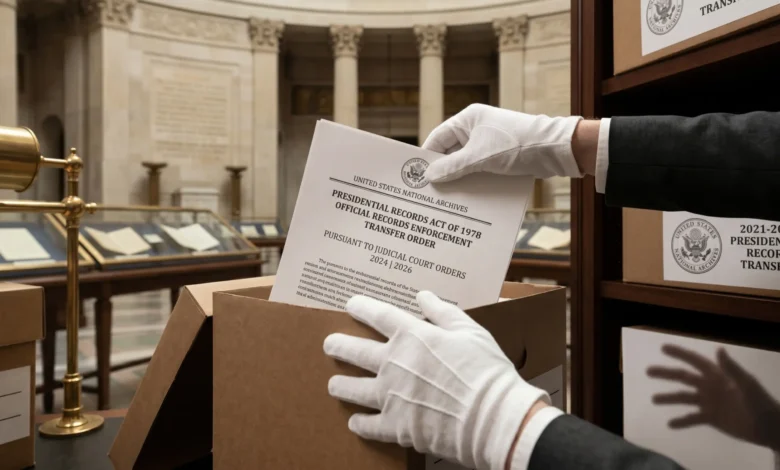
- It mandates the transfer of these files to the National Archives the moment the president leaves office.
The records of the Reagan administration were the first to be fully administered under this 1978 law.
Pro Tip: Do not confuse the Presidential Records Act with the Espionage Act. The PRA dictates standard records management for the White House, while the Espionage Act strictly governs national defense information and carries severe criminal penalties.
Official vs. Personal Records: The Legal Difference
The PRA forces the White House to categorize documents as they are created. It recognizes that presidents generate massive amounts of paperwork, but only certain files belong to the public.
The statute strictly defines “personal records” as documents with no connection to the constitutional or statutory duties of the president. If a document involves official government business, it is a presidential record.
Common Mistake: Many people assume a president can reclassify official national security memos as personal records simply by taking them home. Under the PRA, the content of the document—not its physical location—dictates its legal classification.
| Record Type | Legal Definition | Examples | Ownership |
| Presidential Records | Documents relating to the constitutional, statutory, and official duties of the president. | Foreign policy memos, official text messages, meeting transcripts. | United States Government |
| Personal Records | Documents of a purely private or political nature. | Campaign diaries, private family emails, personal medical notes. | The Individual |
Pro Tip: If working within the Executive Branch, never use auto-deleting messaging apps for official business without contemporaneously copying an official .gov account to comply with the PRA.
Timeline of Recent Presidential Records Act Rulings
The application of the PRA has faced major legal tests across two entirely different arenas: federal criminal defense and civil accountability lawsuits. Untangling these cases requires looking at the specific rulings issued by different federal judges.
April 2024: The Criminal Pre-Trial Motion (Judge Aileen Cannon)
In early 2024, the PRA became a focal point in the federal criminal prosecution of former President Donald Trump in Florida. His legal team filed a pre-trial motion to dismiss the classified documents indictment, arguing that the PRA shielded his actions.
Mini Case Study: The 2024 Pre-Trial Criminal Motion
- The Argument: Defense lawyers asserted that the PRA gave the president unreviewable discretion to designate highly classified national security materials as “personal records” at the moment he left office. They argued this classification neutralized any criminal charges under the Espionage Act.
- The Ruling: On April 4, 2024, U.S. District Judge Aileen Cannon denied the motion to dismiss. She determined that the PRA does not provide a valid pre-trial basis to throw out charges brought under the Espionage Act.
While Judge Cannon rejected the pre-trial dismissal, her order left open a subtle window. She indicated that the legal definitions within the PRA could still be introduced to a jury later during trial instructions to help evaluate the defendant’s intent.
The criminal case itself never reached a jury on those grounds. In July 2024, Judge Cannon dismissed the entire prosecution on separate constitutional grounds. She ruled that the appointment and funding of Special Counsel Jack Smith violated the Appointments Clause of the U.S. Constitution. That dismissal was subsequently appealed by the Department of Justice.
May 2026: The Civil Injunction (Judge John Bates)
The legal battle over presidential records shifted back to civil compliance in early 2026. Watchdog groups grew concerned over modern digital record-keeping policies following an April 2026 Department of Justice Office of Legal Counsel (OLC) memorandum. The memorandum suggested parts of the PRA’s enforcement mechanisms might infringe upon executive branch authority.
In response, groups like Citizens for Responsibility and Ethics in Washington (CREW) and the American Historical Association filed suit U.S. District Court DC Filing. They sought to block policies that allowed the automatic deletion of certain communications.
Mini Case Study: The 2026 Ephemeral Messaging Civil Case
- The Issue: Civil plaintiffs argued that White House staff were utilizing auto-deleting messaging applications without creating permanent backups, directly violating the preservation mandates of the PRA.
- The Ruling: In May 2026, U.S. District Judge John Bates issued a preliminary injunction. He rejected the argument that the PRA unconstitutionally bound the executive branch, ordering the White House to strictly enforce data preservation rules.
This civil ruling directly adapted the 1978 law to modern workplace technology. Under Judge Bates’ order, text messages and encrypted communications regarding official government business cannot be cleared automatically.
“The court’s decision helps ensure that the American people—not the White House—retain ownership over the historical record of the presidency.” — Chioma Chukwu, American Oversight, 2026
Pro Tip: If you work in a public or federal compliance role, remember that using encrypted apps like Signal is not illegal by itself. However, the PRA requires that any message concerning official business must be preserved by copying or forwarding it to an official government archival account.
Mid-Article Summary
- Criminal Court Impact: Federal judges have confirmed the PRA cannot be used as a shield to dismiss criminal charges involving national security data.
- Civil Court Impact: Civil courts actively enforce the PRA to ensure modern digital communications are not permanently deleted.
- Core Legal Rule: The content of a record determines its status, and the public retains ultimate ownership of official presidential history.
Supreme Court Precedent and the PRA
The ongoing battles in lower federal courts rely heavily on historical decisions from the U.S. Supreme Court. The high court has consistently backed Congress’s right to regulate executive branch paperwork.
- Nixon v. Administrator of General Services (1977): This foundational case occurred just before the PRA was written. The Supreme Court explicitly affirmed that Congress has the constitutional authority to regulate and preserve executive branch documents. This ruling directly laid the groundwork for the 1978 statute.
- Trump v. Thompson (2022): The issue re-emerged when former President Trump attempted to block NARA from releasing White House files to the House January 6th Committee [External Link: U.S. Supreme Court Opinions]. In January 2022, the Supreme Court denied his request, allowing the transfer of records to proceed under the framework of the PRA.
Confirmed vs. Unconfirmed: What Happens Next?
Legal proceedings regarding federal records move slowly. To understand the news, readers must separate settled legal facts from ongoing arguments.
- What is Confirmed: The text of the law explicitly makes presidential records public property. Lower courts agree that the PRA does not override national defense laws, and judges have authority to order the preservation of digital communications like texts and Signal messages.
- What is Unconfirmed: The final constitutional boundaries between a president’s personal authority and Congress’s archival laws remain subject to appellate review. The appeal of the July 2024 classified documents dismissal continues to wind through the higher courts.
Practical Tooling: Source Verification Guide
If you want to track PRA compliance or view released documents yourself without relying on secondary news reports, use this simple three-step checklist:
- [ ] Step 1: Access official FOIA reading rooms. Once an administration has been out of office for five years, its records become accessible via Freedom of Information Act (FOIA) requests. Navigate directly to the NARA FOIA processing rooms online.
- [ ] Step 2: Check the Executive Order logs. Presidents frequently issue updates on how they classify non-archival personal materials. Review these direct text logs on the Federal Register website.
- [ ] Step 3: Audit court dockets directly. For active civil disputes like the CREW or American Oversight cases, use the federal PACER (Public Access to Court Electronic Records) system to read the judge’s exact orders rather than news summaries.
End Summary
The Presidential Records Act remains a foundational piece of post-Watergate transparency legislation. Recent rulings across both criminal and civil courts continue to define its boundaries, ensuring that public business conducted by the executive branch remains public property, even as communication shifts to digital applications.
3 Next Steps for Readers
- Review NARA’s official archival repository online to see how historical presidential records are organized.
- Read the full text of Judge John Bates’ May 2026 preliminary injunction regarding federal text message preservation.
- Track the ongoing federal appellate court dockets to see if higher courts alter the current rulings on official versus personal document classification.
FAQs
What does the Presidential Records Act say?
The Act states that all official records created by a president and their staff during their term are government property. Legal custody automatically shifts to the National Archives when an administration ends.
Who enforces the Presidential Records Act?
The National Archives and Records Administration (NARA) manages the collection and storage of records. Federal courts handle enforcement when watchdog groups or the government file lawsuits over missing or deleted files.
What was Judge Cannon’s ruling on the Presidential Records Act?
In April 2024, Judge Aileen Cannon ruled that the Presidential Records Act did not provide a valid pre-trial reason to dismiss criminal charges brought under the Espionage Act.
Are text messages covered by the Presidential Records Act?
Yes. Federal courts, including a May 2026 ruling by Judge John Bates, have affirmed that text messages and encrypted app communications concerning official White House duties must be preserved.
What is the penalty for violating the Presidential Records Act?
The PRA itself is an administrative and civil statute without direct criminal penalties. However, destroying or concealing government records can trigger separate federal criminal charges under Title 18 of the U.S. Code.
When do presidential records become public?
The public can begin requesting presidential records through FOIA five years after the president leaves office. The former president can restrict certain sensitive records for up to 12 years.
What is the difference between the PRA and the Freedom of Information Act (FOIA)?
The PRA governs how records are created and preserved while the president is in office. FOIA is the legal mechanism citizens use to request access to those records after the mandatory restriction periods end.
Has the Supreme Court ever ruled the Presidential Records Act unconstitutional?
No. The Supreme Court has consistently upheld the legal framework behind the preservation of executive records, dating back to its landmark 1977 decision involving former President Richard Nixon.
References
- National Archives and Records Administration, 1978
- U.S. District Court for the Southern District of Florida, 2024
- U.S. District Court for the District of Columbia, 2026
- U.S. Supreme Court, 1977
- U.S. Supreme Court, 2022