
United States Department of Justice: Jurisdictions Explained
Most people recognize the badges of the FBI or the DEA on television. Yet, few realize how these powerful groups plug into a single cabinet-level department. Navigating American law requires understanding how this federal coordination works.
The department operates as a massive legal network. It manages domestic law enforcement and represents the federal government in court.
The United States Department of Justice (DOJ) is a cabinet-level executive department responsible for enforcing federal laws, handling federal criminal prosecutions, and representing the government in civil litigation. Headed by the U.S. Attorney General, the DOJ oversees major bureaus including the FBI, DEA, ATF, and the U.S. Marshals Service.
Key Takeaways
- The DOJ belongs to the executive branch of the federal government.
- Congress officially created the department in 1870.
- The U.S. Attorney General leads the department as the chief law enforcement officer.
- Core bureaus include the FBI, DEA, ATF, U.S. Marshals, and Bureau of Prisons.
- Federal jurisdiction triggers only under specific conditions, like crimes crossing state lines.
Quick Start: The DOJ Agency Matcher
If you need to interact with federal law enforcement, matching your issue to the correct agency saves time. Use this quick reference guide to see where responsibilities fall:
- Finding a Federal Fugitive: United States Marshals Service (USMS)
- Investigating Interstate Cybercrimes: Federal Bureau of Investigation (FBI)
- Enforcing Controlled Substances Acts: Drug Enforcement Administration (DEA)
- Tracking Illegal Firearms Trafficking: Bureau of Alcohol, Tobacco, Firearms and Explosives (ATF)
- Managing Federal Inmates: Federal Bureau of Prisons (BOP)
What is the United States Department of Justice?
The DOJ is the primary enforcement arm of the United States national government. Unlike local police forces that protect specific cities, the DOJ handles laws passed by Congress that affect the entire nation. You can access their main public portal directly at [External Link: justice.gov portal].
The department steps in when crimes affect national security or break federal statutes (written laws). It ensures that federal laws are applied equally across all fifty states and U.S. territories.
History and Origins of the DOJ
The office of the leader came long before the actual department. The U.S. Congress first created the Office of the Attorney General through the Judiciary Act of 1789. For decades, the Attorney General operated without a large department, advising the President alone.
This changed after the American Civil War. To handle the growing volume of federal lawsuits and crimes, President Ulysses S. Grant signed a new law on July 1, 1870. This act officially established the Department of Justice to manage all federal legal matters under one roof.
The Core Mission
The department operates under three strict goals. These guide every investigation, arrest, and court case handled by federal lawyers.
According to its official mandate, the mission of the Department of Justice is:
“To uphold the rule of law, to keep our country safe, and to protect civil rights.”
Executive Leadership: The Role of the Attorney General
The U.S. Attorney General sits at the top of the department’s hierarchy. As a member of the President’s cabinet, this official serves as the chief law enforcement officer of the United States.
The Attorney General does not act as a personal lawyer for the President. Instead, the role acts as the legal advisor to the entire executive branch. The leader directs thousands of federal prosecutors who represent the public interest in court.
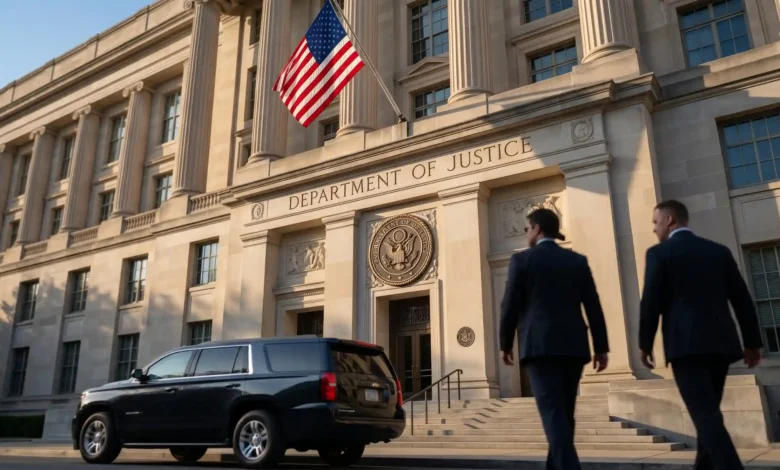
The entire operation runs from a central command post in the nation’s capital. The department is headquartered at the historic Robert F. Kennedy Department of Justice Building in Washington, D.C.
Common Mistake: Many people assume the Attorney General belongs to the judicial branch because they deal with law. In reality, the DOJ belongs strictly to the executive branch, meaning its job is to execute and enforce laws, not interpret them.
The 5 Core Law Enforcement Agencies of the DOJ
The department relies on specific operational bureaus to enforce the law. Each agency has a defined target area, preventing overlap and ensuring highly specialized investigations.
- Federal Bureau of Investigation (FBI): The FBI serves as the principal investigative and intelligence arm of the DOJ. It handles counterterrorism, cyber defense, and major federal crimes.
- Drug Enforcement Administration (DEA): The DEA focuses entirely on controlled substance laws. Agents disrupt global and domestic drug trafficking networks.
- Bureau of Alcohol, Tobacco, Firearms and Explosives (ATF): The ATF combats illegal firearm trafficking, arson, and explosives offenses, while also monitoring alcohol and tobacco diversion.
- United States Marshals Service (USMS): Founded in 1789, the Marshals Service stands as the nation’s oldest federal law enforcement agency. It handles fugitive apprehension, judicial security, and witness protection.
- Federal Bureau of Prisons (BOP): The BOP handles the administrative management of federal correctional facilities and the custody of federally convicted inmates.
Pro Tip: While the FBI investigates general federal crimes, the U.S. Marshals Service is specifically tasked with tracking down federal fugitives.
Pro Tip: If you need to find someone in federal custody, always use the Federal Bureau of Prisons (BOP) database. State-level Department of Corrections websites only track state inmates.
Federal vs. State Jurisdiction: Who Has the Power?
The U.S. Constitution creates boundaries between federal and local police power. The DOJ does not police everyday street crime. It steps in only when an offense involves interstate commerce, federal property, or specific constitutional violations.
Typical scenario example: A bank robbery automatically triggers FBI jurisdiction because bank deposits are federally insured by the FDIC. In contrast, robbing a local convenience store falls to municipal or state police.
The Civil Rights Division Exception
Federal authority can override state limitations when civil rights are violated. Even if a crime stays within state lines, the DOJ can step in if the offense breaks federal civil rights laws.
For instance, the Civil Rights Division actively prosecutes constitutional violations. In May 2026, the division announced a 15-city National Awareness & Action Tour to combat antisemitism.
Typical scenario example: Consider a state correctional officer abusing inmates, similar to a recent high-profile Texas Department of Criminal Justice case. Even if local authorities decline to press charges, the DOJ’s Civil Rights Division can step in to prosecute the officer federally for constitutional violations.
Practical Tooling: The Federal Jurisdiction Quick Test
Unsure if an issue belongs to the local police or the DOJ? Ask these three questions:
- Did the crime cross state lines? (e.g., kidnapping across borders, internet fraud)
- Does it involve federal property or agencies? (e.g., assaulting a postal worker, vandalism on a military base)
- Is it a suspected civil rights or constitutional violation? (e.g., housing discrimination, police misconduct)
If the answer to any of these is yes, it is likely a federal matter under DOJ jurisdiction.
DOJ vs. DHS: Clearing the Confusion
Many Americans confuse the Department of Justice with the Department of Homeland Security (DHS). While both are powerful executive departments, they handle entirely different threats.
Pro Tip: Do not confuse the two. The DOJ houses investigative agencies like the FBI and DEA. Agencies like Immigration and Customs Enforcement (ICE) and the Secret Service belong to the DHS.
| Element | Department of Justice (DOJ) | Department of Homeland Security (DHS) |
| Core Focus | Enforcing federal statutes & criminal prosecution | Domestic safety, border security, & disaster response |
| Primary Agencies | FBI, DEA, ATF, USMS, BOP | Secret Service, ICE, CBP, TSA, FEMA |
| Legal Head | U.S. Attorney General | Secretary of Homeland Security |
Mid-Article Summary: Quick Reference
- The DOJ prosecutes federal crimes; the DHS secures borders and infrastructure.
- The FBI reports to the DOJ; the Secret Service reports to the DHS.
- Both are executive branch departments but operate under entirely different legal authorities.
Funding Local Law Enforcement: The Office of Justice Programs
The federal government also supports state and municipal policing. It does this primarily through the Office of Justice Programs (OJP).
The OJP serves as the largest grantmaking component of the DOJ. Instead of making arrests, it provides direct funding, training, and statistical research support to local, state, and tribal law enforcement agencies. You can view their available grants through the [External Link: ojp.gov grant portal].
Pro Tip: Local police departments and municipal governments should monitor the OJP portal regularly. It manages the bulk of federal funding allocations used for community policing upgrades and training.
Summary and Next Steps
The DOJ functions as a highly coordinated legal network rather than a single police force. By directing specialized bureaus like the FBI, DEA, and U.S. Marshals, it maintains federal law across the nation and ensures civil rights are protected.
3 Practical Next Steps:
- Locate Inmates: Use the official BOP database if attempting to locate an individual in federal custody.
- Report Violations: Route suspected constitutional or ADA violations directly to the Civil Rights Division portal rather than local police precincts.
- Request Records: Utilize the official FOIA (Freedom of Information Act) portal to request declassified federal investigative files.
FAQs
What is the main purpose of the United States Department of Justice?
The DOJ enforces federal laws, handles federal criminal prosecutions, represents the U.S. government in civil court, and protects civil rights.
Who is currently in charge of the DOJ?
The department is headed by the United States Attorney General, who is appointed by the President and confirmed by the Senate.
Is the FBI part of the Department of Justice?
Yes. The FBI operates as the principal investigative intelligence arm of the DOJ.
What is the difference between the DOJ and the DHS?
The DOJ focuses on enforcing federal laws and prosecuting crimes. The Department of Homeland Security (DHS) manages border security, disaster response, and infrastructure protection.
When does a crime become a federal case under DOJ jurisdiction?
A case becomes federal when it involves interstate commerce, occurs on federal property, or violates specific federal statutes and constitutional rights.
Where is the headquarters of the United States Department of Justice located?
The DOJ is headquartered at the Robert F. Kennedy Department of Justice Building in Washington, D.C.
How old is the United States Department of Justice?
Congress officially established the department on July 1, 1870, making it over 150 years old. However, the Office of the Attorney General dates back to 1789.
Can the DOJ investigate local police departments?
Yes. The DOJ’s Civil Rights Division has the authority to investigate local police departments for patterns of constitutional violations or excessive force.
References
- U.S. Department of Justice, 2026
- Office of Justice Programs, 2026
- U.S. Government Manual, 2021
- DOJ Civil Rights Division Press Release, 2026
- DOJ History Timeline, 2025